


Page 649 - Cardiac Nursing
P. 649
CHAPTER 26 / Mechanical Circulatory Assist Devices  625


                                                                DISPLAY 26-2  Physiologic Effects and Expected Clinical
                                                                             Outcomes of Balloon Inflation

                                                                 Physiologic effects
                                                                 Increased early diastolic pressure (by about 30%)
                                                                 Diastolic augmentation
                                                                 Increased aortic root pressure
                                                                 Enhanced coronary artery perfusion pressure
                                                                 Improved oxygen delivery
                                                                 Decreased ischemia
                                                                 Clinical outcomes
                                                                 Early diastolic pressure $ systolic pressure
                                                                 Decreased angina
                                                                 Decreased signs of ischemia on the electrocardiogram
                                                                 Decreased ventricular ectopy of ischemic origin


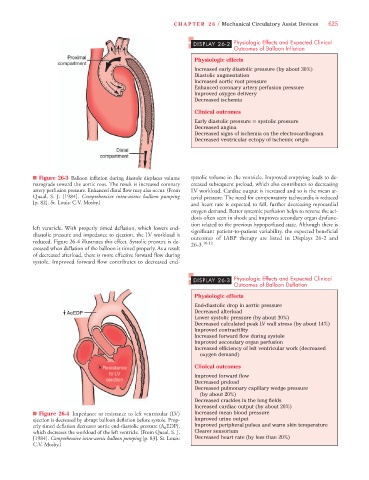
            n Figure 26-3 Balloon inflation during diastole displaces volume  systolic volume in the ventricle. Improved emptying leads to de-
            retrograde toward the aortic root. The result is increased coronary   creased subsequent preload, which also contributes to decreasing
            artery perfusion pressure. Enhanced distal flow may also occur. (From  LV workload. Cardiac output is increased and so is the mean ar-
            Quaal, S. J. [1984].  Comprehensive intra-aortic balloon pumping  terial pressure. The need for compensatory tachycardia is reduced
            [p. 82]. St. Louis: C.V. Mosby.)                   and heart rate is expected to fall, further decreasing myocardial
                                                               oxygen demand. Better systemic perfusion helps to reverse the aci-
                                                               dosis often seen in shock and improves secondary organ dysfunc-
                                                               tion related to the previous hypoperfused state. Although there is
            left ventricle. With properly timed deflation, which lowers end-  significant patient-to-patient variability, the expected beneficial
            diastolic pressure and impedance to ejection, the LV workload is  outcomes of IABP therapy are listed in Displays 26-2 and
            reduced. Figure 26-4 illustrates this effect. Systolic pressure is de-  26-3. 10,12
            creased when deflation of the balloon is timed properly. As a result
            of decreased afterload, there is more effective forward flow during
            systole. Improved forward flow contributes to decreased end-


                                                                DISPLAY 26-3  Physiologic Effects and Expected Clinical
                                                                             Outcomes of Balloon Deflation
                                                                 Physiologic effects
                                                                 End-diastolic drop in aortic pressure
                                                                 Decreased afterload
                                                                 Lower systolic pressure (by about 20%)
                                                                 Decreased calculated peak LV wall stress (by about 14%)
                                                                 Improved contractility
                                                                 Increased forward flow during systole
                                                                 Improved secondary organ perfusion
                                                                 Increased efficiency of left ventricular work (decreased
                                                                  oxygen demand)
                                                                 Clinical outcomes
                                                                 Improved forward flow
                                                                 Decreased preload
                                                                 Decreased pulmonary capillary wedge pressure
                                                                  (by about 20%)
                                                                 Decreased crackles in the lung fields
                                                                 Increased cardiac output (by about 20%)
            n Figure 26-4 Impedance or resistance to left ventricular (LV)  Increased mean blood pressure
            ejection is decreased by abrupt balloon deflation before systole. Prop-  Improved urine output
            erly timed deflation decreases aortic end-diastolic pressure (A 0 EDP),  Improved peripheral pulses and warm skin temperature
            which decreases the workload of the left ventricle. (From Quaal, S. J.  Clearer sensorium
            [1984]. Comprehensive intra-aortic balloon pumping [p. 83]. St. Louis:  Decreased heart rate (by less than 20%)
            C.V. Mosby.)

