


Page 663 - Cardiac Nursing
P. 663
p
                    63
                   p
                                          Pa
                                          Pa
                    63
                      8-6
                        54.
                      8-6
                                          Pa
                                        M
                                              39
                                              39
                                                A
                                                 p
                                                A
                                              39
                                           g
                                           g
                                           g
                                            e 6
                                            e 6
                                    1
                                   1
                                /09
                                /09
                                /09
                                   1
                                     1 A
                                        M
                                     1 A
                                   2:0
                                   2:0
                          q
                          q
                          q
                        54.
                        54.
                           xd
                              /30
                              /30
                             6
                           xd
                             6
                                                 p
         LWB K34 0-c 27_ pp638-654.qxd  6/30/09  12:01 AM  Page 639 Aptara Inc.
         LWB
                                                      c.
                                                      c.
         LWBK340-c27_
                 27_
               0-c
            K34
                 27_
                                                  ara
                                                   a
                                                   a
                                                  ara
                                                  t
                                                  t
                                                 p
                                                     In
                                                     In
                                                              C HAPTER 2 7 / Sudden Cardiac Death and Cardiac Arrest  639
                                                                                 Conventional coronary
                                                              Atherogenesis                             Conditioned risk
                                                                              risk factors; plaque formation
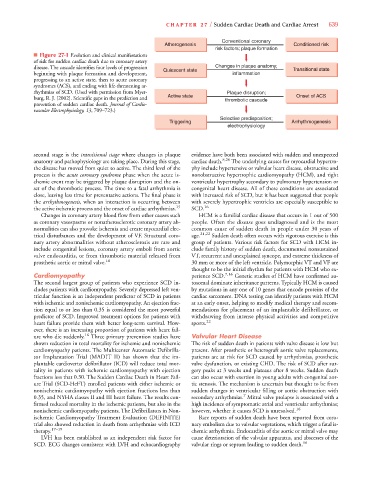
                   ■ Figure 27-1 Evolution and clinical manifestations
                   of risk for sudden cardiac death due to coronary artery
                   disease. The cascade identifies four levels of progression  Quiescent state  Changes in plaque anatomy;  Transitional state
                   beginning with plaque formation and development,                 inflammation
                   progressing to an active state, then to acute coronary
                   syndromes (ACS), and ending with life-threatening ar-
                   rhythmias of SCD. (Used with permission from Myer-             Plaque disruption;
                   burg, R. J. [2002]. Scientific gaps in the prediction and  Active state  thrombotic cascade  Onset of ACS
                   prevention of sudden cardiac death. Journal of Cardio-
                   vascular Electrophysiology, 13, 709–723.)
                                                                                Selective predisposition;
                                                               Triggering                              Arrhythmogenesis
                                                                                  electrophysiology
                   second stage is the transitional stage where changes in plaque  evidence have both been associated with sudden and unexpected
                   anatomy and pathophysiology are taking place. During this stage,  cardiac death. 8,20  The underlying causes for myocardial hypertro-
                   the disease has moved from quiet to active. The third level of the  phy include hypertensive or valvular heart disease, obstructive and
                   process is the acute coronary syndrome phase when the acute is-  nonobstructive hypertrophic cardiomyopathy (HCM), and right
                   chemic event may be triggered by plaque disruption and the on-  ventricular hypertrophy secondary to pulmonary hypertension or
                   set of the thrombotic process. The time to a fatal arrhythmia is  congenital heart disease. All of these conditions are associated
                   close, leaving less time for preventative actions. The final phase is  with increased risk of SCD, but it has been suggested that people
                   the arrhythmogenesis, when an interaction is occurring between  with severely hypertrophic ventricles are especially susceptible to
                   the active ischemic process and the onset of cardiac arrhythmias. 15  SCD. 16
                     Changes in coronary artery blood flow from other causes such  HCM is a familial cardiac disease that occurs in 1 out of 500
                   as coronary vasospasms or nonatherosclerotic coronary artery ab-  people. Often the disease goes undiagnosed and is the most
                   normalities can also provoke ischemia and create myocardial elec-  common cause of sudden death in people under 30 years of
                   trical disturbances and the development of VF. Structural coro-  age. 21,22  Sudden death often occurs with vigorous exercise is this
                   nary artery abnormalities without atherosclerosis are rare and  group of patients. Various risk factors for SCD with HCM in-
                   include congenital lesions, coronary artery emboli from aortic  clude family history of sudden death, documented nonsustained
                   valve endocarditis, or from thrombotic material released from  VT, recurrent and unexplained syncope, and extreme thickness of
                   prosthetic aortic or mitral valve. 16               30 mm or more of the left ventricle. Polymorphic VT and VF are
                                                                       thought to be the initial rhythm for patients with HCM who ex-
                   Cardiomyopathy                                      perience SCD. 7,16  Genetic studies of HCM have confirmed au-
                   The second largest group of patients who experience SCD in-  tosomal dominate inheritance patterns. Typically HCM is caused
                   cludes patients with cardiomyopathy. Severely depressed left ven-  by mutations in any one of 10 genes that encode proteins of the
                   tricular function is an independent predictor of SCD in patients  cardiac sarcomere. DNA testing can identify patients with HCM
                   with ischemic and nonischemic cardiomyopathy. An ejection frac-  at an early onset, helping to modify medical therapy and recom-
                   tion equal to or less than 0.35 is considered the most powerful  mendations for placement of an implantable defibrillator, or
                   predictor of SCD. Improved treatment options for patients with  withdrawing from intense physical activities and competitive
                   heart failure provide them with better long-term survival. How-  sports. 22
                   ever, there is an increasing proportion of patients with heart fail-
                   ure who die suddenly. 16  Three primary prevention studies have  Valvular Heart Disease
                   shown reduction in total mortality for ischemic and nonischemic  The risk of sudden death in patients with valve disease is low but
                   cardiomyopathy patients. The Multicenter Automatic Defibrilla-  present. After prosthetic or heterograft aortic valve replacements,
                   tor Implantation Trial (MADIT II) has shown that the im-  patients are at risk for SCD caused by arrhythmias, prosthetic
                   plantable cardioverter defibrillator (ICD) will reduce total mor-  valve dysfunction, or existing CHD. The risk of SCD after sur-
                   tality in patients with ischemic cardiomyopathy with ejection  gery peaks at 3 weeks and plateaus after 8 weeks. Sudden death
                   fractions less that 0.30. The Sudden Cardiac Death in Heart Fail-  can also occur with exertion in young adults with congenital aor-
                   ure Trial (SCD-HeFT) enrolled patients with either ischemic or  tic stenosis. The mechanism is uncertain but thought to be from
                   nonischemic cardiomyopathy with ejection fractions less than  sudden changes in ventricular filling or aortic obstruction with
                                                                                        7
                   0.35, and NYHA classes II and III heart failure. The results con-  secondary arrhythmias. Mitral valve prolapse is associated with a
                   firmed reduced mortality in the ischemic patients, but also in the  high incidence of symptomatic atrial and ventricular arrhythmias;
                   nonischemic cardiomyopathy patients. The Defibrillators in Non-  however, whether it causes SCD is unresolved. 16
                   ischemic Cardiomyopathy Treatment Evaluation (DEFINITE)  Rare reports of sudden death have been reported from coro-
                   trial also showed reduction in death from arrhythmias with ICD  nary embolism due to valvular vegetations, which trigger a fatal is-
                   therapy. 17–19                                      chemic arrhythmia. Endocarditis of the aortic or mitral valve may
                     LVH has been established as an independent risk factor for  cause deterioration of the valvular apparatus, and abscesses of the
                   SCD. ECG changes consistent with LVH and echocardiography  valvular rings or septum leading to sudden death. 16

