


Page 664 - Cardiac Nursing
P. 664
a
                                                   a
                                           g
                                            e 6
                                           g
                                                  ara
                        54.
                        54.
                      8-6
                                                  ara
                      8-6
                    63
                    63
                                                     In
                                                      c.
                                                     In
                                                A
                                              40
                                            e 6
                                              40
                                                A
                                                A
                          q
                                   2:0
                                     1 A
                                   2:0
                                   1
                                   1
                                     1 A
                                          Pa
                                           g
                                          Pa
                                        M
                                        M
                           xd
                              6
                           xd
                          q
                          q
                             6
                                /09
                                /09
                              /30
                             6
                              /30
                                                      c.
                 27_
                 27_
               0-c
                                                 p
                                                  t
                                                 p
                                                 p
         LWBK340-c27_ p p pp638-654.qxd  6/30/09  12:01 AM  Page 640 Aptara Inc.
                                                  t
                                                      c.
               0-c
            K34
            K34
                  640    PA R T  I V / Pathophysiology and Management of Heart Disease
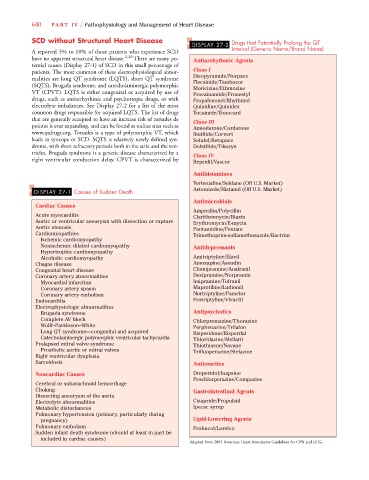
                  SCD without Structural Heart Disease                              Drugs that Potentially Prolong the QT
                                                                       DISPLAY 27-2
                  A reported 5% to 10% of those patients who experience SCD         Interval (Generic Name/Brand Name)
                  have no apparent structural heart disease. 2,20  There are many po-  Antiarrhythmic Agents
                  tential causes (Display 27-1) of SCD in this small percentage of
                  patients. The most common of these electrophysiological abnor-  Class I
                  malities are long QT syndrome (LQTS), short QT syndrome  Disopyramide/Norpace
                  (SQTS), Brugada syndrome, and catecholaminergic polymorphic  Flecainide/Tambocor
                                                                       Moricizine/Ethmozine
                  VT (CPVT). LQTS is either congenital or acquired by use of  Procainamide/Pronestyl
                  drugs, such as antiarrhythmic and psychotropic drugs, or with  Propafenonel/Rhythmol
                  electrolyte imbalances. See Display 27-2 for a list of the most  Quinidine/Quinidex
                  common drugs responsible for acquired LQTS. The list of drugs  Tocainide/Tonocard
                  that are generally accepted to have an increase risk of torsades de  Class III
                  pointes is ever expanding, and can be found at online sites such as  Amiodarone/Cordarone
                  www.qtdrugs.org. Torsades is a type of polymorphic VT, which  Ibutilide/Corvert
                  leads to syncope or SCD. SQTS is relatively newly defined syn-  Sotalol/Betapace
                  drome, with short refractory periods both in the atria and the ven-  Dofetilide/Tikosyn
                  tricles. Brugada syndrome is a genetic disease characterized by a  Class IV
                  right ventricular conduction delay. CPVT is characterized by
                                                                       Bepridil/Vascor
                                                                       Antihistamines
                                                                       Terfenadine/Seldane (Off U.S. Market)
                   DISPLAY 27-1 Causes of Sudden Death                 Astemizole/Histamil (Off U.S. Market)
                                                                       Antimicrobials
                    Cardiac Causes
                                                                       Ampicillin/Polycillin
                    Acute myocarditis                                  Clarithromycin/Biaxin
                    Aortic or ventricular aneurysm with dissection or rupture  Erythromycin/E-mycin
                    Aortic stenosis                                    Pentamidine/Pentam
                    Cardiomyopathies                                   Trimethoprim-sulfamethoxazole/Bactrim
                     Ischemic cardiomyopathy
                     Nonischemic dilated cardiomyopathy                Antidepressants
                     Hypertrophic cardiomyopathy
                     Alcoholic cardiomyopathy                          Amitriptyline/Elavil
                    Chagas disease                                     Amoxapine/Asendin
                    Congenital heart disease                           Clomipramine/Anafranil
                    Coronary artery abnormalities                      Desipramine/Norpramin
                     Myocardial infarction                             Imipramine/Tofranil
                     Coronary artery spasm                             Maprotiline/Ludiomil
                     Coronary artery embolism                          Nortriptyline/Pamelor
                    Endocarditis                                       Protriptyline/Vivactil
                    Electrophysiologic abnormalities
                     Brugada syndrome                                  Antipsychotics
                     Complete AV block                                 Chlorpromazine/Thorazine
                     Wolff–Parkinson–White                             Perphenazine/Trilafon
                     Long QT syndrome—congenital and acquired          Risperidone/Risperdal
                     Catecholaminergic polymorphic ventricular tachycardia  Thioridazine/Mellaril
                    Prolapsed mitral valve syndrome                    Thiothixene/Navane
                     Prosthetic aortic or mitral valves                Trifluoperazine/Stelazine
                    Right ventricular dysplasia
                    Sarcoidosis                                        Antiemetics
                    Noncardiac Causes                                  Droperidol/Inapsine
                                                                       Prochlorperazine/Compazine
                    Cerebral or subarachnoid hemorrhage
                    Choking                                            Gastrointestinal Agents
                    Dissecting aneurysm of the aorta
                    Electrolyte abnormalities                          Cisapride/Propulsid
                    Metabolic disturbances                             Ipecac syrup
                    Pulmonary hypertension (primary, particularly during
                     pregnancy)                                        Lipid-Lowering Agents
                    Pulmonary embolism                                 Probucol/Lorelco
                    Sudden infant death syndrome (should at least in part be
                     included in cardiac causes)
                                                                      Adapted from 2005 American Heart Association Guidelines for CPR and ECG.

