


Page 667 - Cardiac Nursing
P. 667
/09
                                /09
                                /09
                              /30
                             6
                             6
                              /30
                                   2:0
                                     1 A
                                     1 A
                                   2:0
                                    1
                                   1
                                   1
                      8-6
                      8-6
                        54.
                    63
                   p
                   p
                    63
                          q
                           xd
                           xd
                          q
                        54.
                        54.
                          q
                                                  t
                                                  t
                                                  ara
                                                 p
                                                A
                                                 p
                                                 p
                                                     In
                                                      c.
                                                      c.
                                                     In
                                                  ara
                                                   a
                                                   a
                                          Pa
                                           g
                                           g
                                          Pa
                                        M
                                        M
                                          Pa
                                              43
                                              43
                                                A
                                              43
                                           g
                                            e 6
                                            e 6
               0-c
            K34
                 27_
                 27_
         LWB K34 0-c 27_ pp638-654.qxd  6/30/09  12:01 AM  Page 643 Aptara Inc.
         LWB
         LWBK340-c27_
                                                              C HAPTER 2 7 / Sudden Cardiac Death and Cardiac Arrest  643
                     Elevated TTI reduces the chance of successful defibrillation.
                   Common causes of increased TTI include chest hair, which can
                   increase impedance by 35%, and improper paddle position. 43,44
                   The optimal paddle size for adults in hand-held and self-adhesive
                   pads are 8.5 to 12 cm in diameter, although defibrillation success
                   may be higher with the electrodes that are 12 cm in diameter. 40
                     Energy Requirements. Energy recommendations for defib-
                   rillation were changed with the 2005 AHA Guidelines. 32  The
                   type of waveform the defibrillator delivers determines the amount
                   of energy required to convert VF or pulseless VT. Defibrillators
                   available today deliver either a monophasic waveform or one of
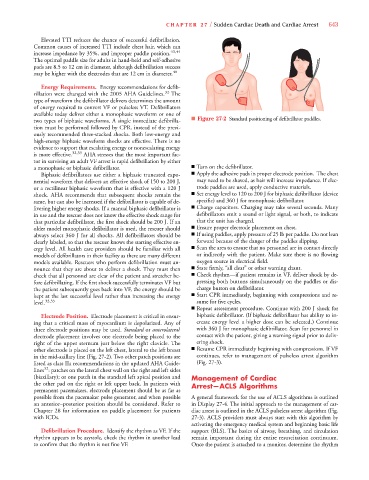
                   two types of biphasic waveforms. A single immediate defibrilla-  ■ Figure 27-2 Standard positioning of defibrillator paddles.
                   tion must be performed followed by CPR, instead of the previ-
                   ously recommended three-stacked shocks. Both low-energy and
                   high-energy biphasic waveform shocks are effective. There is no
                   evidence to support that escalating energy or nonescalating energy
                   is more effective. 32,33  AHA stresses that the most important fac-
                   tor in surviving an adult VF arrest is rapid defibrillation by either
                   a monophasic or biphasic defibrillator.              ■ Turn on the defibrillator.
                     Biphasic defibrillators use either a biphasic truncated expo-  ■ Apply the adhesive pads in proper electrode position.  The chest
                   nential waveform that delivers an effective shock of 150 to 200 J,  may need to be shaved, as hair will increase impedance. If elec-
                   or a rectilinear biphasic waveform that is effective with a 120 J  trode paddles are used, apply conductive materials.
                   shock. AHA recommends that subsequent shocks remain the  ■ Set energy level to 120 to 200 J for biphasic defibrillator (device
                   same, but can also be increased if the defibrillator is capable of de-  specific) and 360 J for monophasic defibrillator.
                   livering higher energy shocks. If a manual biphasic defibrillator is  ■ Charge capacitors. Charging may take several seconds. Many
                   in use and the rescuer does not know the effective shock range for  defibrillators emit a sound or light signal, or both, to indicate
                   that particular defibrillator, the first shock should be 200 J. If an  that the unit has charged.
                   older model monophasic defibrillator is used, the rescuer should  ■ Ensure proper electrode placement on chest.
                   always select 360 J for all shocks. All defibrillators should be  ■ If using paddles, apply pressure of 25 lb per paddle. Do not lean
                   clearly labeled, so that the rescuer knows the starting effective en-  forward because of the danger of the paddles slipping.
                   ergy level. All health care providers should be familiar with all  ■ Scan the area to ensure that no personnel are in contact directly
                   models of defibrillators in their facility as there are many different  or indirectly with the patient. Make sure there is no flowing
                   models available. Rescuers who perform defibrillation must an-  oxygen source in electrical field.
                   nounce that they are about to deliver a shock. They must then  ■ State firmly, “all clear” or other warning chant.
                   check that all personnel are clear of the patient and stretcher be-  ■ Check rhythm—if patient remains in VF, deliver shock by de-
                   fore defibrillating. If the first shock successfully terminates VF but  pressing both buttons simultaneously on the paddles or dis-
                   the patient subsequently goes back into VF, the energy should be  charge button on defibrillator.
                   kept at the last successful level rather than increasing the energy  ■ Start CPR immediately, beginning with compressions and re-
                   level. 32,33                                         sume for five cycles.
                                                                       ■ Repeat assessment procedure. Continue with 200 J shock for
                     Electrode Position. Electrode placement is critical in ensur-  biphasic defibrillator. (If biphasic defibrillator has ability to in-
                   ing that a critical mass of myocardium is depolarized. Any of  crease energy level a higher dose can be selected.) Continue
                   three electrode positions may be used. Standard or anterolateral  with 360 J for monophasic defibrillator. Scan for personnel in
                   electrode placement involves one electrode being placed to the  contact with the patient, giving a warning signal prior to deliv-
                   right of the upper sternum just below the right clavicle. The  ering shock.
                   other electrode is placed on the left chest, lateral to the left breast  ■ Resume CPR immediately beginning with compressions. If VF
                   in the mid-axillary line (Fig. 27-2). Two other patch positions are  continues, refer to management of pulseless arrest algorithm
                   listed as class IIa recommendations in the updated AHA Guide-  (Fig. 27-3).
                      32
                   lines : patches on the lateral chest wall on the right and left sides
                   (biaxillary); or one patch in the standard left apical position and  Management of Cardiac
                   the other pad on the right or left upper back. In patients with  Arrest—ACLS Algorithms
                   permanent pacemakers, electrode placement should be as far as
                   possible from the pacemaker pulse generator, and when possible  A general framework for the use of ACLS algorithms is outlined
                   an anterior–posterior position should be considered. Refer to  in Display 27-4. The initial approach to the management of car-
                   Chapter 28 for information on paddle placement for patients  diac arrest is outlined in the ACLS pulseless arrest algorithm (Fig.
                   with ICDs.                                          27-3). ACLS providers must always start with this algorithm by
                                                                       activating the emergency medical system and beginning basic life
                     Defibrillation Procedure. Identify the rhythm as VF. If the  support (BLS). The basics of airway, breathing, and circulation
                   rhythm appears to be asystole, check the rhythm in another lead  remain important during the entire resuscitation continuum.
                   to confirm that the rhythm is not fine VF.            Once the patient is attached to a monitor, determine the rhythm

