


Page 666 - Cardiac Nursing
P. 666
1
                                   1
                                   2:0
                                /09
                              /30
                              /30
                                /09
                                   2:0
                                          Pa
                                          Pa
                                           g
                                        M
                                     1 A
                                     1 A
                                        M
                          q
                          q
                          q
                      8-6
                        54.
                        54.
                      8-6
                           xd
                    63
                   p
                             6
                    63
                           xd
                              6
                             6
                                           g
            K34
               0-c
                                                     In
            K34
                                                   a
                                                   a
         LWBK340-c27_ p pp638-654.qxd  6/30/09  12:01 AM  Page 642 Aptara Inc.
                                                      c.
                 27_
                 27_
               0-c
                                                     In
                                                      c.
                                                      c.
                                                  ara
                                              42
                                                A
                                                A
                                              42
                                           g
                                            e 6
                                            e 6
                                                  t
                                                  t
                                                  ara
                                                 p
                                                 p
                                                A
                                                 p
                  642    PA R T  I V / Pathophysiology and Management of Heart Disease
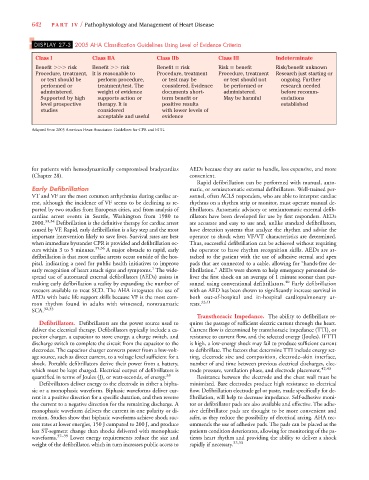
                   DISPLAY 27-3 2005 AHA Classification Guidelines Using Level of Evidence Criteria
                    Class I           Class IIA            Class IIb           Class III          Indeterminate
                    Benefit     risk   Benefit    risk       Benefit   risk       Risk   benefit      Risk/benefit unknown
                    Procedure, treatment, It is reasonable to   Procedure, treatment  Procedure, treatment  Research just starting or
                     or test should be  perform procedure,   or test may be      or test should not  ongoing. Further
                     performed or       treatment/test. The   considered. Evidence   be performed or  research needed
                     administered.      weight of evidence   documents short-    administered.      before recomm-
                     Supported by high   supports action or  term benefit or      May be harmful     endations
                     level prospective   therapy. It is      positive results                       established
                     studies            considered           with lower levels of
                                        acceptable and useful  evidence
                  Adapted from 2005 American Heart Association Guidelines for CPR and ECG.
                  for patients with hemodynamically compromised bradycardias  AEDs because they are easier to handle, less expensive, and more
                  (Chapter 28).                                       convenient.
                                                                        Rapid defibrillation can be performed with manual, auto-
                  Early Defibrillation                                 matic, or semiautomatic external defibrillators. Well-trained per-
                  VT and VF are the most common arrhythmias during cardiac ar-  sonnel, often ACLS responders, who are able to interpret cardiac
                  rest, although the incidence of VF seems to be declining as re-  rhythms on a rhythm strip or monitor, must operate manual de-
                  ported by two studies from European cities, and from analysis of  fibrillators. Automatic advisory or semiautomatic external defib-
                  cardiac arrest events in Seattle, Washington  from 1980 to  rillators have been developed for use by first responders. AEDs
                  2000. 33,34  Defibrillation is the definitive therapy for cardiac arrest  are accurate and easy to use and, unlike standard defibrillators,
                  caused by VF. Rapid, early defibrillation is a key step and the most  have detection systems that analyze the rhythm and advise the
                  important intervention likely to save lives. Survival rates are best  operator to shock when VF/VT characteristics are determined.
                  when immediate bystander CPR is provided and defibrillation oc-  Thus, successful defibrillation can be achieved without requiring
                  curs within 3 to 5 minutes. 35,36  A major obstacle to rapid, early  the operator to have rhythm recognition skills. AEDs are at-
                  defibrillation is that most cardiac arrests occur outside of the hos-  tached to the patient with the use of adhesive sternal and apex
                  pital, indicating a need for public health initiatives to improve  pads that are connected to a cable, allowing for “hands-free de-
                                                          1
                  early recognition of heart attack signs and symptoms. The wide-  fibrillation.” AEDs were shown to help emergency personnel de-
                  spread use of automated external defibrillators (AEDs) assists in  liver the first shock on an average of 1 minute sooner than per-
                  making early defibrillation a reality by expanding the number of  sonnel using conventional defibrillators. 40  Early defibrillation
                  rescuers available to treat SCD. The AHA integrates the use of  with an AED has been shown to significantly increase survival in
                  AEDs with basic life support skills because VF is the most com-  both out-of-hospital and in-hospital cardiopulmonary ar-
                  mon rhythm  found in adults with witnessed, nontraumatic  rests. 32,41
                  SCA. 32,33
                                                                        Transthoracic Impedance. The ability to defibrillate re-
                     Defibrillators. Defibrillators are the power source used to  quires the passage of sufficient electric current through the heart.
                  deliver the electrical therapy. Defibrillators typically include a ca-  Current flow is determined by transthoracic impedance (TTI), or
                  pacitor charger, a capacitor to store energy, a charge switch, and  resistance to current flow, and the selected energy (Joules). If TTI
                  discharge switch to complete the circuit from the capacitor to the  is high, a low-energy shock may fail to produce sufficient current
                  electrodes. The capacitor charger converts power from a low-volt-  to defibrillate. The factors that determine TTI include energy set-
                  age source, such as direct current, to a voltage level sufficient for a  ting, electrode size and composition, electrode–skin interface,
                  shock. Portable defibrillators derive their power from a battery,  number of and time between previous electrical discharges, elec-
                  which must be kept charged. Electrical output of defibrillators is  trode pressure, ventilation phase, and electrode placement. 42,43
                  quantified in terms of Joules (J), or watt-seconds, of energy. 33  Resistance between the electrode and the chest wall must be
                     Defibrillators deliver energy to the electrode in either a bipha-  minimized. Bare electrodes produce high resistance to electrical
                  sic or a monophasic waveform. Biphasic waveforms deliver cur-  flow. Defibrillation electrode gel or paste, made specifically for de-
                  rent in a positive direction for a specific duration, and then reverse  fibrillation, will help to decrease impedance. Self-adhesive moni-
                  the current to a negative direction for the remaining discharge. A  tor or defibrillator pads are also available and effective. The adhe-
                  monophasic waveform delivers the current in one polarity or di-  sive defibrillator pads are thought to be more convenient and
                  rection. Studies show that biphasic waveforms achieve shock suc-  safer, as they reduce the possibility of electrical arcing. AHA rec-
                  cess rates at lower energies, 150 J compared to 200 J, and produce  ommends the use of adhesive pads. The pads can be placed as the
                  less ST-segment change than shocks delivered with monophasic  patients condition deteriorates, allowing for monitoring of the pa-
                  waveforms. 37–39  Lower energy requirements reduce the size and  tients heart rhythm and providing the ability to deliver a shock
                  weight of the defibrillator, which in turn increases public access to  rapidly if necessary. 32,33

