


Page 794 - Cardiac Nursing
P. 794
LWBK340-c33_p769-782.qxd  09/09/2009  08:35 AM  Page 770 Aptara


                  770    PA R T  V / Health Promotion and Disease Prevention


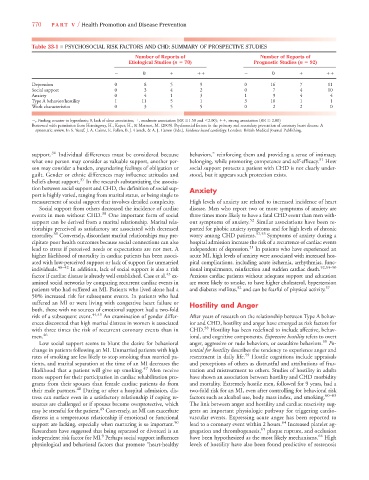
                  Table 33-1 ■ PSYCHOSOCIAL RISK FACTORS AND CHD: SUMMARY OF PROSPECTIVE STUDIES
                                                    Number of Reports of                     Number of Reports of
                                                                (
                                                                (
                                                  Etiological Studies (n   70)             Prognostic Studies (n   92)
                                                                                                         (
                                                                                                         (
                                                       0


                       0
                  Depression                 0         8        5        9              0       16        7        11
                  Social support             0         3        4        2              0        7        4        10
                  Anxiety                    0         4        1        3              1        9        4         4
                  Type A behavior/hostility  1        11        5        1              3       10        1         1
                  Work characteristics       0         3        5        5              0        2        2         0
                   , Finding counter to hypothesis; 0, lack of clear association;
, moderate association (RR  1.50 and  2.00);

, strong association (RR   2.00)
                  Borrowed with permission from Hemingway, H., Kuper, H., & Marmot, M. (2003). Psychosocial factors in the primary and secondary prevention of coronary heart disease: A
                    systematic review. In S. Yusuf, J. A. Cairns, E. Fallen, B. J. Gersch, & A. J. Camm (Eds.), Evidence based cardiology. London: British Medical Journal Publishing.


                  support. 36  Individual differences must be considered because  behaviors,” reinforcing them and providing a sense of intimacy,
                  what one person may consider as valuable support, another per-  belonging, while promoting competence and self-efficacy. 51  How
                  son may consider a burden, engendering feelings of obligation or  social support protects a patient with CHD is not clearly under-
                  guilt. Gender or ethnic differences may influence attitudes and  stood, but it appears such protection exists.
                  beliefs about support. 37  In the research substantiating the associa-
                  tion between social support and CHD, the definition of social sup-  Anxiety
                  port is highly varied, ranging from marital status, or being single to
                  measurement of social support that involves detailed complexity.  High levels of anxiety are related to increased incidence of heart
                     Social support from others decreased the incidence of cardiac  disease. Men who report two or more symptoms of anxiety are
                  events in men without CHD. 38  One important form of social  three times more likely to have a fatal CHD event than men with-
                  support can be derived from a marital relationship. Marital rela-  out symptoms of anxiety.  52  Similar associations have been re-
                  tionships perceived as satisfactory are associated with decreased  ported for phobic anxiety symptoms and for high levels of chronic
                  mortality. 39  Conversely, discordant marital relationships may pre-  worry among CHD patients. 52,53  Symptoms of anxiety during a
                  cipitate poor health outcomes because social connections can also  hospital admission increase the risk of a recurrence of cardiac events
                  lead to stress if perceived needs or expectations are not met. A  independent of depression. 21  In patients who have experienced an
                  higher likelihood of mortality in cardiac patients has been associ-  acute MI, high levels of anxiety were associated with increased hos-
                  ated with low-perceived support or lack of support for unmarried  pital complications, including acute ischemia, arrhythmias, func-
                  individuals. 40–42  In addition, lack of social support is also a risk  tional impairments, reinfarction and sudden cardiac death. 52,54–56
                                                              43
                  factor if cardiac disease is already well established. Case et al. ex-  Anxious cardiac patients without adequate support and education
                  amined social networks by comparing recurrent cardiac events in  are more likely to smoke, to have higher cholesterol, hypertension
                                                                                      52
                  patients who had suffered an MI. Patients who lived alone had a  and diabetes mellitus, and can be fearful of physical activity. 57
                  50% increased risk for subsequent events. In patients who had
                  suffered an MI or were living with congestive heart failure or  Hostility and Anger
                  both, those with no sources of emotional support had a two-fold
                  risk of a subsequent event. 44,45  An examination of gender differ-  After years of research on the relationship between Type A behav-
                  ences discovered that high marital distress in women is associated  ior and CHD, hostility and anger have emerged as risk factors for
                  with three times the risk of recurrent coronary events than in  CHD. 58  Hostility has been redefined to include affective, behav-
                  men. 46                                             ioral, and cognitive components. Expressive hostility refers to overt
                     Low social support seems to blunt the desire for behavioral  anger, aggressive or rude behaviors, or assaultive behaviors. 59  Po-
                  change in patients following an MI. Unmarried patients with high  tential for hostility describes the tendency to experience anger and
                  rates of smoking are less likely to stop smoking than married pa-  resentment in daily life. 59  Hostile cognitions include appraisals
                  tients, and marital separation at the time of an MI decreases the  and perceptions of others as distrustful and attributions of frus-
                  likelihood that a patient will give up smoking. 47  Men receive  tration and mistreatment to others. Studies of hostility in adults
                  more support for their participation in cardiac rehabilitation pro-  have shown an association between hostility and CHD morbidity
                  grams from their spouses than female cardiac patients do from  and mortality. Extremely hostile men, followed for 9 years, had a
                  their male partners. 48  During or after a hospital admission, dis-  two-fold risk for an MI, even after controlling for behavioral risk
                  tress can surface even in a satisfactory relationship if coping re-  factors such as alcohol use, body mass index, and smoking.  60–63
                  sources are challenged or if spouses become overprotective, which  The link between anger and hostility and cardiac reactivity sug-
                                         49
                  may be stressful for the patient. Conversely, an MI can exacerbate  gests an important physiologic pathway for triggering cardio-
                  distress in a tempestuous relationship if emotional or functional  vascular events. Expressing acute anger has been reported to
                  support are lacking, especially when nurturing is so important. 50  lead to a coronary event within 2 hours. 64  Increased platelet ag-
                  Researchers have suggested that being separated or divorced is an  gregation and thrombogenesis,  65  plaque rupture, and occlusion
                                         9
                  independent risk factor for MI. Perhaps social support influences  have been hypothesized as the most likely mechanisms. 66  High
                  physiological and behavioral factors that promote “heart-healthy  levels of hostility have also been found predictive of restenosis

