


Page 797 - Cardiac Nursing
P. 797
LWBK340-c33_p769-782.qxd  09/09/2009  08:35 AM  Page 773 Aptara


                                       C HAP TE R  33 / Psychosocial Risk Factors: Assessment and Management Interventions  773

                                                                         symptoms present at least more than half the days in the past
                   Table 33-2 ■ TWO-ITEM INSTRUMENT—                     2 weeks: in addition, one of the symptoms has to be depressed
                   DEPRESSION SCREEN                                     mood or anhedonia.
                                                                       4. The Beck Depression Inventory: This frequently used, 21-
                   During the past month, have you often been bothered                     104
                     by . . .                                            question self-report scale  has been recommended for epi-
                   1. Little interest or pleasure in doing things?  Yes  No  demiological studies of CHD patients. 33  Response scores for
                   2. Feeling down, depressed, or hopeless?  Yes  No     this first version, valid and reliable tool 105  can range from 0 to
                                                                         63. A person who scores between 10 and 18 is considered
                                                                                   d
                                                                                                                  d
                                                                                   d
                                                                                                                  d
                   Adapted from McManus, D., Pipkin, S. S., & Whooley, M. A. (2005). Screening for  mildly depressed, between 19 and 29 moderately depressed, and
                    depression in patients with coronary heart disease. (Data from the Heart and Soul  more than 30 severely depressed.
                                                                                              d
                                                                                              d
                                          6
                                          6
                    Study.) American Journal of Cardiology, 96, 1076–1081.
                                                                         Although there are some good choices for brief screening tools
                                                                       available, a recent advisory statement by the American Heart As-
                   given their extensive contact with cardiac patients, are in a pivotal  sociation has recommendations about the choice of screening in-
                                                                                                                    106
                   role to recognize or screen for depression. Several brief and reliable  struments for depression in CHD patients. Lichtman et al.
                   screening tools for clinical purposes can be used by nurses to iden-  recommend the use of the two-item instrument followed by the
                   tify patients at high risk for depression:          Patient Health Questionnaire-9, if one of the items on the two-
                                                                       item instrument meets criteria for depression.
                   1. The two-item instrument: This screening tool (Table 33-2)
                     based on the Patient Health Questionnaire is a two-item in-  Screening for Low-Perceived
                     strument about depressed mood and anhedonia with yes/no  Social Support
                     responses and a higher sensitivity to identifying major depres-
                     sion. 100,101  The symptom duration is for a month. If no is the  The ENRICHD Social Support Instrument, a seven-item, five-
                     response to both questions, a patient is unlikely to have major  point Likert scale (Table 33-4), is based on several other social
                     depression. If yes is the answer to either question, a follow-up  support scales that are predictive of mortality. 107,108  This self-
                     clinical interview is recommended.                report instrument has items that assess for different types of sup-
                   2. The Patient Health Questionnaire-2: The Patient Health Ques-  port including structural, instrumental, and emotional support
                     tionnaire-2 102  is a two-item depressive symptom subscale of a  and takes about 5 minutes to complete. The criteria for low-per-
                     longer version, Patient Health Questionnaire-9 described be-  ceived social support are based on five of the seven items (i.e.,
                     low (Table 33-3). The two items assess depressed mood and  items 1, 2, 3, 5, and 6). The criteria are met if a score is less than
                     anhedonia. The symptom duration is for 2 weeks and the cut-  or equal to 2 on at least two of the five items and a total score of
                     off score is 3 or more with a score range of 0 to 6. This is a very  less than 18. This tool can also be used for further clarification
                     suitable tool for quick and reliable screening.   about a patient’s social support system.
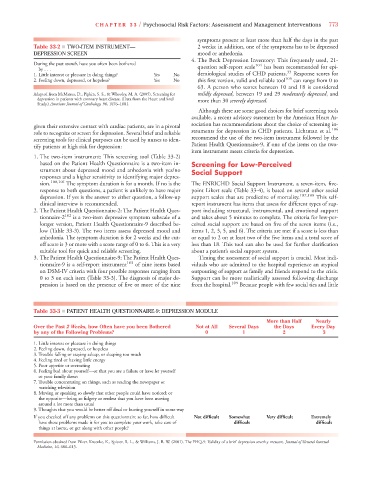
                   3. The Patient Health Questionnaire-9: The Patient Health Ques-  Timing the assessment of social support is crucial. Most indi-
                     tionnaire-9 is a self-report instrument 103  of nine items based  viduals who are admitted to the hospital experience an atypical
                     on DSM-IV criteria with four possible responses ranging from  outpouring of support as family and friends respond to the crisis.
                     0 to 3 on each item (Table 33-3). The diagnosis of major de-  Support can be more realistically assessed following discharge
                     pression is based on the presence of five or more of the nine  from the hospital. 109  Because people with few social ties and little


                   Table 33-3 ■ PATIENT HEALTH QUESTIONNAIRE-9: DEPRESSION MODULE

                                                                                               More than Half   Nearly
                   Over the Past 2 Weeks, how Often have you been Bothered   Not at All  Several Days  the Days  Every Day
                   by any of the Following Problems?                       0           1            2             3
                   1. Little interest or pleasure in doing things
                   2. Feeling down, depressed, or hopeless
                   3. Trouble falling or staying asleep, or sleeping too much
                   4. Feeling tired or having little energy
                   5. Poor appetite or overeating
                   6. Feeling bad about yourself—or that you are a failure or have let yourself
                     or your family down
                   7. Trouble concentrating on things, such as reading the newspaper or
                     watching television
                   8. Moving or speaking so slowly that other people could have noticed; or
                     the opposite—being so fidgety or restless that you have been moving
                     around a lot more than usual
                   9. Thoughts that you would be better off dead or hurting yourself in some way
                   If you checked off any problems on this questionnaire so far, how difficult  Not difficult  Somewhat   Very difficult  Extremely
                     have these problems made it for you to complete your work, take care of  difficult         difficult
                     things at home, or get along with other people?

                   Permission obtained from Pfizer. Kroenke, K., Spitzer, R. L., & Williams, J. B. W. (2001). The PHQ-9: Validity of a brief depression severity measure. Journal of General Internal
                    Medicine, 16, 606–613.
                          6
                          6

