


Page 796 - Cardiac Nursing
P. 796
9/0
                               0
                                  9/2
                                        8:3
                                    009
                       9-7
                    p76
                         82.
                           qxd
                         82.
                                                    72
                                                  e 7
                                                    72
                                                         ara
                                                       Apt
                                             M
                                           5 A
                                               P
                                                 g
                                               P
            K34
               0-c
                 33_
            K34
         L L LWB K34 0-c 33_ p76 9-7 82. qxd  0 9/0 9/2 009  0 0 8:3 5 A M  P a a g e 7 72  Apt ara
         LWB
         LWBK340-c33_33_p769-782.qxd  09/09/2009  08:35 AM  Page 772 Aptara
                  772    PA R T  V / Health Promotion and Disease Prevention
                                          Catecholamine and
                                          cortisol release
                                          Increased platelet
                                          reactivity
                                          Increased thrombin         Ischemia
                     Moderate to
                                          activity                   Plaque rupture
                     intense mental
                                                                     Myocardial infarction
                     stress
                                          Increased autonomic        Sudden cardiac death
                                          imbalance
                                          Decreased heart rate
                                          variability
                                          Increased systolic and
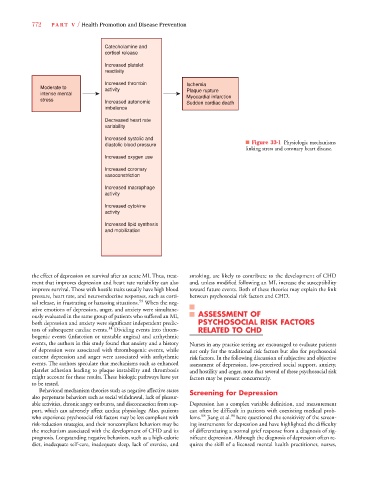
                                          diastolic blood pressure                      ■ Figure 33-1 Physiologic mechanisms
                                                                                        linking stress and coronary heart disease.
                                          Increased oxygen use
                                          Increased coronary
                                          vasoconstriction
                                          Increased macrophage
                                          activity
                                          Increased cytokine
                                          activity
                                          Increased lipid synthesis
                                          and mobilization


                  the effect of depression on survival after an acute MI. Thus, treat-  smoking, are likely to contribute to the development of CHD
                  ment that improves depression and heart rate variability can also  and, unless modified following an MI, increase the susceptibility
                  improve survival. Those with hostile traits usually have high blood  toward future events. Both of these theories may explain the link
                  pressure, heart rate, and neuroendocrine responses, such as corti-  between psychosocial risk factors and CHD.
                                                     59
                  sol release, in frustrating or harassing situations. When the neg-
                  ative emotions of depression, anger, and anxiety were simultane-
                  ously evaluated in the same group of patients who suffered an MI,  ASSESSMENT OF
                  both depression and anxiety were significant independent predic-  PSYCHOSOCIAL RISK FACTORS
                                           14
                  tors of subsequent cardiac events. Dividing events into throm-  RELATED TO CHD
                  bogenic events (infarction or unstable angina) and arrhythmic
                  events, the authors in this study found that anxiety and a history  Nurses in any practice setting are encouraged to evaluate patients
                  of depression were associated with thrombogenic events, while  not only for the traditional risk factors but also for psychosocial
                  current depression and anger were associated with arrhythmic  risk factors. In the following discussion of subjective and objective
                  events. The authors speculate that mechanisms such as enhanced  assessment of depression, low-perceived social support, anxiety,
                  platelet adhesion leading to plaque instability and thrombosis  and hostility and anger, note that several of these psychosocial risk
                  might account for these results. These biologic pathways have yet  factors may be present concurrently.
                  to be tested.
                     Behavioral mechanism theories such as negative affective states  Screening for Depression
                  also perpetuate behaviors such as social withdrawal, lack of pleasur-
                  able activities, chronic angry outbursts, and disconnection from sup-  Depression has a complex variable definition, and measurement
                  port, which can adversely affect cardiac physiology. Also, patients  can often be difficult in patients with coexisting medical prob-
                                                                                   99
                  who experience psychosocial risk factors may be less compliant with  lems. 98  Jiang et al. have questioned the sensitivity of the screen-
                  risk-reduction strategies, and their noncompliant behaviors may be  ing instruments for depression and have highlighted the difficulty
                  the mechanism associated with the development of CHD and its  of differentiating a normal grief response from a diagnosis of sig-
                  prognosis. Longstanding negative behaviors, such as a high-calorie  nificant depression. Although the diagnosis of depression often re-
                  diet, inadequate self-care, inadequate sleep, lack of exercise, and  quires the skill of a licensed mental health practitioner, nurses,

