


Page 826 - Cardiac Nursing
P. 826
9-8
                        9-8
                                                         02
                               d
                     p79
                   5
                                                              ar
                                                                a
                                                            Apt
                                             8:
                                             8:
                                        009
                                            0
                                        009
                                                         02
                                       2
                                     6
                                  9
                                 2
                                  9
                                    0
                                   /
                             qx
                             qx
                  3
                                                    Pa
                                                      g
                                                       e 8
                  3
         LWBK340-c35_p799-822.qxd  29/06/2009  08:59 PM  Page 802 Aptara
         LWB
         LWB K34 0-c 3 5 _ _ p79 9-8 22. qx d  2 9 / 0 6 / / 2 009  0 8: 5 9 P M  Pa g e 8 02  Apt ar a
                0-c
            K34
            K34
                                              5
                                               9 P
                                                  M
                                                    Pa
                          22.
                          22.
                  802    PA R T  V / Health Promotion and Disease Prevention
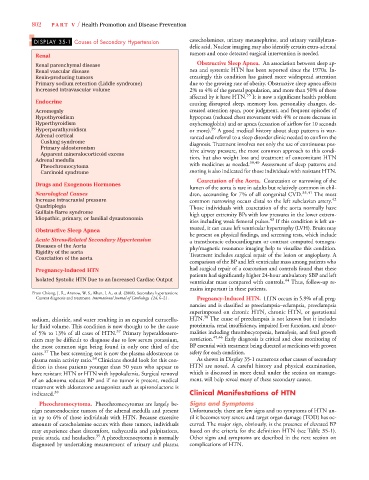
                   DISPLAY 35-1 Causes of Secondary Hypertension      catecholamines, urinary metanephrine, and urinary vanillylman-
                                                                      delic acid. Nuclear imaging may also identify certain extra-adrenal
                                                                      tumors and once detected surgical intervention is needed.
                    Renal
                                                                        Obstructive Sleep Apnea. An association between sleep ap-
                    Renal parenchymal disease
                    Renal vascular disease                            nea and systemic HTN has been reported since the 1970s. In-
                    Renin-producing tumors                            creasingly this condition has gained more widespread attention
                    Primary sodium retention (Liddle syndrome)        due to the growing rate of obesity. Obstructive sleep apnea affects
                    Increased intravascular volume                    2% to 4% of the general population, and more than 50% of those
                                                                      affected by it have HTN. 35  It is now a significant health problem
                    Endocrine                                         causing disrupted sleep, memory loss, personality changes, de-
                    Acromegaly                                        creased attention span, poor judgment, and frequent episodes of
                    Hypothyroidism                                    hypopnea (reduced chest movement with 4% or more decrease in
                    Hyperthyroidism                                   oxyhemoglobin) and or apnea (cessation of airflow for 10 seconds
                    Hyperparathyroidism                               or more). 39  A good medical history about sleep patterns is war-
                    Adrenal cortical                                  ranted and referral to a sleep disorder clinic needed to confirm the
                     Cushing syndrome                                 diagnosis. Treatment involves not only the use of continuous pos-
                     Primary aldosteronism                            itive airway pressure, the most common approach to this condi-
                     Apparent mineralocorticoid excess
                    Adrenal medulla                                   tion, but also weight loss and treatment of concomitant HTN
                                                                                          39,40
                     Pheochromocytoma                                 with medicines as needed.  Assessment of sleep patterns and
                     Carcinoid syndrome                               snoring is also indicated for those individuals with resistant HTN.
                                                                        Coarctation of the Aorta. Coarctation or narrowing of the
                    Drugs and Exogenous Hormones
                                                                      lumen of the aorta is rare in adults but relatively common in chil-
                    Neurological Causes                               dren, accounting for 7% of all congenital CVD. 35,41  The most
                    Increase intracranial pressure                    common narrowing occurs distal to the left subclavian artery. 42
                    Quadriplegia                                      Those individuals with coarctation of the aorta normally have
                    Guillain-Barre syndrome                           high upper extremity BPs with low pressures in the lower extrem-
                    Idiopathic, primary, or familial dysautonomia                               43
                                                                      ities including weak femoral pulses.  If this condition is left un-
                                                                      treated, it can cause left ventricular hypertrophy (LVH). Bruits may
                    Obstructive Sleep Apnea
                                                                      be present on physical findings, and screening tests, which include
                    Acute Stress-Related Secondary Hypertension       a transthoracic echocardiogram or contrast computed tomogra-
                    Diseases of the Aorta                             phy/magnetic resonance imaging help to visualize this condition.
                    Rigidity of the aorta                             Treatment includes surgical repair of the lesion or angioplasty. A
                    Coarctation of the aorta
                                                                      comparison of the BP and left ventricular mass among patients who
                    Pregnancy-Induced HTN                             had surgical repair of a coarctation and controls found that these
                                                                      patients had significantly higher 24-hour ambulatory SBP and left
                    Isolated Systolic HTN Due to an Increased Cardiac Output                         44
                                                                      ventricular mass compared with controls.  Thus, follow-up re-
                                                                      mains important in these patients.
                   From Chiong, J. R., Aronow, W. S., Khan, I. A., et al. (2008). Secondary hypertension:
                                                           4
                                                           4
                    Current diagnosis and treatment. International Journal of Cardiology, 124, 6–21.  Pregnancy-Induced HTN. HTN occurs in 5.9% of all preg-
                                                                      nancies and is classified as preeclampsia–eclampsia, preeclampsia
                                                                      superimposed on chronic HTN, chronic HTN, or gestational
                  sodium, chloride, and water resulting in an expanded extracellu-  HTN. 38  The cause of preeclampsia is not known but it includes
                  lar fluid volume. This condition is now thought to be the cause  proteinuria, renal insufficiency, impaired liver function, and abnor-
                  of 5% to 13% of all cases of HTN. 37  Primary hyperaldostero-  malities including thrombocytopenia, hemolysis, and fetal growth
                  nism may be difficult to diagnose due to low serum potassium,  restriction. 45,46  Early diagnosis is critical and close monitoring of
                  the most common sign being found in only one third of the  BP essential with treatment being directed at medicines with proven
                  cases. 37  The best screening test is now the plasma aldosterone to  safety for each condition.
                                      38
                  plasma renin activity ratio. Clinicians should look for this con-  As shown in Display 35-1 numerous other causes of secondary
                  dition in those patients younger than 50 years who appear to  HTN are noted. A careful history and physical examination,
                  have resistant HTN or HTN with hypokalemia. Surgical removal  which is discussed in more detail under the section on manage-
                  of an adenoma reduces BP and if no tumor is present, medical  ment, will help reveal many of these secondary causes.
                  treatment with aldosterone antagonists such as spironolactone is
                  indicated. 38                                       Clinical Manifestations of HTN
                     Pheochromocytoma. Pheochromocytomas are largely be-  Signs and Symptoms
                  nign neuroendocrine tumors of the adrenal medulla and present  Unfortunately, there are few signs and no symptoms of HTN un-
                  in up to 6% of those individuals with HTN. Because excessive  til it becomes very severe and target organ damage (TOD) has oc-
                  amounts of catecholamine occurs with these tumors, individuals  curred. The major sign, obviously, is the presence of elevated BP
                  may experience chest discomfort, tachycardia and palpitations,  based on the criteria for the definition HTN (see Table 35-1).
                  panic attack, and headaches. 35  A pheochromocytoma is normally  Other signs and symptoms are described in the next section on
                  diagnosed by undertaking measurement of urinary and plasma  complications of HTN.

