


Page 828 - Cardiac Nursing
P. 828
LWBK340-c35_p799-822.qxd  29/06/2009  08:59 PM  Page 804 Aptara


                  804    PA R T  V / Health Promotion and Disease Prevention

                  and glomerular capillary pressures to accelerate nephrosclerosis.
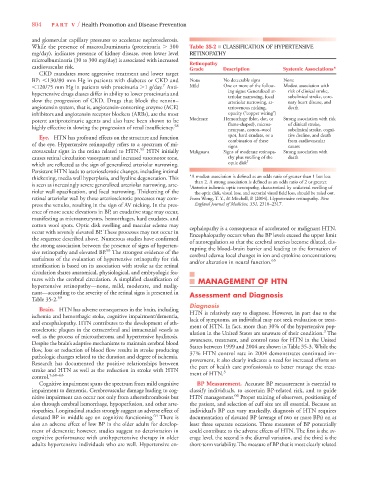
                  While the presence of macroalbuminuria (proteinuria   300  Table 35-2 ■ CLASSIFICATION OF HYPERTENSIVE
                  mg/day), indicates presence of kidney disease, even lower level  RETINOPATHY
                  microalbuminuria (30 to 300 mg/day) is associated with increased  Retinopathy
                  cardiovascular risk.                                Grade      Description         Systemic Associations*
                     CKD mandates more aggressive treatment and lower target
                  BP:  130/80 mm Hg in patients with diabetes or CKD and  None   No detectable signs  None
                                                             7
                   120/75 mm Hg in patients with proteinuria  1 g/day. Anti-  Mild  One or more of the follow-  Modest association with
                  hypertensive drugs classes differ in ability to lower proteinuria and  ing signs: Generalized ar-  risk of clinical stroke,
                                                                                   teriolar narrowing, focal
                                                                                                      subclinical stroke, coro-
                  slow the progression of CKD. Drugs that block the rennin–        arteriolar narrowing, ar-  nary heart disease, and
                  angiotensin system, that is, angiotensin-converting enzyme (ACE)  teriovenous nicking,  death
                  inhibitors and angiotensin receptor blockers (ARBs), are the most  opacity (“copper wiring”)
                  potent antiproteinuric agents and also have been shown to be  Moderate  Hemorrhage (blot, dot, or  Strong association with risk
                                                                                   flame-shaped), microa-
                                                                                                      of clinical stroke,
                  highly effective in slowing the progression of renal insufficiency. 58  neurysm, cotton–wool  subclinical stroke, cogni-
                                                                                   spot, hard exudate, or a  tive decline, and death
                     Eye. HTN has profound effects on the structure and function
                                                                                   combination of these  from cardiovascular
                  of the eye. Hypertensive retinopathy refers to a spectrum of mi-  signs             causes
                  crovascular signs in the retina related to HTN. 59  HTN initially  Malignant  Signs of moderate retinopa-  Strong association with
                  causes retinal circulation vasospasm and increased vasomotor tone,  thy plus swelling of the  death
                  which are reflected as the sign of generalized arteriolar narrowing.  optic disk †
                  Persistent HTN leads to arteriosclerotic changes, including intimal
                  thickening, media wall hyperplasia, and hyaline degeneration. This  *A modest association is defined as an odds ratio of greater than 1 but less
                                                                        than 2. A strong association is defined as an odds ratio of 2 or greater.
                  is seen as increasingly severe generalized arteriolar narrowing, arte-  † Anterior ischemic optic neuropathy, characterized by unilateral swelling of
                  riolar wall opacification, and focal narrowing. Thickening of the  the optic disk, visual loss, and sectorial visual field loss, should be ruled out.
                  retinal arteriolar wall by these arteriosclerotic processes may com-  From Wong, T. Y., & Mitchell, P. (2004). Hypertensive retinopathy. New
                  press the venules, resulting in the sign of AV nicking. In the pres-  England Journal of Medicine, 351, 2310–2317.
                  ence of more acute elevations in BP, an exudative stage may occur,
                  manifesting as microaneurysms, hemorrhages, hard exudates, and
                  cotton wool spots. Optic disk swelling and macular edema may
                                                                      cephalopathy is a consequence of accelerated or malignant HTN.
                  occur with severely elevated BP. These processes may not occur in
                                                                      Encephalopathy occurs when the BP levels exceed the upper limit
                  the sequence described above. Numerous studies have confirmed
                                                                      of autoregulation so that the cerebral arteries become dilated, dis-
                  the strong association between the presence of signs of hyperten-  rupting the blood–brain barrier and leading to the formation of
                                           59
                  sive retinopathy and elevated BP. The strongest evidence of the
                                                                      cerebral edema; local changes in ion and cytokine concentrations;
                  usefulness of the evaluation of hypertensive retinopathy for risk              65
                                                                      and/or alteration in neural function.
                  stratification is based on its association with stroke as the retinal
                  circulation shares anatomical, physiological, and embryologic fea-
                  tures with the cerebral circulation. A simplified classification of  MANAGEMENT OF HTN
                  hypertensive retinopathy—none, mild, moderate, and malig-
                  nant—according to the severity of the retinal signs is presented in  Assessment and Diagnosis
                  Table 35-2. 59
                                                                      Diagnosis
                     Brain. HTN has adverse consequences in the brain, including  HTN is relatively easy to diagnose. However, in part due to the
                  ischemia and hemorrhagic stoke, cognitive impairment/dementia,  lack of symptoms, an individual may not seek evaluation or treat-
                  and encephalopathy. HTN contributes to the development of ath-  ment of HTN. In fact, more than 30% of the hypertensive pop-
                  erosclerotic plaques in the extracerebral and intracranial vessels as  ulation in the United States are unaware of their condition. The
                                                                                                                  3
                  well as the process of microatheroma and hypertensive hyalinosis.  awareness, treatment, and control rates for HTN in the United
                  Despite the brain’s adaptive mechanisms to maintain cerebral blood  States between 1999 and 2004 are shown in Table 35-3. While the
                  flow, loss or reduction of blood flow results in stroke producing  37% HTN control rate in 2004 demonstrates continued im-
                  pathologic changes related to the duration and degree of ischemia.  provement, it also clearly indicates a need for increased efforts on
                  Research  has  documented the positive relationships  between  the part of health care professionals to better manage the treat-
                  stroke and HTN as well as the reduction in stroke with HTN  ment of HTN. 3
                  control. 5,60–63
                     Cognitive impairment spans the spectrum from mild cognitive  BP Measurement. Accurate BP measurement is essential to
                  impairment to dementia. Cerebrovascular damage leading to cog-  classify individuals, to ascertain BP-related risk, and to guide
                                                                                     66
                  nitive impairment can occur not only from atherothrombosis but  HTN management. Proper training of observers, positioning of
                  also through cerebral hemorrhage, hypoperfusion, and other arte-  the patient, and selection of cuff size are all essential. Because an
                  riopathies. Longitudinal studies strongly suggest an adverse effect of  individual’s BP can vary markedly, diagnosis of HTN requires
                  elevated BP in middle age on cognitive functioning. 64  There is  documentation of elevated BP (average of two or more BPs) on at
                  also an adverse effect of low BP in the older adults for develop-  least three separate occasions. Three measures of BP potentially
                  ment of dementia; however, studies suggest no deterioration in  could contribute to the adverse effects of HTN. The first is the av-
                  cognitive performance with antihypertensive therapy in older  erage level, the second is the diurnal variation, and the third is the
                  adults hypertensive individuals who are well. Hypertensive en-  short-term variability. The measure of BP that is most clearly related

