


Page 827 - Cardiac Nursing
P. 827
009
                                        009
                                       2
                                    0
                                     6
                                            0
                                               9 P
                                                  M
                                              5
                                             8:
                                             8:
                                   /
                          22.
                          22.
                        9-8
                     p79
                        9-8
                             qx
                                  9
                                  9
                                 2
                             qx
                               d
         LWB
         LWBK340-c35_p799-822.qxd  29/06/2009  08:59 PM  Page 803 Aptara
         LWB K34 0-c 3 5 _ _ p79 9-8 22. qx d  2 9 / 0 6 / / 2 009  0 8: 5 9 P M  Pa g e 8 03  Apt ar a
                   5
            K34
                  3
                  3
            K34
                0-c
                                                                a
                                                            Apt
                                                    Pa
                                                    Pa
                                                         03
                                                       e 8
                                                      g
                                                              ar
                                                         03
                                                                                     C HAPTER  35 / Hypertension   803
                    DISPLAY 35-2 Cardiovascular Risk Factors             Changes in the Vascular Endothelium. The vascular en-
                                                                       dothelium is the largest organ in the body. 50  Vascular endothelial
                                                                       cells are extremely active and play a critical role in regulation of
                    Major Risk Factors
                                                                       blood vessel tone and cellular activity in the vascular wall. En-
                    Hypertension                                       dothelial cells modulate blood vessel tone by secreting a variety of
                    Cigarette smoking                                  dilator and constrictor substances. In addition to their effect on
                                                 2
                    Obesity (body mass index   30 kg/m )               vascular tone, these substances and other factors produced by the
                    Physical inactivity
                    Dyslipidemia                                       endothelium, may also modify platelet aggregation, thrombo-
                    Diabetes mellitus                                  genicity of the blood, vascular inflammation, and oxidative stress
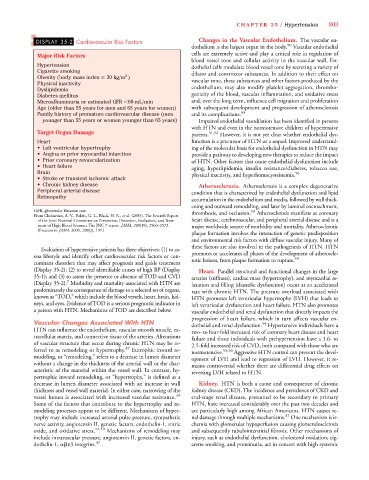
                    Microalbuminuria or estimated GFR  60 mL/min       and, over the long term, influence cell migration and proliferation
                    Age (older than 55 years for men and 65 years for women)  with subsequent development and progression of atherosclerosis
                    Family history of premature cardiovascular disease (men  and its complications. 50
                      younger than 55 years or women younger than 65 years)  Impaired endothelial vasodilation has been identified in persons
                                                                       with HTN and even in the normotensive children of hypertensive
                    Target Organ Damage                                parents. 51,52  However, it is not yet clear whether endothelial dys-
                    Heart                                              function is a precursor of HTN or a sequel. Improved understand-
                    • Left ventricular hypertrophy                     ing of the molecular basis for endothelial dysfunction in HTN may
                    • Angina or prior myocardial infarction            provide a pathway to developing new therapies to reduce the impact
                    • Prior coronary revascularization                 of HTN. Other factors that cause endothelial dysfunction include
                    • Heart failure                                    aging, hyperlipidemia, insulin resistance/diabetes, tobacco use,
                    Brain                                              physical inactivity, and hyperhomocysteinemia. 50
                    • Stroke or transient ischemic attack
                    • Chronic kidney disease                             Atherosclerosis. Atherosclerosis is a complex degenerative
                    Peripheral arterial disease                        condition that is characterized by endothelial dysfunction and lipid
                    Retinopathy
                                                                       accumulation in the endothelium and media, followed by wall thick-
                                                                       ening and outward remodeling, and later by luminal encroachment,
                   GFR, glomerular filtration rate.                     thrombosis, and occlusion. 53  Atherosclerosis manifests as coronary
                   From Chobanian, A. V., Bakris, G. L., Black, H. R., et al. (2003). The Seventh Report
                    of the Joint National Committee on Prevention, Detection, Evaluation, and Treat-  heart disease, cerebrovascular, and peripheral arterial disease and is a
                    ment of High Blood Pressure: The JNC 7 report. JAMA, 289(19), 2560–2572.  major worldwide source of morbidity and mortality. Atherosclerotic
                    (Erratum in JAMA, 2003, 290[2], 197.)
                                                                       plaque formation involves the interaction of genetic predisposition
                                                                       and environmental risk factors with diffuse vascular injury. Many of
                                                                       these factors are also involved in the pathogenesis of HTN. HTN
                     Evaluation of hypertensive patients has three objectives: (1) to as-
                   sess lifestyle and identify other cardiovascular risk factors or con-  promotes or accelerates all phases of the development of atheroscle-
                                                                                                        53
                   comitant disorders that may affect prognosis and guide treatment  rotic lesions, from plaque formation to rupture.
                   (Display 35-2); (2) to reveal identifiable causes of high BP (Display  Heart. Parallel structural and functional changes in the large
                   35-1); and (3) to assess the presence or absence of TOD and CVD  arteries (stiffness), cardiac mass (hypertrophy), and myocardial re-
                              7
                   (Display 35-2). Morbidity and mortality associated with HTN are  laxation and filling (diastolic dysfunction) occur at an accelerated
                   predominately the consequence of damage to a selected set of organs,  rate with chronic HTN. The pressure overload associated with
                   known as “TOD,” which include the blood vessels, heart, brain, kid-  HTN promotes left ventricular hypertrophy (LVH) that leads to
                   neys, and eyes. Evidence of TOD is a serious prognostic indicator in  left ventricular dysfunction and heart failure. HTN also promotes
                   a person with HTN. Mechanisms of TOD are described below.  vascular endothelial and renal dysfunction that directly impacts the
                                                                       progression of heart failure, which in turn affects vascular en-
                   Vascular Changes Associated With HTN                dothelial and renal dysfunction. Hypertensive individuals have a
                                                                                              54
                   HTN can influence the endothelium, vascular smooth muscle, ex-  two- to four-fold increased risk of coronary heart disease and heart
                   tracellular matrix, and connective tissue of the arteries. Alterations  failure and those individuals with prehypertension have a 1.6- to
                   of vascular structure that occur during chronic HTN may be re-  2.5-fold increased risk of CVD, both compared with those who are
                   ferred to as remodeling or hypertrophy. 47  Eutrophic inward re-  normotensive. 55,56  Aggressive HTN control can prevent the devel-
                   modeling, or “remodeling,” refers to a decrease in lumen diameter  opment of LVH and lead to regression of LVH. However, it re-
                   without a change in the thickness of the arterial wall or the char-  mains controversial whether there are differential drug effects on
                   acteristic of the material within the vessel wall. In contrast, hy-  reversing LVH related to HTN.
                   pertrophic inward remodeling, or “hypertrophy,” is defined as a
                   decrease in lumen diameter associated with an increase in wall  Kidney. HTN is both a cause and consequence of chronic
                   thickness and vessel wall material. In either case, narrowing of the  kidney disease (CKD). The incidence and prevalence of CKD and
                   vessel lumen is associated with increased vascular resistance. 48  end-stage renal disease, presumed to be secondary to primary
                   Some of the factors that contribute to the hypertrophy and re-  HTN, have increased considerably over the past two decades and
                   modeling processes appear to be different. Mechanisms of hyper-  are particularly high among African Americans. HTN causes re-
                                                                                                     57
                   trophy may include increased arterial pulse pressure, sympathetic  nal damage through multiple mechanisms. One mechanism is is-
                   nerve activity, angiotensin II, genetic factors, endothelin-1, nitric  chemia with glomerular hypoperfusion causing glomerulosclerosis
                   oxide, and oxidative stress. 47,49  Mechanisms of remodeling may  and subsequently tubulointerstitial fibrosis. Other mechanisms of
                   include intravascular pressure, angiotensin II, genetic factors, en-  injury, such as endothelial dysfunction, cholesterol oxidation, cig-
                   dothelin-1,    3 integrins. 47                      arette smoking, and proteinuria, act in concert with high systemic

