


Page 84 - Cardiac Nursing
P. 84
0
0
0
xd
xd
6/3
009
009
0/2
6/3
0/2
04
2-0
04
p
p
2-0
q
q
q
68.
68.
1
0 A
p
0 A
e 6
e 6
p
r
r
ta
p
ta
3
3
5:3
1
5:3
Pa
g
g
g
Pa
Pa
LWBK340-c02_
LWB K34 0-c 02_ pp042-068.qxd 06/30/2009 15:33 Page 60 Aptara a a
02_
0-c
K34
LWB
60 PA R T I / Anatomy and Physiology
behind the movement of oxygen and carbon dioxide across the
alveolar membrane into the pulmonary capillaries. Zone 1
P a >
Perfusion is the process of transporting gases to and from the P > P a P v
A
cells of the body. This event includes mixed venous blood flow to
the pulmonary capillaries where gases are exchanged between the
alveoli and blood, and blood flow to the systemic capillaries
where gases are exchanged between the blood and the surround- Alveolar Zone 2
ing body fluids. P P A P a> P P A> P v
Other lung functions that affect respiration but do not involve P P P a P P
P v
gas exchange include hormonal activity and the work of breath- Arterial
ing. Work of breathing is the metabolic demand of breathing. It Venous Distance
includes the energy needed to move the lung and chest wall and
results in a demand for oxygen.
Dead Space Zone 3
Ventilation must keep pace with the constant demand to replenish P > P > P P A Blood flow
v
a
oxygen and eliminate carbon dioxide exchanged in the alveoli.
P
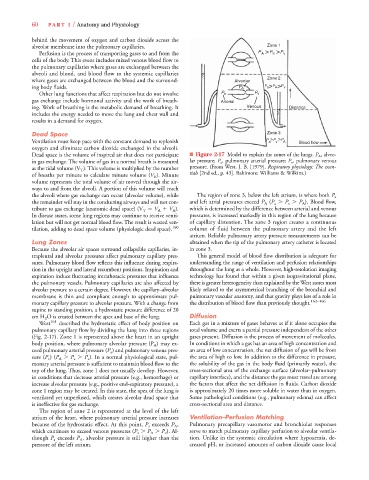
Dead space is the volume of inspired air that does not participate ■ Figure 2-17 Model to explain the zones of the lungs. P A , alveo-
P
P
in gas exchange. The volume of gas in a normal breath is measured lar pressure; P a P , pulmonary arterial pressure; P v P , pulmonary venous
V V
as the tidal volume (V T ). This volume is multiplied by the number pressure. (From West, J. B. [1979]. Respiratory physiology: The essen-
tials [2nd ed., p. 43]. Baltimore: Williams & Wilkins.)
of breaths per minute to calculate minute volume (V E ). Minute
V V
volume represents the total volume of air moved through the air-
ways to and from the alveoli. A portion of this volume will reach
P
the alveoli where gas exchange can occur (alveolar volume), while The region of zone 3, below the left atrium, is where both P a P
P
P
P
P
the remainder will stay in the conducting airways and will not con- and left atrial pressures exceed P A (P a P P v P P A ). Blood flow,
V V
V V
tribute to gas exchange (anatomic dead space) (V T V A
V A ). which is determined by the difference between arterial and venous
V V
In disease states, some lung regions may continue to receive venti- pressures, is increased markedly in this region of the lung because
lation but will not get normal blood flow. The result is wasted ven- of capillary distention. The zone 3 region creates a continuous
tilation, adding to dead space volume (physiologic dead space). 160 column of fluid between the pulmonary artery and the left
atrium. Reliable pulmonary artery pressure measurements can be
Lung Zones obtained when the tip of the pulmonary artery catheter is located
Because the alveolar air spaces surround collapsible capillaries, in- in zone 3.
trapleural and alveolar pressures affect pulmonary capillary pres- This general model of blood flow distribution is adequate for
sures. Pulmonary blood flow reflects this influence during respira- understanding the range of ventilation and perfusion relationships
tion in the upright and lateral recumbent positions. Inspiration and throughout the lung as a whole. However, high-resolution imaging
expiration induce fluctuating intrathoracic pressures that influence technology has found that within a given isogravitational plane,
the pulmonary vessels. Pulmonary capillaries are also affected by there is greater heterogeneity than explained by the West zones most
alveolar pressure to a certain degree. However, the capillary–alveolar likely related to the asymmetrical branching of the bronchial and
membrane is thin and compliant enough to approximate pul- pulmonary vascular anatomy, and that gravity plays less of a role in
monary capillary pressure to alveolar pressure. With a change from the distribution of blood flow than previously thought. 162–166
supine to standing position, a hydrostatic pressure difference of 20
cm H 2 O is created between the apex and base of the lung. Diffusion
West 161 described the hydrostatic effect of body position on Each gas in a mixture of gases behaves as if it alone occupies the
pulmonary capillary flow by dividing the lung into three regions total volume and exerts a partial pressure independent of the other
(Fig. 2-17). Zone 1 is represented above the heart in an upright gases present. Diffusion is the process of movement of molecules.
body position, where pulmonary alveolar pressure (P A ) may ex- In conditions in which a gas has an area of high concentration and
P
ceed pulmonary arterial pressure (P a P ) and pulmonary venous pres- an area of low concentration, the net diffusion of gas will be from
P
P
P
sure (P v P ) (P A P a P P v P ). In a normal physiological state, pul- the area of high to low. In addition to the difference in pressure,
P
monary arterial pressure is sufficient to maintain blood flow to the the solubility of the gas in the body fluid (primarily water), the
top of the lung. Thus, zone 1 does not usually develop. However, cross-sectional area of the exchange surface (alveolar–pulmonary
in conditions that decrease arterial pressure (e.g., hemorrhage) or capillary interface), and the distance the gas must travel are among
increase alveolar pressure (e.g., positive end-expiratory pressure), a the factors that affect the net diffusion in fluids. Carbon dioxide
zone 1 region may be created. In this state, the apex of the lung is is approximately 20 times more soluble in water than in oxygen.
ventilated yet unperfused, which creates alveolar dead space that Some pathological conditions (e.g., pulmonary edema) can affect
is ineffective for gas exchange. cross-sectional area and distance.
The region of zone 2 is represented at the level of the left
atrium of the heart, where pulmonary arterial pressure increases Ventilation–Perfusion Matching
P
P
because of the hydrostatic effect. At this point, P a P exceeds P A , Pulmonary precapillary vasomotor and bronchiolar responses
which continues to exceed venous pressures (P a P P A P v P ). Al- serve to match pulmonary capillary perfusion to alveolar ventila-
P
P
P
P
P
though P a P exceeds P A , alveolar pressure is still higher than the tion. Unlike in the systemic circulation where hypoxemia, de-
pressure of the left atrium. creased pH, or increased amounts of carbon dioxide cause local

