


Page 82 - Cardiac Nursing
P. 82
LWBK340-c02_p042-068.qxd  06/30/2009  15:33  Page 58 Aptara


                  58    PA R T  I / Anatomy and Physiology

                  which is equal to the product of hydraulic conductivity and the  Pulmonary blood volume decreases or is diverted to the sys-
                  available area (L p A), is expressed as milliliters of net filtrate formed  temic circulation in conditions such as generalized systemic va-
                              p p
                  in 100 g of tissue per minute for each milliliter increase in mean  sodilation, the standing position, positive end-expiratory pressure,
                                                                –1
                  capillary filtration pressure (ml   min –1  mm Hgg –1    100 gg ).  or circulatory shock. Conditions that increase pulmonary blood
                  The capillary filtration coefficient is a useful indicator of capillary  volume include generalized systemic vasoconstriction, the supine
                  permeability. 147  A decrease in the capillary filtration coefficient,  position, mitral stenosis, and left heart failure. 156
                  for example by a decrease in the area available for exchange, re-  The pulmonary circulation originates from the base of the
                  duces the rate of net capillary filtration for any given net filtration  right ventricle, extends 5 cm, and divides into the right and left
                  pressure. The second factor, the reflection coefficient ( ), repre-  pulmonary arteries. As the pulmonary artery rises, the right pul-
                  sents the osmotic pressure exerted by a difference in the concen-  monary artery is positioned posterior to the aorta and superior
                  tration gradient of a substance across a membrane (oncotic effect  vena cava and anterior to the right mainstem bronchus. The left
                  of the concentration gradient) and the greater the ratio of the  pulmonary artery extends over the left main bronchus and di-
                  solute size to pore size, the greater the ratio. 155  vides into lobar branches. The pulmonary arteries and segmen-
                     The reflection coefficient is close to 1 for tight-junction en-  tal and lobar branches are composed of elastic arteries to main-
                  dothelium, which is completely impermeable to protein. In nor-  tain  low vascular resistance. These arteries contain smooth
                  mal systemic exchange vessels in the skin and skeletal muscle, with  muscle with the capability of vasoconstriction and vasodilata-
                  continuous or fenestrated endothelium, the reflection coefficient  tion. The muscular arteries have internal and external elastic
                  ranges from 0.8 to 0.95 for albumin and total protein, 146,147  laminae with a layer of smooth muscle cells. The acinour and su-
                  which indicates that these vessels are not completely impermeable  pernumerary arteries (precapillary arteries) are muscular. In-
                  to proteins. In the lungs, the reflection coefficients are, in general,  creases in pulmonary vascular resistance come from the precap-
                  lower for albumin (0.5 to 0.6) and protein (0.5 to 0.7). 147  In cases  illary arteries. Arterioles are vessels with a thin intima and a
                  of injury to the endothelium, the reflection coefficient is markedly  single elastic lamina.  These vessels make up the accessory
                  reduced, allowing increased movement of large molecules (e.g.,  branches of the respiratory tree and end at the alveolar capillary
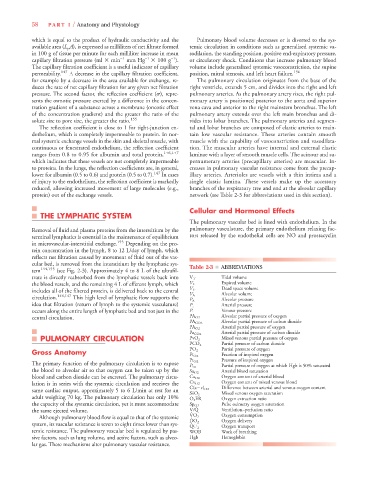
                  protein) out of the exchange vessels.               network (see Table 2-3 for abbreviations used in this section).

                                                                      Cellular and Hormonal Effects
                     THE LYMPHATIC SYSTEM
                                                                      The pulmonary vascular bed is lined with endothelium. In the
                  Removal of fluid and plasma proteins from the interstitium by the  pulmonary vasculature, the primary endothelium relaxing fac-
                  terminal lymphatics is essential in the maintenance of equilibrium  tors released by the endothelial cells are NO and prostacyclin
                  in microvascular-interstitial exchange. 155  Depending on the pro-
                  tein concentration in the lymph, 8 to 12 L/day of lymph, which
                  reflects net filtration caused by movement of fluid out of the vas-
                  cular bed, is removed from the interstitium by the lymphatic sys-
                  tem 144,155  (see Fig. 2-3). Approximately 4 to 8 L of the ultrafil-  Table 2-3 ■ ABBREVIATIONS
                  trate is directly reabsorbed from the lymphatic vessels back into  V V  Tidal volume
                                                                      V T
                  the blood vessels, and the remaining 4 L of efferent lymph, which  V V  Expired volume
                                                                      V E
                                                                      V V       Dead space volume
                  includes all of the filtered protein, is delivered back to the central  V D  Alveolar volume
                                                                      V V
                  circulation. 144,147  This high level of lymphatic flow supports the  V A  Alveolar pressure
                                                                      P
                                                                      P A
                  idea that filtration (return of lymph to the systemic vasculature)  P a P P  Arterial pressure
                  occurs along the entire length of lymphatic bed and not just in the  P v P P  Venous pressure
                  central circulation.                                PA O2     Alveolar partial pressure of oxygen
                                                                      PA CO2    Alveolar partial pressure of carbon dioxide
                                                                                Arterial partial pressure of oxygen
                                                                      PA O2
                                                                                Arterial partial pressure of carbon dioxide
                                                                      Pa CO2
                     PULMONARY CIRCULATION                            PvO 2     Mixed venous partial pressure of oxygen
                                                                      PCO 2     Partial pressure of carbon dioxide
                                                                                Partial pressure of oxygen
                  Gross Anatomy
                                                                      PO 2
                                                                      FI O2     Fraction of inspired oxygen
                                                                                Pressure of inspired oxygen
                                                                      PI O2
                  The primary function of the pulmonary circulation is to expose  P P P 50  Partial pressure of oxygen at which Hgb is 50% saturated
                  the blood to alveolar air so that oxygen can be taken up by the  Sa O2  Arterial blood saturation
                  blood and carbon dioxide can be excreted. The pulmonary circu-  Ca O2  Oxygen content of arterial blood
                  lation is in series with the systemic circulation and receives the  Cv O2  Oxygen content of mixed venous blood
                  same cardiac output, approximately 5 to 6 L/min at rest for an  C(a v) O2  Difference between arterial and venous oxygen content
                                                                      SvO 2     Mixed venous oxygen saturation
                  adult weighing 70 kg. The pulmonary circulation has only 10%  O 2 ER  Oxygen extraction ratio
                  the capacity of the systemic circulation, yet it must accommodate  Sp O2  Pulse oximetry oxygen saturation

                  the same ejected volume.                            V Q       Ventilation–perfusion ratio

                     Although pulmonary blood flow is equal to that of the systemic  VO 2  Oxygen consumption

                                                                                Oxygen delivery

                  system, its vascular resistance is seven to eight times lower than sys-  DO 2  Oxygen transport
                                                                      Q Q
                                                                      QO 2
                  temic resistance. The pulmonary vascular bed is regulated by pas-  WOB  Work of breathing
                  sive factors, such as lung volume, and active factors, such as alveo-  Hgb  Hemoglobin
                  lar gas. These mechanisms alter pulmonary vascular resistance.

