


Page 79 - Cardiac Nursing
P. 79
6/3
                                0/2
                              6/3
                             0
                             0
                                     1
                                     1
                                  009
                                0/2
                                  009
                        68.
                          q
                        68.
                      2-0
                      2-0
                           xd
                              0
                           xd
                          q
                          q
                                      5:3
                                                p
                                                p
                                              5 A
                                            e 5
                                              5 A
                                                  r
                                                  r
                                                 ta
                                                p
                                                 ta
                                         Pa
                                         Pa
                                        3
                                      5:3
                                        3
                                           g
                                            e 5
                                           g
                                         Pa
                                           g
               0-c
            K34
            K34
                 02_
                 02_
               0-c
         LWB
                    04
         LWBK340-c02_ p pp042-068.qxd  06/30/2009  15:33  Page 55 Aptara a a
                    04
         LWB
                   p
                                                   C HAPTER 2 / Systemic and Pulmonary Circulation and Oxygen Delivery  55
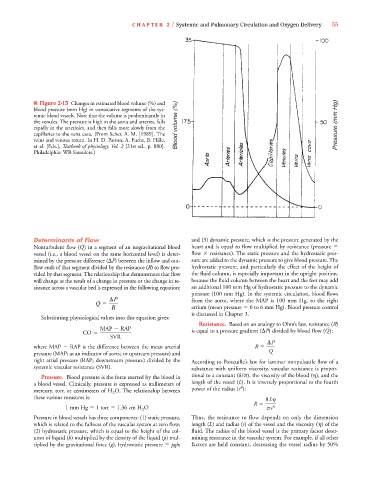
                   ■ Figure 2-15 Changes in estimated blood volume (%) and
                   blood pressure (mm Hg) in consecutive segments of the sys-
                   temic blood vessels. Note that the volume is predominantly in
                   the venules. The pressure is high in the aorta and arteries, falls
                   rapidly in the arterioles, and then falls more slowly from the
                   capillaries to the vena cava. (From Scher, A. M. [1989]. The
                   veins and venous return. In H. D. Patton, A. Fuchs, B. Hille,
                   et al. [Eds.], Textbook of physiology, Vol. 2 [21st ed., p. 880].
                   Philadelphia: WB Saunders.)
                   Determinants of Flow                                and (3) dynamic pressure, which is the pressure generated by the
                                  ˙
                   Nonturbulent flow (Q) in a segment of an isogravitational blood  heart and is equal to flow multiplied by resistance (pressure
                   vessel (i.e., a blood vessel on the same horizontal level) is deter-  flow   resistance). The static pressure and the hydrostatic pres-
                                             P
                   mined by the pressure difference (	P) between the inflow and out-P  sure are added to the dynamic pressure to give blood pressure. The
                                                        R
                                                        R
                   flow ends of that segment divided by the resistance (R) to flow pro-  hydrostatic pressure, and particularly the effect of the height of
                   vided by that segment. The relationship that demonstrates that flow  the fluid column, is especially important in the upright position,
                   will change as the result of a change in pressure or the change in re-  because the fluid column between the heart and the feet may add
                   sistance across a vascular bed is expressed in the following equation:  an additional 100 mm Hg of hydrostatic pressure to the dynamic
                                                                       pressure (100 mm Hg). In the systemic circulation, blood flows
                                        #   ¢P                         from the aorta, where the MAP is 100 mm Hg, to the right
                                       Q
                                            R                          atrium (mean pressure   0 to 6 mm Hg). Blood pressure control
                                                                       is discussed in Chapter 3.
                     Substituting physiological values into this equation gives:
                                                                         Resistance. Based on an analogy to Ohm’s law, resistance (R)
                                                                                                                     R
                                                                                                                     R
                                         MAP   RAP                                                                 ˙
                                                                                               P
                                                                                               P
                                   CO                                  is equal to a pressure gradient (	P) divided by blood flow (Q):
                                            SVR
                                                                                               ¢P
                   where MAP   RAP is the difference between the mean arterial             R     #
                   pressure (MAP; as an indicator of aortic or upstream pressure) and           Q
                   right atrial pressure (RAP; downstream pressure) divided by the  According to Poiseuille’s law for laminar nonpulsatile flow of a
                   systemic vascular resistance (SVR).                 substance with uniform viscosity, vascular resistance is propor-
                     Pressure. Blood pressure is the force exerted by the blood in  tional to a constant (8/ ), the viscosity of the blood ( ), and the
                   a blood vessel. Clinically, pressure is expressed as millimeters of  length of the vessel (L). It is inversely proportional to the fourth
                                                                                       4
                                                                                      r
                   mercury, torr, or centimeters of H 2 O. The relationship between  power of the radius (r ):
                   these various measures is:                                                  8Lh
                                                                                           R
                             1 mm Hg   1 torr   1.36 cm H 2 O                                  pr 4
                   Pressure in blood vessels has three components: (1) static pressure,  Thus, the resistance to flow depends on only the dimension
                   which is related to the fullness of the vascular system at zero flow;  length (L) and radius (r) of the vessel and the viscosity ( ) of the
                                                                                       r
                   (2) hydrostatic pressure, which is equal to the height of the col-  fluid. The radius of the blood vessel is the primary factor deter-
                   umn of liquid (h) multiplied by the density of the liquid (p) mul-  mining resistance in the vascular system. For example, if all other
                                                             (
                                            (
                                            (
                                            g
                   tiplied by the gravitational force (g), hydrostatic pressure   pgh;  factors are held constant, decreasing the vessel radius by 50%
                                            g

