


Page 87 - Cardiac Nursing
P. 87
0
                             0
                              0
                           xd
                           xd
                              6/3
                                  009
                                  009
                                0/2
                              6/3
                                0/2
                    04
                      2-0
                    04
                   p
                   p
                      2-0
                          q
                          q
                          q
                        68.
                        68.
                                     1
                                              3 A
                                                p
                                              3 A
                                            e 6
                                            e 6
                                                p
                                                  r
                                                  r
                                                 ta
                                                p
                                                 ta
                                        3
                                        3
                                      5:3
                                     1
                                      5:3
                                         Pa
                                           g
                                           g
                                           g
                                         Pa
                                         Pa
         LWBK340-c02_
         LWB
         LWB K34 0-c 02_ pp042-068.qxd  06/30/2009  15:33  Page 63 Aptara a a
                 02_
               0-c
            K34
                                                   C HAPTER 2 / Systemic and Pulmonary Circulation and Oxygen Delivery  63
                   porphyrin and iron. The molecule is composed of two   and two  100
                     polypeptide chains, each with an iron-containingheme mole-
                                                                                  a
                   cule capable ofbinding oxygen. Theoretically, 1 g of Hgb is ca-  O  affinity
                                                                                2
                   pable of transporting 1.39 mL of oxygen. However, some of the                    Normal O  affinity
                                                                                                             f
                                                                                                      r
                                                                                                           2
                   heme sites are in an alternate form (methemoglobin) that is not
                   capable of combining with oxygen. The maximum amount of
                   oxygen that can be transported is approximately 1.34 to 1.36                         P CO 2
                                                                                                          +
                   mL/g of Hgb (some authors suggest this number may be lower,             O  affinity  H  or    pH
                                                                                              affinity
                   approximately 1.31 mL/g). 156  Hgb has a unique chemical struc-  50       2 2        Temperature
                                                                                                             e
                   ture that accounts for the differences in the speed at which oxy-                    2,3-DPG
                                                                                                            P
                   gen binds with Hgb (affinity). Oxygen affinity increases as more
                   Hgb is saturated with oxygen, so that the affinity of the last heme
                   unit is greater than the first unit. This relationship explains the      P P P 50
                   nonlinear curve represented in the oxyhemoglobin dissociation
                   (or equilibrium) curve. 138
                                                                          0
                     Partial Pressure of Oxygen. Alveolar oxygen diffuses into  0  20   40     60    80    100    120
                   the pulmonary capillaries. The amount of oxygen transferred de-         P P P  (mm Hg)
                                                                                            O 2
                   pends on the mechanics of the ventilation–perfusion relationship
                   of the lungs and the amount of inspired oxygen. The majority  0  2  4  6    8    10   12   14   16
                   (97%) of the oxygen transportedby the blood is bound to Hgb.             P P P  (kPa)
                                                                                             O 2
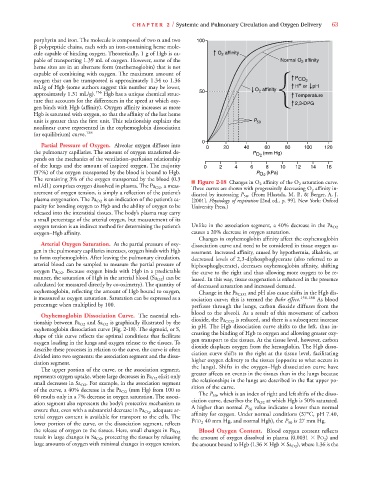
                   The remaining 3% of the oxygen transportedby the blood (0.3  ■ Figure 2-18 Changes in O 2 affinity of the O 2 saturation curve.
                   mL/dL) comprises oxygen dissolved in plasma. The Pa O2 , a meas-  Three curves are shown with progressively decreasing O 2 affinity in-
                   urement of oxygen tension, is simply a reflection of the patient’s  dicated by increasing P 50 . (From Hlastala, M. P., & Berger, A. J.
                   plasma oxygenation. The Pa O2 is an indication of the patient’s ca-  [2001]. Physiology of respiration [2nd ed., p. 99]. New York: Oxford
                   pacity for bonding oxygen to Hgb and the ability of oxygen to be  University Press.)
                   released into the interstitial tissues. The body’s plasma may carry
                   a small percentage of the arterial oxygen, but measurement of its
                   oxygen tension is an indirect methodfor determining the patient’s  Unlike in the association segment, a 40% decrease in the Pa O2
                   oxygen–Hgb affinity.                                 causes a 20% decrease in oxygen saturation.
                                                                         Changes in oxyhemoglobin affinity affect the oxyhemoglobin
                     Arterial Oxygen Saturation. As the partialpressure of oxy-  dissociation curve and need to be considered in tissue oxygen as-
                   gen in the pulmonary capillaries increases, oxygen binds with Hgb  sessment. Increased affinity, caused by hypothermia, alkalosis, or
                   to form oxyhemoglobin. After leaving the pulmonary circulation,  decreased levels of 2,3-diphosphoglycerate (also referred to as
                   arterialblood can be sampled to measure the partialpressure of  biphosphoglycerate), decreases oxyhemoglobin affinity, shifting
                   oxygen Pa O2 . Because oxygen binds with Hgb in a predictable  the curve to the right and thus allowing more oxygen to be re-
                   manner, the saturation of Hgb in the arterialblood (Sa O2 ) can be  leased. In this way, tissue oxygenation is enhanced in the presence
                   calculated (or measureddirectly by co-oximetry). The quantity of  of decreased saturation and increased demand.
                   oxyhemoglobin, reflecting the amount of Hgb bound to oxygen,  Change in the Pa CO2 and pH also cause shifts in the Hgb dis-
                   is measured as oxygen saturation. Saturation can be expressed as a  sociation curve; this is termed the Bohr effect. 156,188  As blood
                   percentage when multipliedby 100.                   perfuses through the lungs, carbon dioxide diffuses from the
                                                                       blood to the alveoli. As a result of this movement of carbon
                     Oxyhemoglobin Dissociation Curve. The essential rela-
                   tionshipbetween Pa O2 and Sa O2 is graphically illustratedby the  dioxide, the Pa CO2 is reduced, and there is a subsequent increase
                   oxyhemoglobin dissociation curve (Fig. 2-18). The sigmoid, or S,  in pH. The Hgb dissociation curve shifts to the left, thus in-
                   shape of this curve reflects the optimal conditions that facilitate  creasing the binding of Hgb to oxygen and allowing greater oxy-
                   oxygen loading in the lungs and oxygen release to the tissues. To  gen transport to the tissues. At the tissue level, however, carbon
                   describe these processes in relation to the curve, the curve is often  dioxide displaces oxygen from the hemoglobin. The Hgb disso-
                   divided into two segments: the association segment and the disso-  ciation curve shifts to the right at the tissue level, facilitating
                   ciation segment.                                    higher oxygen delivery to the tissues (opposite to what occurs in
                     The upper portion of the curve, or the association segment,  the lungs). Shifts in the oxygen–Hgb dissociation curve have
                   represents oxygen uptake, where large decreases in Pa O2  elicit only  greater affects on events in the tissues than in the lungs because
                   small decreases in Sa O2 . For example, in the association segment  the relationships in the lungs are described in the flat upper po-
                   of the curve, a 40% decrease in the Pa O2 (mm Hg) from 100 to  sition of the curve.
                                                                            P P
                   60 results only in a 7% decrease in oxygen saturation. The associ-  The P 50 , which is an index of right and left shifts of the disso-
                   ation segment also represents the body’s protective mechanism to  ciation curve, describes the Pa O2 at which Hgb is 50% saturated.
                                                                                        P
                                                         , adequate ar-  A higher than normal P 50 value indicates a lower than normal
                   ensure that, even with a substantialdecrease in Pa O 2  affinity for oxygen. Under normal conditions (37°C, pH 7.40,
                   terial oxygen content is available for transport to the cells. The
                                                                                                     P P
                   lower portion of the curve, or the dissociation segment, reflects  PCO 2 40 mm Hg, and normal Hgb), the P 50 is 27 mm Hg.
                                                                         Blood Oxygen Content. Blood oxygen content reflects
                   the release of oxygen to the tissues. Here, small changes in Pa O2
                   result in large changes in Sa O2 , protecting the tissues by releasing  the amount of oxygen dissolved in plasma (0.0031   PO 2 ) and
                   large amounts of oxygen with minimal changes in oxygen tension.  the amount bound to Hgb (1.36   Hgb   Sa O2 ), where 1.36 is the

