


Page 841 - Cardiac Nursing
P. 841
9
                                   /
                                 2
                                  9
                                       2
                                        009
                                    0
                                     6
                        9-8
                          22.
                     p79
                        9-8
                             qx
                               d
                          22.
                             qx
                                                       e 8
                                                         17
                                                    Pa
                                                      g
                                                              ar
                                                                a
                                                         17
                                                            Apt
                                             8:
                                             8:
                                        009
                                            0
                                                  M
                                                    Pa
                                              5
                                               9 P
            K34
            K34
         LWBK340-c35_p799-822.qxd  29/06/2009  08:59 PM  Page 817 Aptara
         LWB K34 0-c 3 5 _ _ p79 9-8 22. qx d  2 9 / 0 6 / / 2 009  0 8: 5 9 P M  Pa g e 8 17  Apt ar a
         LWB
                  3
                   5
                0-c
                  3
                                                                                                    /
                                                                                                                   817
                                                                                                     Hyper
                                                                                     C HAPTER  35 / Hypertensiontension  817
                                                                                     CHAPTER 35
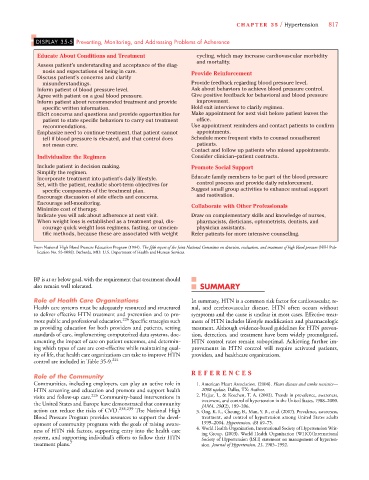
                    DISPLAY 35-5 Preventing, Monitoring, and Addressing Problems of Adherence
                    Educate About Conditions and Treatment              cycling, which may increase cardiovascular morbidity
                                                                        and mortality.
                    Assess patient’s understanding and acceptance of the diag-
                      nosis and expectations of being in care.         Provide Reinforcement
                    Discuss patient’s concerns and clarify
                      misunderstandings.                               Provide feedback regarding blood pressure level.
                    Inform patient of blood pressure level.            Ask about behaviors to achieve blood pressure control.
                    Agree with patient on a goal blood pressure.       Give positive feedback for behavioral and blood pressure
                    Inform patient about recommended treatment and provide  improvement.
                      specific written information.                     Hold exit interviews to clarify regimen.
                    Elicit concerns and questions and provide opportunities for  Make appointment for next visit before patient leaves the
                      patient to state specific behaviors to carry out treatment  office.
                      recommendations.                                 Use appointment reminders and contact patients to confirm
                    Emphasize need to continue treatment, that patient cannot  appointments.
                      tell if blood pressure is elevated, and that control does  Schedule more frequent visits to counsel nonadherent
                      not mean cure.                                    patients.
                                                                       Contact and follow up patients who missed appointments.
                    Individualize the Regimen                          Consider clinician–patient contracts.
                    Include patient in decision making.                Promote Social Support
                    Simplify the regimen.
                    Incorporate treatment into patient’s daily lifestyle.  Educate family members to be part of the blood pressure
                    Set, with the patient, realistic short-term objectives for   control process and provide daily reinforcement.
                      specific components of the treatment plan.        Suggest small group activities to enhance mutual support
                    Encourage discussion of side effects and concerns.  and motivation.
                    Encourage self-monitoring.                         Collaborate with Other Professionals
                    Minimize cost of therapy.
                    Indicate you will ask about adherence at next visit.  Draw on complementary skills and knowledge of nurses,
                    When weight loss is established as a treatment goal, dis-  pharmacists, dieticians, optometrists, dentists, and
                      courage quick weight loss regimens, fasting, or unscien-  physician assistants.
                      tific methods, because these are associated with weight  Refer patients for more intensive counselling.
                   From National High Blood Pressure Education Program (1994). The fifth report of the Joint National Committee on detection, evaluation, and treatment of high blood pressure (NIH Pub-
                    lication No. 93-1088). Bethesda, MD: U.S. Department of Health and Human Services.
                   BP is at or below goal, with the requirement that treatment should
                   also remain well tolerated.                           SUMMARY
                   Role of Health Care Organizations                   In summary, HTN is a common risk factor for cardiovascular, re-
                   Health care systems must be adequately resourced and structured  nal, and cerebrovascular disease. HTN often occurs without
                   to deliver effective HTN treatment and prevention and to pro-  symptoms and the cause is unclear in most cases. Effective treat-
                   mote public and professional education. 226  Specific strategies such  ment of HTN includes lifestyle modification and pharmacologic
                   as providing education for both providers and patients, setting  treatment. Although evidence-based guidelines for HTN preven-
                   standards of care, implementing computerized data systems, doc-  tion, detection, and treatment have been widely promulgated,
                   umenting the impact of care on patient outcomes, and determin-  HTN control rates remain suboptimal. Achieving further im-
                   ing which types of care are cost-effective while maintaining qual-  provements in HTN control will require activated  patients,
                   ity of life, that health care organizations can take to improve HTN  providers, and healthcare organizations.
                   control are included in Table 35-9. 221
                                                                       R EFEREN C E S
                   Role of the Community
                   Communities, including employers, can play an active role in  1. American Heart Association. (2008). Heart disease and stroke statistics—
                                                                                 e
                   HTN screening and education and promote and support health  2008 update. Dallas, TX: Author.
                   visits and follow-up care. 226  Community-based interventions in  2.Hajjar, I., & Kotchen, T. A. (2003). Trends in prevalence, awareness,
                                                                          treatment, and control of hypertension in the United States, 1988–2000.
                   the United States and Europe have demonstrated that community  JAMA, 290(2), 199–206.
                   action can reduce the risks of CVD.  238,239  The National High  3.Ong, K. L., Cheung, B., Man, Y. B., et al. (2007). Prevalence, awareness,
                   Blood Pressure Program provides resources to support the devel-  treatment, and control of hypertension among United States adults
                                                                                           9
                                                                                           9
                   opment of community programs with the goals of raising aware-  1999–2004. Hypertension, 49, 69–75.
                   ness of HTN risk factors, supporting entry into the health care  4. World Health Organization, International Society of Hypertension Writ-
                                                                          ing Group. (2003). World Health Organization (WHO)/International
                   system, and supporting individual’s efforts to follow their HTN  Society of Hypertension (ISH) statement on management of hyperten-
                   treatment plans. 7                                     sion. Journal of Hypertension, 21, 1983–1992.

