


Page 839 - Cardiac Nursing
P. 839
LWBK340-c35_p799-822.qxd  29/06/2009  08:59 PM  Page 815 Aptara


                                                                                     C HAPTER  35 / Hypertension   815


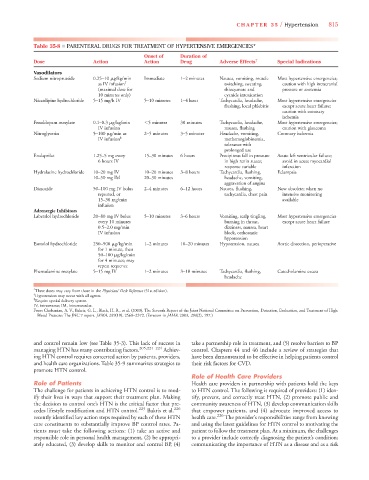
                   Table 35-8 ■ PARENTERAL DRUGS FOR TREATMENT OF HYPERTENSIVE EMERGENCIES*
                                                       Onset of    Duration of
                   Dose               Action           Action      Drug         Adverse Effects †  Special Indications

                   Vasodilators
                   Sodium nitroprusside  0.25–10  g/kg/min  Immediate  1–2 minutes  Nausea, vomiting, muscle  Most hypertensive emergencies;
                                        as IV infusion †                         twitching, sweating,   caution with high intracranial
                                        (maximal dose for                        thiocyanate and    pressure or azotemia
                                        10 minutes only)                         cyanide intoxication
                   Nicardipine hydrochloride  5–15 mg/h IV  5–10 minutes  1–4 hour  Tachycardia, headache,   Most hypertensive emergencies
                                                                                 flushing, local phlebitis  except acute heart failure;
                                                                                                    caution with coronary
                                                                                                    ischemia
                   Fenoldopam mesylate  0.1–0.3  g/kg/min   5 minutes  30 minutes  Tachycardia, headache,   Most hypertensive emergencies;
                                        IV infusion                              nausea, flushing    caution with glaucoma
                   Nitroglycerin      5–100  g/min as   2–5 minutes  3–5 minutes  Headache, vomiting,   Coronary ischemia
                                        IV infusion ‡                            methemoglobinemia,
                                                                                 tolerance with
                                                                                 prolonged use
                   Enalaprilat        1.25–5 mg every   15–30 minutes  6 hours  Precipitous fall in pressure   Acute left ventricular failure;
                                        6 hours IV                               in high renin states;   avoid in acute myocardial
                                                                                 response variable  infarction
                   Hydralazine hydrochloride  10–20 mg IV  10–20 minutes  3–8 hours  Tachycardia, flushing,  Eclampsia
                                      10–50 mg IM      20–30 minutes             headache, vomiting,
                                                                                 aggravation of angina
                   Diazoxide          50–100 mg IV bolus  2–4 minutes  6–12 hours  Nausea, flushing,    Now obsolete; when no
                                        repeated, or                             tachycardia, chest pain  intensive monitoring
                                        15–30 mg/min                                                available
                                        infusion
                   Adrenergic Inhibitors
                   Labetalol hydrochloride  20–80 mg IV bolus  5–10 minutes  3–6 hours  Vomiting, scalp tingling,  Most hypertensive emergencies
                                        every 10 minutes                         burning in throat,  except acute heart failure
                                        0.5–2.0 mg/min                           dizziness, nausea, heart
                                        IV infusion                              block, orthostatic
                                                                                 hypotension
                   Esmolol hydrochloride  250–500  g/kg/min  1–2 minutes  10–20 minutes  Hypotension, nausea  Aortic dissection, perioperative
                                        for 1 minute, then
                                        50–100  g/kg/min
                                        for 4 minutes; may
                                        repeat sequence
                   Phentolamine mesylate  5–15 mg IV   1–2 minutes  3–10 minutes  Tachycardia, flushing,  Catecholamine excess
                                                                                 headache

                   * These doses may vary from those in the Physicians’ Desk Reference (51st edition).
                   † Hypotension may occur with all agents.
                   ‡ Require special delivery system.
                   IV, intravenous; IM, intramuscular.
                   From Chobanian, A. V., Bakris, G. L., Black, H. R., et al. (2003). The Seventh Report of the Joint National Committee on Prevention, Detection, Evaluation, and Treatment of High
                    Blood Pressure: The JNC 7 report. JAMA, 289(19), 2560–2572. (Erratum in JAMA, 2003, 290(2), 197.)


                   and control remain low (see Table 35-3). This lack of success in  take a partnership role in treatment, and (5) resolve barriers to BP
                   managing HTN has many contributing factors. 205,221–224  Achiev-  control. Chapters 44 and 46 include a review of strategies that
                   ing HTN control requires concerted action by patients, providers,  have been demonstrated to be effective in helping patients control
                   and health care organizations. Table 35-9 summarizes strategies to  their risk factors for CVD.
                   promote HTN control.
                                                                       Role of Health Care Providers
                   Role of Patients                                    Health care providers in partnership with patients hold the keys
                   The challenge for patients in achieving HTN control is to mod-  to HTN control. The following is required of providers: (1) iden-
                   ify their lives in ways that support their treatment plan. Making  tify, prevent, and correctly treat HTN, (2) promote public and
                   the decision to control one’s HTN is the critical factor that pre-  community awareness of HTN, (3) develop communication skills
                   cedes lifestyle modification and HTN control. 225  Bakris et al. 226  that empower patients, and (4) advocate improved access to
                   recently identified key action steps required by each of these HTN  health care. 226 The provider’s responsibilities range from knowing
                   care constituents to substantially improve BP control rates. Pa-  and using the latest guidelines for HTN control to motivating the
                   tients must take the following actions: (1) take an active and  patient to follow the treatment plan. At a minimum, the challenges
                   responsible role in personal health management, (2) be appropri-  to a provider include correctly diagnosing the patient’s condition;
                   ately educated, (3) develop skills to monitor and control BP, (4)  communicating the importance of HTN as a disease and as a risk

