


Page 836 - Cardiac Nursing
P. 836
M
                                                    Pa
                                                    Pa
                                               9 P
                                        009
                                             8:
                                              5
                                        009
                                    0
                                  9
                                  9
                                       2
                                            0
                                             8:
                                     6
                                                                a
                          22.
                        9-8
                     p79
                             qx
                                 2
                               d
                             qx
                   5
                                                            Apt
                                                            Apt
                                                              ar
                                   /
                                                      g
                                                       e 8
                                                         12
                0-c
                  3
                  3
            K34
         LWB K34 0-c 3 5 _ _ p79 9-8 22. qx d  2 9 / 0 6 / / 2 009  0 8: 5 9 P M  Pa g e 8 12  Apt ar a
         L L LWB
         LWBK340-c35_p799-822.qxd  29/06/2009  08:59 PM  Page 812 Aptara
                  812    PA R T  V / Health Promotion and Disease Prevention
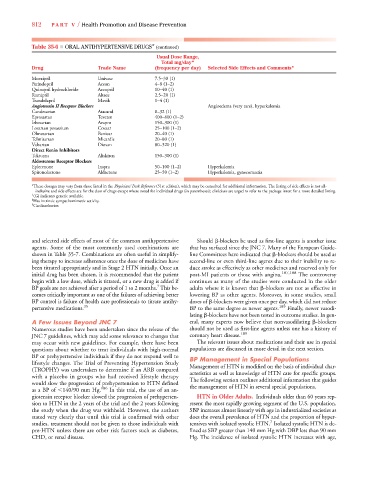
                  Table 35-6 ■ ORAL ANTIHYPERTENSIVE DRUGS* (continued)
                                                           Usual Dose Range,
                                                             Total mg/day*
                  Drug                  Trade Name         (frequency per day)  Selected Side Effects and Comments*
                  Moexipril             Univasc            7.5–30 (1)
                  Perindopril           Aceon              4–8 (1–2)
                  Quinapril hydrochloride  Accupril        10–40 (1)
                  Ramipril              Altace             2.5–20 (1)
                  Trandolapril          Mavik              1–4 (1)
                  Angiotensin II Receptor Blockers                          Angioedema (very rare), hyperkalemia
                  Candesartan           Atacand            8–32 (1)
                  Eprosartan            Teveten            400–800 (1–2)
                  Irbesartan            Avapro             150–300 (1)
                  Losartan potassium    Cozaar             25–100 (1–2)
                  Olmesartan            Benicar            20–40 (1)
                  Telmisartan           Micardis           20–80 (1)
                  Valsartan             Diovan             80–320 (1)
                  Direct Renin Inhibitors
                  Tekturna              Aliskiren          150–300 (1)
                  Aldosterone Receptor Blockers
                  Eplerenone            Inspra             50–100 (1–2)     Hyperkalemia
                  Spironolactone        Aldactone          25–50 (1–2)      Hyperkalemia, gynecomastia
                  *These dosages may vary from those listed in the Physicians’ Desk Reference (51st edition), which may be consulted for additional information. The listing of side effects is not all-
                    inclusive and side effects are for the class of drugs except where noted for individual drugs (in parentheses); clinicians are urged to refer to the package insert for a more detailed listing.
                  †
                   (G) indicates generic available.
                  ‡
                   Has intrinsic sympathomimetic activity.
                  §
                   Cardioselective.
                  and selected side effects of most of the common antihypertensive  Should  -blockers be used as first-line agents is another issue
                  agents. Some of the most commonly used combinations are  that has surfaced since the JNC 7. Many of the European Guide-
                  shown in Table 35-7. Combinations are often useful in simplify-  line Committees have indicated that  -blockers should be used as
                  ing therapy to increase adherence once the dose of medicines have  second-line or even third-line agents due to their inability to re-
                  been titrated appropriately and in Stage 2 HTN initially. Once an  duce stroke as effectively as other medicines and reserved only for
                  initial drug has been chosen, it is recommended that the patient  post-MI patients or those with angina. 187,188  The controversy
                  begin with a low dose, which is titrated, or a new drug is added if  continues as many of the studies were conducted in the older
                                                           7
                  BP goals are not achieved after a period of 1 to 2 months. This be-  adults where it is known that  -blockers are not as effective in
                  comes critically important as one of the failures of achieving better  lowering BP as other agents. Moreover, in some studies, small
                  BP control is failure of health care professionals to titrate antihy-  doses of  -blockers were given once per day, which did not reduce
                  pertensive medications. 35                          BP to the same degree as newer agents. 189  Finally, newer vasodi-
                                                                      lating  -blockers have not been tested in outcome studies. In gen-
                  A Few Issues Beyond JNC 7                           eral, many experts now believe that nonvasodilating  -blockers
                  Numerous studies have been undertaken since the release of the  should not be used as first-line agents unless one has a history of
                  JNC 7 guidelines, which may add some relevance to changes that  coronary heart disease. 189
                  may occur with new guidelines. For example, there have been  The relevant issues about medications and their use in special
                  questions about whether to treat individuals with high-normal  populations are discussed in more detail in the next section.
                  BP or prehypertensive individuals if they do not respond well to  BP Management in Special Populations
                  lifestyle changes. The Trial of Preventing Hypertension Study
                  (TROPHY) was undertaken to determine if an ARB compared  Management of HTN is modified on the basis of individual char-
                  with a placebo in groups who had received lifestyle therapy  acteristics as well as knowledge of HTN care for specific groups.
                  would slow the progression of prehypertension to HTN defined  The following section outlines additional information that guides
                  as a BP of  140/90 mm Hg. 186  In this trial, the use of an an-  the management of HTN in several special populations.
                  giotensin receptor blocker slowed the progression of prehyperten-  HTN in Older Adults. Individuals older than 60 years rep-
                  sion to HTN in the 2 years of the trial and the 2 years following  resent the most rapidly growing segment of the U.S. population.
                  the study when the drug was withheld. However, the authors  SBP increases almost linearly with age in industrialized societies as
                  stated very clearly that until this trial is confirmed with other  does the overall prevalence of HTN and the proportion of hyper-
                                                                                                7
                  studies, treatment should not be given to those individuals with  tensives with isolated systolic HTN. Isolated systolic HTN is de-
                  pre-HTN unless there are other risk factors such as diabetes,  fined as SBP greater than 140 mm Hg with DBP less than 90 mm
                  CHD, or renal disease.                              Hg. The incidence of isolated systolic HTN increases with age,

