


Page 840 - Cardiac Nursing
P. 840
LWBK340-c35_p799-822.qxd  29/06/2009  08:59 PM  Page 816 Aptara


                  816    PA R T  V / Health Promotion and Disease Prevention


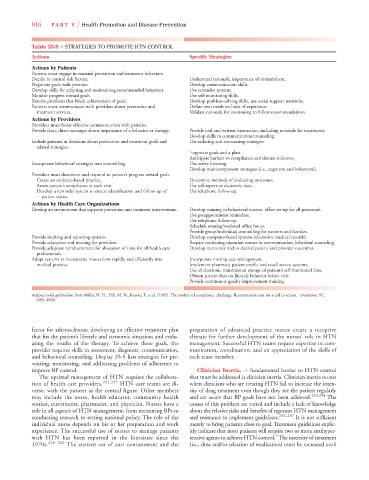
                  Table 35-9 ■ STRATEGIES TO PROMOTE HTN CONTROL
                  Actions                                             Specific Strategies
                  Actions by Patients
                  Patients must engage in essential prevention and treatment behaviors.
                  Decide to control risk factors.                     Understand rationale, importance of commitment.
                  Negotiate goals with provider.                      Develop communication skills.
                  Develop skills for adopting and maintaining recommended behaviors.  Use reminder systems.
                  Monitor progress toward goals.                      Use self-monitoring skills.
                  Resolve problems that block achievement of goals.   Develop problem-solving skills, use social support networks.
                  Patients must communicate with providers about prevention and  Define own needs on basis of experience.
                    treatment services.                               Validate rationale for continuing to follow recommendations.
                  Actions by Providers
                  Providers must foster effective communication with patients.
                  Provide clear, direct messages about importance of a behavior or therapy.  Provide oral and written instruction, including rationale for treatments.
                                                                      Develop skills in communication/counseling.
                  Include patients in decisions about prevention and treatment goals and   Use tailoring and contracting strategies.
                    related strategies.
                                                                      Negotiate goals and a plan.
                                                                      Anticipate barriers to compliance and discuss solutions.
                  Incorporate behavioral strategies into counselling.  Use active listening.
                                                                      Develop multicomponent strategies (i.e., cognitive and behavioral).
                  Providers must document and respond to patient’s progress toward goals.
                    Create an evidence-based practice.                Determine methods of evaluating outcomes.
                    Assess patient’s compliance at each visit.        Use self-report or electronic data.
                    Develop a reminder system to ensure identification and follow-up of   Use telephone follow-up.
                      patient status.
                  Actions by Health Care Organizations
                  Develop an environment that supports prevention and treatment interventions.  Develop training in behavioral science, office set-up for all personnel.
                                                                      Use preappointment reminders.
                                                                      Use telephone follow-up.
                                                                      Schedule evening/weekend office hours.
                                                                      Provide group/individual counselling for patients and families.
                  Provide tracking and reporting systems.             Develop computer-based systems (electronic medical records).
                                                                      R
                                                                      Require continuing education courses in communication, behavioral counseling.
                  Provide education and training for providers.       R
                  Provide adequate reimbursement for allocation of time for all health care  Develop incentives tied to desired patient and provider outcomes.
                    professionals.
                  Adopt systems to incorporate innovations rapidly and efficiently into   Incorporate nursing case management.
                    medical practice.                                 Implement pharmacy patient profile and recall review systems.
                                                                      Use of electronic transmission storage of patient’s self-monitored data.
                                                                      Obtain patient data on lifestyle behavior before visit.
                                                                      Provide continuous quality improvement training.
                                                                                                                 5
                  Adapted with permission from Miller, N. H., Hill, M. N., Kottke, T, et al. (1997). The multilevel compliance challenge: Recommendations for a call to action. Circulation, 95,
                                                                                                                 5
                    1085–1090.


                  factor for atherosclerosis; developing an effective treatment plan  preparation of advanced  practice nurses create a receptive
                  that fits the patient’s lifestyle and economic situation; and evalu-  climate for further development of the nurses’ role in HTN
                  ating the results of the therapy. To  achieve these goals, the  management. Successful HTN teams require expertise in com-
                  provider requires skills in assessment, diagnosis, communication,  munication, coordination, and an appreciation of the skills of
                  and behavioral counseling. Display 35-5 lists strategies for pre-  each team member.
                  venting, monitoring, and addressing problems of adherence to
                  improve BP control.                                   Clinician Inertia. A fundamental barrier to HTN control
                     The optimal management of HTN requires the collabora-  that must be addressed is clinician inertia. Clinician inertia occurs
                  tion of health care providers. 221,227  HTN care teams are di-  when clinicians who are treating HTN fail to increase the inten-
                  verse, with the patient as the central figure. Other members  sity of drug treatment even though they see the patient regularly
                  may include the nurse, health educator, community health  and are aware that BP goals have not been achieved. 233,234  The
                  worker, nutritionist, pharmacist, and physician. Nurses have a  causes of this problem are varied and include a lack of knowledge
                  role in all aspects of HTN management, from measuring BPs to  about the relative risks and benefits of rigorous HTN management
                  conducting research to setting national policy. The role of the  and resistance to implement guidelines. 234–237  It is not sufficient
                  individual nurse depends on his or her preparation and work  merely to bring patients close to goal. Treatment guidelines explic-
                  experience. The successful use of nurses to manage patients  itly indicate that most patients will require two or more antihyper-
                                                                                                  7
                  with HTN has been reported in the literature since the  tensive agents to achieve HTN control. The intensity of treatment
                  1970s. 228–232  The current era of cost containment and the  (i.e., dose and/or selection of medication) must be increased until

