


Page 837 - Cardiac Nursing
P. 837
LWBK340-c35_p799-822.qxd  29/06/2009  08:59 PM  Page 813 Aptara


                                                                                     C HAPTER  35 / Hypertension   813


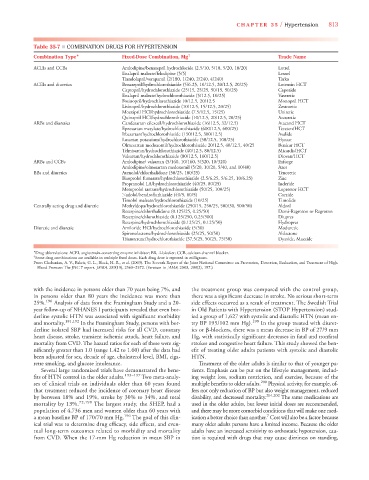
                   Table 35-7 ■ COMBINATION DRUGS FOR HYPERTENSION
                   Combination Type*            Fixed-Dose Combination, Mg †                       Trade Name
                   ACEIs and CCBs               Amlodipine/benazepril hydrochloride (2.5/10, 5/10, 5/20, 10/20)  Lotrel
                                                Enalapril maleate/felodipine (5/5)                 Lexxel
                                                Trandolapril/verapamil (2/180, 1/240, 2/240, 4/240)  Tarka
                   ACEIs and diuretics          Benazepril/hydrochlorothiazide (5/6.25, 10/12.5, 20/12.5, 20/25)  Lotensin HCT
                                                Captopril/hydrochlorothiazide (25/15, 25/25, 50/15, 50/25)  Capozide
                                                Enalapril maleate/hydrochlorothiazide (5/12.5, 10/25)  Vaseretic
                                                Fosinopril/hydrochlorothiazide 10/12.5, 20/12.5    Monopril HCT
                                                Lisinopril/hydrochlorothiazide (10/12.5, 15/12.5, 20/25)  Zestoretic
                                                Moexipril HCl/hydrochlorothiazide (7.5/12.5, 15/25)  Uniretic
                                                Quinapril HCl/hydrochlorothiazide (10/12.5, 20/12.5, 20/25)  Accuretic
                   ARBs and diuretics           Candesartan cilexetil/hydrochlorothiazide (16/12.5, 32/12.5)  Atacand HCT
                                                Eprosartan mesylate/hydrochlorothiazide (600/12.5, 600/25)  Teveten/HCT
                                                Irbesartan/hydrochlorothiazide (150/12.5, 300/12.5)  Avalide
                                                Losartan potassium/hydrochlorothiazide (50/12.5, 100/25)  Hyzaar
                                                Olmesartan medoxomil/hydrochlorothiazide 20/12.5, 40/12.5, 40/25  Benicar HCT
                                                Telmisartan/hydrochlorothiazide (40/12.5, 80/12.5)  Micardis/HCT
                                                Valsartan/hydrochlorothiazide (80/12.5, 160/12.5)  Diovan/HCT
                   ARBs and CCBs                Amlodipine/ valsartan (5/160, 10/160, 5/320, 10/320)  Exforge
                                                Amlodipine/olmesartan medoxomil (5/20, 10/20, 5/40, and 10/40)  Azor
                   BBs and diuretics            Atenolol/chlorthalidone (50/25, 100/25)            Tenoretic
                                                Bisoprolol fumarate/hydrochlorothiazide (2.5/6.25, 5/6.25, 10/6.25)  Ziac
                                                Propranolol LA/hydrochlorothiazide (40/25, 80/25)  Inderide
                                                Metoprolol tartrate/hydrochlorothiazide (50/25, 100/25)  Lopressor HCT
                                                Nadolol/bendrofluthiazide (40/5, 80/5)              Corzide
                                                Timolol maleate/hydrochlorothiazide (10/25)        Timolide
                   Centrally acting drug and diuretic   Methyldopa/hydrochlorothiazide (250/15, 250/25, 500/30, 500/50)  Aldoril
                                                Reserpine/chlorthalidone (0.125/25, 0.25/50)       Demi-Regroton or Regroton
                                                Reserpine/chlorothiazide (0.125/250, 0.25/500)     Diupres
                                                Reserpine/hydrochlorothiazide (0.125/25, 0.125/50)  Hydropres
                   Diuretic and diuretic        Amiloride HCl/hydrochlorothiazide (5/50)           Moduretic
                                                Spironolactone/hydrochlorothiazide (25/25, 50/50)  Aldactone
                                                Triamterene/hydrochlorothiazide (37.5/25, 50/25, 75/50)  Dyazide, Maxzide

                   *Drug abbreviations: ACEI, angiotensin-converting enzyme inhibitor; BB,  -blocker; CCB, calcium channel blocker.
                   † Some drug combinations are available in multiple fixed doses. Each drug dose is reported in milligrams.
                   From Chobanian, A. V., Bakris, G. L., Black, H. R., et al. (2003). The Seventh Report of the Joint National Committee on Prevention, Detection, Evaluation, and Treatment of High
                    Blood Pressure: The JNC 7 report. JAMA, 289(19), 2560–2572. (Erratum in JAMA, 2003, 290(2), 197.)


                   with the incidence in persons older than 70 years being 7%, and  the treatment group was compared with the control group,
                   in persons older than 80 years the incidence was more than  there was a significant decrease in stroke. No serious short-term
                   25%. 190  Analysis of data from the Framingham Study and a 20-  side effects occurred as a result of treatment. The Swedish Trial
                   year follow-up of NHANES I participants revealed that even bor-  in Old Patients with Hypertension (STOP Hypertension) stud-
                   derline systolic HTN was associated with significant morbidity  ied a group of 1,627 with systolic and diastolic HTN (mean en-
                   and mortality. 191,192  In the Framingham Study, persons with bor-  try BP 195/102 mm Hg).  199  In the group treated with diuret-
                   derline isolated SBP had increased risks for all CVD, coronary  ics or  -blockers, there was a mean decrease in BP of 27/9 mm
                   heart disease, stroke, transient ischemic attack, heart failure, and  Hg, with statistically significant decreases in fatal and nonfatal
                   mortality from CVD. The hazard ratios for each of these were sig-  strokes and congestive heart failure. This study showed the ben-
                   nificantly greater than 1.0 (range 1.42 to 1.60) after the data had  efit of treating older adults patients with systolic and diastolic
                   been adjusted for sex, decade of age, cholesterol level, BMI, ciga-  HTN.
                   rette smoking, and glucose intolerance.               Treatment of the older adults is similar to that of younger pa-
                     Several large randomized trials have demonstrated the bene-  tients. Emphasis can be put on the lifestyle management, includ-
                   fits of HTN control in the older adults. 193–197  Two meta-analy-  ing weight loss, sodium restriction, and exercise, because of the
                   ses of clinical trials on individuals older than 60 years found  multiple benefits to older adults. 200 Physical activity, for example, of-
                   that treatment reduced the incidence of coronary heart disease  fers not only reduction of BP but also weight management, reduced
                   by between 18% and 19%, stroke by 30% to 34%, and total  disability, and decreased mortality. 201,202  The same medications are
                   mortality by 13%. 72,198  The largest study, the SHEP, had a  used in the older adults, but lower initial doses are recommended,
                   population of 4,736 men and women older than 60 years with  and there may be more comorbid conditions that will make one med-
                                                                                               7
                   a mean baseline BP of 170/70 mm Hg. 196  The goal of this clin-  ication a better choice than another. Cost will also be a factor because
                   ical trial was to determine drug efficacy, side effects, and even-  many older adults persons have a limited income. Because the older
                   tual long-term outcomes related to morbidity and mortality  adults have an increased sensitivity to orthostatic hypotension, cau-y y
                   from CVD. When the 17-mm Hg reduction in mean SBP in  tion is required with drugs that may cause dizziness on standing,

