


Page 850 - Cardiac Nursing
P. 850
7/1
                                7/2
                              7/1
                             0
                             0
                                7/2
                                     1
                                      0:1
                                     1
                                  009
                                  009
                        41.
                        41.
                        41.
                      3-8
                      3-8
                          q
                           xd
                              0
                           xd
                          q
                          q
                                      0:1
                                                  A
                                                   p
                                                  A
                                                26
                                                26
                                                   p
                                                     ara
                                                     ara
                                                    t
                                                   p
                                                    t
                                          M
                                            Pa
                                          M
                                        7 P
                                        7 P
                                            Pa
                                              e 8
                                              e 8
                                              g
                                              g
                                              g
               0-c
               0-c
                 36_
         LWBK340-c36_ p p pp823-841.qxd  07/17/2009  10:17 PM  Page 826 Aptara
            K34
            K34
                 36_
                    82
                    82
                  826    PA R T  V / Health Promotion and Disease Prevention
                                                                      jor lipoprotein, apo A-I to form incomplete (or nascent) lipid-
                                                                      poor HDL precursors. These precursors acquire excess cholesterol
                                         VLDL                         through a variety of mechanisms outlined below. One early step is
                                                                      the cholesterol efflux from macrophages mediated by the mem-
                                                                      brane protein, adenosine triphosphate binding cassette trans-
                                                                      porter A-1 (ABCA1), one of a family of proteins that transport
                                                                                              32
                                                                      molecules across cell membranes. It is proposed that ABCA1 al-
                            LDL                      VLDL             lows binding with apo A-I in nascent HDL to form more mature
                              p
                          Receptors                 Remnant           HDL particles. 33  Other steps include the action of the enzyme,
                                                                      lecithin cholesterol acyltransferase, which converts free cholesterol
                                                                      in the tissues into an HDL cholesteryl ester core. 34,35  Apo A-I has
                                                                      been shown to activate lecithin cholesterol acyltransferase and
                                                                      may influence the activity of the CETP. CETP facilitates the ex-
                                                                      change of cholesterol esters for the triglycerides in apo B lipopro-
                                         LDL
                           Other Sites                                teins including LDL and VLDL. Apo C-II is a cofactor for LPL.
                                                                                              36
                                                                      In the presence of circulating triglycerides, apo C-II moves from
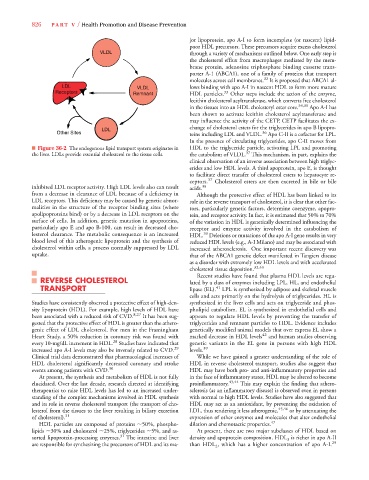
                  ■ Figure 36-2 The endogenous lipid transport system originates in  HDL to the triglyceride particle, activating LPL and promoting
                                                                                        37
                  the liver. LDLs provide essential cholesterol to the tissue cells.  the catabolism of VLDL. This mechanism, in part, explains the
                                                                      clinical observation of an inverse association between high triglyc-
                                                                      erides and low HDL levels. A third apoprotein, apo E, is thought
                                                                      to facilitate direct transfer of cholesterol esters to hepatocyte re-
                                                                      ceptors. 37  Cholesterol esters are then excreted in bile or bile
                  inhibited LDL receptor activity. High LDL levels also can result  acids. 38
                  from a decrease in clearance of LDL because of a deficiency in  Although the protective effect of HDL has been linked to its
                  LDL receptors. This deficiency may be caused by genetic abnor-  role in the reverse transport of cholesterol, it is clear that other fac-
                  malities in the structure of the receptor binding sites (where  tors, particularly genetic factors, determine coenzyme, apopro-
                  apolipoproteins bind) or by a decrease in LDL receptors on the  tein, and receptor activity. In fact, it is estimated that 50% to 70%
                  surface of cells. In addition, genetic mutation in apoproteins,  of the variation in HDL is genetically determined influencing the
                  particularly apo E and apo B-100, can result in decreased cho-  receptor and enzyme activity involved in the catabolism of
                  lesterol clearance. The metabolic consequence is an increased  HDL. Deletions or mutations of the apo A-I gene results in very
                                                                           39
                  blood level of this atherogenic lipoprotein and the synthesis of  reduced HDL levels (e.g., A-I Milano) and may be associated with
                  cholesterol within cells, a process normally suppressed by LDL  increased atherosclerosis.  One important recent discovery was
                  uptake.                                             that of the ABCA1 genetic defect manifested in Tangiers disease
                                                                      as a disorder with extremely low HDL levels and with accelerated
                                                                      cholesterol tissue deposition. 32,40
                                                                        Recent studies have found that plasma HDL levels are regu-
                     REVERSE CHOLESTEROL                              lated by a class of enzymes including LPL, HL, and endothelial
                     TRANSPORT                                        lipase (EL). 41  LPL is synthesized by adipose and skeletal muscle
                                                                      cells and acts primarily on the hydrolysis of triglycerides. HL is
                  Studies have consistently observed a protective effect of high-den-  synthesized in the liver cells and acts on triglyceride and phos-
                  sity lipoprotein (HDL). For example, high levels of HDL have  pholipid catabolism. EL is synthesized in endothelial cells and
                  been associated with a reduced risk of CVD. 8,27  It has been sug-  appears to regulate HDL levels by preventing the transfer of
                  gested that the protective effect of HDL is greater than the athero-  triglycerides and remnant particles to HDL. Evidence includes
                  genic effect of LDL cholesterol. For men in the Framingham  genetically modified animal models that over express EL show a
                  Heart Study, a 50% reduction in coronary risk was found with  marked decrease in HDL levels 42  and human studies observing
                                             28
                  every 10-mg/dL increment in HDL. Studies have indicated that  genetic variants in the EL  gene in persons with high HDL
                  increased apo A-I levels may also be inversely related to CVD. 29  levels. 39
                  Clinical trial data demonstrated that pharmacological increases of  While we have gained a greater understanding of the role of
                  HDL cholesterol significantly  decreased coronary and stroke  HDL in reverse cholesterol transport, studies also suggest that
                  events among patients with CVD. 30                  HDL may have both pro- and anti-inflammatory properties and
                     At present, the synthesis and metabolism of HDL is not fully  in the face of inflammatory states, HDL may be altered to become
                  elucidated. Over the last decade, research directed at identifying  proinflammatory. 43,44  This may explain the finding that athero-
                  therapeutics to raise HDL levels has led to an increased under-  sclerosis (as an inflammatory disease) is observed even in persons
                  standing of the complex mechanisms involved in HDL synthesis  with normal to high HDL levels. Studies have also suggested that
                  and its role in reverse cholesterol transport (the transport of cho-  HDL may act as an antioxidant, by preventing the oxidation of
                  lesterol from the tissues to the liver resulting in biliary excretion  LDL, thus rendering it less atherogenic, 45,46  or by attenuating the
                  of cholesterol). 31                                 expression of other enzymes and molecules that alter endothelial
                     HDL particles are composed of proteins  50%, phospho-  dilation and chemotactic properties. 47
                  lipids  30% and cholesterol  25%, triglycerides  5%, and as-  At present, there are two major subclasses of HDL based on
                  sorted lipoprotein-processing enzymes. 31  The intestine and liver  density and apoprotein composition. HDL 3 is richer in apo A-II
                  are responsible for synthesizing the precursors of HDL and its ma-  than HDL 2 , which has a higher concentration of apo A-I.  29

