


Page 854 - Cardiac Nursing
P. 854
LWBK340-c36_p823-841.qxd  29/06/2009  09:01 PM  Page 830 Aptara


                  830    PA R T  V / Health Promotion and Disease Prevention


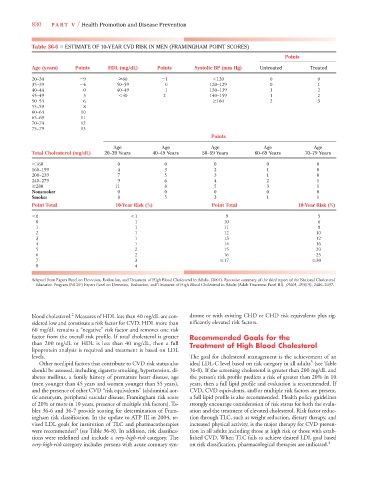
                  Table 36-6 ■ ESTIMATE OF 10-YEAR CVD RISK IN MEN (FRAMINGHAM POINT SCORES)
                                                                                                     Points
                  Age (years)    Points    HDL (mg/dL)     Points       Systolic BP (mm Hg)  Untreated       Treated
                  20–34            9            60            1               120               0               0
                  35–39            4          50–59           0              120–129            0               1
                  40–44            0          40–49           1              130–139            1               2
                  45–49            3            40           2               140–159            1               2
                  50–54            6                                          160               2               3
                  55–59            8
                  60–64           10
                  65–69           11
                  70–74           12
                  75–79           13
                                                                             Points
                                             Age             Age             Age              Age              Age
                  Total Cholesterol (mg/dL)  20–39 Years  40–49 Years     50–59 Years      60–69 Years      70–79 Years
                   160                        0               0               0                0                0
                  160–199                     4               3               2                1                0
                  200–239                     7               5               3                1                0
                  240–279                     9               6               4                2                1
                   280                        11              8               5                3                1
                  Nonsmoker                   0               0               0                0                0
                  Smoker                      8               5               3                1                1
                  Point Total                 10-Year Risk (%)               Point Total                 10-Year Risk (%)
                   0                                1                             9                             5
                    0                               1                            10                             6
                    1                               1                            11                             8
                    2                               1                            12                            10
                    3                               1                            13                            12
                    4                               1                            14                            16
                    5                               2                            15                            20
                    6                               2                            16                            25
                    7                               3                            17                            30
                    8                               4

                  Adapted from Expert Panel on Detection, Evaluation, and Treatment of High Blood Cholesterol in Adults. (2001). Executive summary of the third report of the National Cholesterol
                    Education Program (NCEP) Expert Panel on Detection, Evaluation, and Treatment of High Blood Cholesterol in Adults (Adult Treatment Panel III). JAMA, 285(19), 2486–2497.


                               2
                  blood cholesterol. Measures of HDL less than 40 mg/dL are con-  drome or with existing CHD or CHD risk equivalents plus sig-
                  sidered low and constitute a risk factor for CVD. HDL more than  nificantly elevated risk factors.
                  60 mg/dL remains a “negative” risk factor and removes one risk
                  factor from the overall risk profile. If total cholesterol is greater  Recommended Goals for the
                  than 200 mg/dL or HDL is less than 40 mg/dL, then a full  Treatment of High Blood Cholesterol
                  lipoprotein analysis is required and treatment is based on LDL
                  levels.                                             The goal for cholesterol management is the achievement of an
                                                                                                              3
                     Other nonlipid factors that contribute to CVD risk status also  ideal LDL-C level based on risk category in all adults (see Table
                  should be assessed, including cigarette smoking, hypertension, di-  36-8). If the screening cholesterol is greater than 200 mg/dL and
                  abetes mellitus, a family history of premature heart disease, age  the person’s risk profile predicts a risk of greater than 20% in 10
                  (men younger than 45 years and women younger than 55 years),  years, then a full lipid profile and evaluation is recommended. If
                  and the presence of other CVD “risk equivalents” (abdominal aor-  CVD, CVD equivalents, and/or multiple risk factors are present,
                  tic aneurysm, peripheral vascular disease, Framingham risk score  a full lipid profile is also recommended. Health policy guidelines
                  of 20% or more in 10 years, presence of multiple risk factors). Ta-  strongly encourage consideration of risk status for both the evalu-
                  bles 36-6 and 36-7 provide scoring for determination of Fram-  ation and the treatment of elevated cholesterol. Risk factor reduc-
                  ingham risk classification. In the update to ATP III in 2004, re-  tion through TLC, such as weight reduction, dietary therapy, and
                  vised LDL goals for institution of TLC and pharmacotherapies  increased physical activity, is the major therapy for CVD preven-
                                 3
                  were recommended (see Table 36-8). In addition, risk classifica-  tion in all adults including those at high risk or those with estab-
                  tions were redefined and include a very-high-risk category. The  lished CVD. When TLC fails to achieve desired LDL goal based
                  very-high-risk category includes persons with acute coronary syn-  on risk classification, pharmacological therapies are indicated. 3

