


Page 855 - Cardiac Nursing
P. 855
LWBK340-c36_p823-841.qxd  29/06/2009  09:01 PM  Page 831 Aptara


                                                          C HAP TE R  36 / Lipid Management and Cardiovascular Disease  831


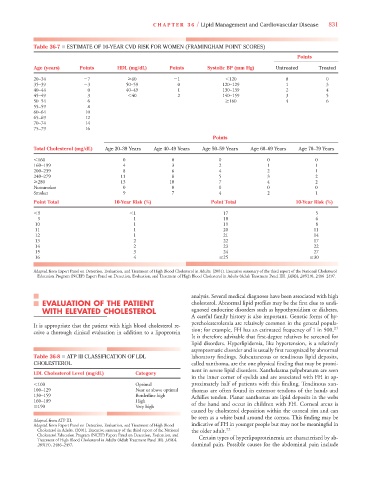
                   Table 36-7 ■ ESTIMATE OF 10-YEAR CVD RISK FOR WOMEN (FRAMINGHAM POINT SCORES)
                                                                                                         Points
                   Age (years)    Points      HDL (mg/dL)      Points       Systolic BP (mm Hg)   Untreated     Treated
                   20–34            7              60             1                120               0             0
                   35–39            3            50–59            0              120–129             1             3
                   40–44             0           40–49            1              130–139             2             4
                   45–49             3             40             2              140–159             3             5
                   50–54             6                                             160               4             6
                   55–59             8
                   60–64            10
                   65–69            12
                   70–74            14
                   75–79            16
                                                                              Points
                   Total Cholesterol (mg/dL)  Age 20–39 Years  Age 40–49 Years  Age 50–59 Years  Age 60–69 Years  Age 70–79 Years
                    160                         0               0               0              0               0
                   160–199                      4               3               2              1               1
                   200–239                      8               6               4              2               1
                   240–279                     11               8               5              3               2
                    280                        13              10               7              4               2
                   Nonsmoker                    0               0               0              0               0
                   Smoker                       9               7               4              2               1
                   Point Total               10-Year Risk (%)                Point Total                 10-Year Risk (%)
                    9                              1                             17                            5
                    9                               1                            18                            6
                   10                               1                            19                            8
                   11                               1                            20                            11
                   12                               1                            21                            14
                   13                               2                            22                            17
                   14                               2                            23                            22
                   15                               3                            24                            27
                   16                               4                            25                           30

                   Adapted from Expert Panel on Detection, Evaluation, and Treatment of High Blood Cholesterol in Adults. (2001). Executive summary of the third report of the National Cholesterol
                    Education Program (NCEP) Expert Panel on Detection, Evaluation, and Treatment of High Blood Cholesterol in Adults (Adult Treatment Panel III). JAMA, 285(19), 2486–2497.


                                                                       analysis. Several medical diagnoses have been associated with high
                      EVALUATION OF THE PATIENT                        cholesterol. Abnormal lipid profiles may be the first clue to undi-
                      WITH ELEVATED CHOLESTEROL                        agnosed endocrine disorders such as hypothyroidism or diabetes.
                                                                       A careful family history is also important. Genetic forms of hy-
                                                                       percholesterolemia are relatively common in the general popula-
                   It is appropriate that the patient with high blood cholesterol re-                                21
                   ceive a thorough clinical evaluation in addition to a lipoprotein  tion; for example, FH has an estimated frequency of 1 in 500.
                                                                       It is therefore advisable that first-degree relatives be screened for
                                                                       lipid disorders. Hyperlipidemia, like hypertension, is a relatively
                                                                       asymptomatic disorder and is usually first recognized by abnormal
                   Table 36-8 ■ ATP III CLASSIFICATION OF LDL          laboratory findings. Subcutaneous or tendinous lipid deposits,
                   CHOLESTEROL                                         called xanthoma, are the one physical finding that may be promi-
                                                                       nent in severe lipid disorders. Xanthelasma palpebrarum are seen
                   LDL Cholesterol Level (mg/dL)    Category
                                                                       in the inner corner of eyelids and are associated with FH in ap-
                    100                             Optimal            proximately half of patients with this finding. Tendinous xan-
                   100–129                          Near or above optimal  thomas are often found in extensor tendons of the hands and
                   130–159                          Borderline high    Achilles tendon. Planar xanthomas are lipid deposits in the webs
                   160–189                          High
                    190                             Very high          of the hand and occur in children with FH. Corneal arcus is
                                                                       caused by cholesterol deposition within the corneal rim and can
                                                                       be seen as a white band around the cornea. This finding may be
                   Adapted from ATP III.
                   Adapted from Expert Panel on Detection, Evaluation, and Treatment of High Blood  indicative of FH in younger people but may not be meaningful in
                    Cholesterol in Adults. (2001). Executive summary of the third report of the National  the older adult. 22
                    Cholesterol Education Program (NCEP) Expert Panel on Detection, Evaluation, and
                    Treatment of High Blood Cholesterol in Adults (Adult Treatment Panel III). JAMA,  Certain types of hyperlipoproteinemia are characterized by ab-
                    285(19), 2486–2497.                                dominal pain. Possible causes for the abdominal pain include

