


Page 852 - Cardiac Nursing
P. 852
LWBK340-c36_p823-841.qxd  29/06/2009  09:01 PM  Page 828 Aptara


                  828    PA R T  V / Health Promotion and Disease Prevention


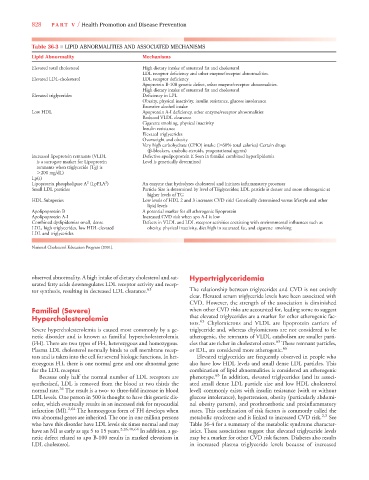
                  Table 36-3 ■ LIPID ABNORMALITIES AND ASSOCIATED MECHANISMS
                  Lipid Abnormality                    Mechanisms
                  Elevated total cholesterol           High dietary intake of saturated fat and cholesterol
                                                       LDL receptor deficiency and other enzyme/receptor abnormalities.
                  Elevated LDL-cholesterol             LDL receptor deficiency
                                                       Apoprotein B-100 genetic defect, other enzyme/receptor abnormalities.
                                                       High dietary intake of saturated fat and cholesterol
                  Elevated triglycerides               Deficiency in LPL
                                                       Obesity, physical inactivity, insulin resistance, glucose intolerance
                                                       Excessive alcohol intake
                  Low HDL                              Apoprotein A-I deficiency, other enzyme/receptor abnormalities
                                                       Reduced VLDL clearance
                                                       Cigarette smoking, physical inactivity
                                                       Insulin resistance
                                                       Elevated triglycerides
                                                       Overweight and obesity
                                                       Very high carbohydrate (CHO) intake ( 60% total calories) Certain drugs
                                                        ( -blockers, anabolic steroids, progestational agents)
                  Increased lipoprotein remnants (VLDL  Defective apolipoprotein E Seen in familial combined hyperlipidemia
                    is a surrogate marker for Lipoprotein   Level is genetically determined
                    remnants when triglyceride (Tg) is
                     200 mg/dL)
                  Lp(a)
                                    2
                                          2
                                   A
                  Lipoprotein phospholipase AA (LpPLAA )  An enzyme that hydrolyzes cholesterol and initiates inflammatory processes
                                         A
                  Small LDL particles                  Particle Size is determined by level of Triglycerides; LDL particle is denser and more atherogenic at
                                                        higher levels of TG
                  HDL Subspecies                       Low levels of HDL 2 and 3 increases CVD risk? Genetically determined versus lifestyle and other
                                                        lipid levels
                  Apolipoprotein B                     A potential marker for all atherogenic lipoprotein
                  Apolipoprotein A-I                   Increased CVD risk when apo A-I is low
                  Combined dyslipidemias small, dense   Defects in VLDL and LDL receptor activities coexisting with environmental influences such as
                  LDL, high triglycerides, low HDL elevated   obesity, physical inactivity, diet high in saturated fat, and cigarette  smoking
                  LDL and triglycerides
                  National Cholesterol Education Program (2001).


                  observed abnormality. A high intake of dietary cholesterol and sat-  Hypertriglyceridemia
                  urated fatty acids downregulates LDL receptor activity and recep-
                  tor synthesis, resulting in decreased LDL clearance. 63  The relationship between triglycerides and CVD is not entirely
                                                                      clear. Elevated serum triglyceride levels have been associated with
                                                                      CVD. However, the strength of the association is diminished
                  Familial (Severe)                                   when other CVD risks are accounted for, leading some to suggest
                  Hypercholesterolemia                                that elevated triglycerides are a marker for other atherogenic fac-
                                                                      tors. 65  Chylomicrons and  VLDL are lipoprotein carriers of
                  Severe hypercholesterolemia is caused most commonly by a ge-  triglyceride and, whereas chylomicrons are not considered to be
                  netic disorder and is known as familial hypercholesterolemia  atherogenic, the remnants of VLDL catabolism are smaller parti-
                                                                                                  65
                  (FH). There are two types of FH, heterozygous and homozygous.  cles that are richer in cholesterol esters. These remnant particles,
                  Plasma LDL cholesterol normally binds to cell membrane recep-  or IDL, are considered more atherogenic. 66
                  tors and is taken into the cell for several biologic functions. In het-  Elevated triglycerides are frequently observed in people who
                  erozygous FH, there is one normal gene and one abnormal gene  also have low HDL levels and small dense LDL particles. This
                  for the LDL receptor.                               combination of lipid abnormalities is considered an atherogenic
                     Because only half the normal number of LDL receptors are  phenotype. 65  In addition, elevated triglycerides (and its associ-
                  synthesized, LDL is removed from the blood at two thirds the  ated small dense LDL particle size and low HDL cholesterol
                           26
                  normal rate. The result is a two- to three-fold increase in blood  level) commonly exists with insulin resistance (with or without
                  LDL levels. One person in 500 is thought to have this genetic dis-  glucose intolerance), hypertension, obesity (particularly abdomi-
                  order, which eventually results in an increased risk for myocardial  nal obesity pattern), and prothrombotic and proinflammatory
                  infarction (MI). 2,64  The homozygous form of FH develops when  states. This combination of risk factors is commonly called the
                  two abnormal genes are inherited. The one in one million persons  metabolic syndrome and is linked to increased CVD risk. 2,3  See
                  who have this disorder have LDL levels six times normal and may  Table 36-4 for a summary of the metabolic syndrome character-
                  have an MI as early as age 5 to 15 years. 2,26,48,64  In addition, a ge-  istics. These associations suggest that elevated triglyceride levels
                  netic defect related to apo B-100 results in marked elevations in  may be a marker for other CVD risk factors. Diabetes also results
                  LDL cholesterol.                                    in increased plasma triglyceride  levels  because of increased

