


Page 876 - Cardiac Nursing
P. 876
LWBK340-c37_p842-860.qxd  29/06/2009  09:40 PM  Page 852 Aptara


                  852    PA R T  V / Health Promotion and Disease Prevention

                  typical patient must be progressed more rapidly, and a greater em-  and recognition of the need for medications or interventions. 68  It
                  phasis must be placed on education, because exercise progression  can also have a beneficial psychological impact on recovery and
                  will often need to be accomplished independently by the patient.  begins the rehabilitation process. The test is considered the first
                     While performing a program of education and increasing ac-  step in the outpatient cardiac rehabilitation exercise program. The
                  tivity for the inpatient, measurable objectives should be estab-  prognostic value of the predischarge test has been debated. Meta-
                  lished that are general and specific to each patient. Some examples  analysis has shown that a low exercise capacity or abnormal sys-
                  of these objectives might include having the patient:  tolic blood pressure responses are better predictors of increased
                                                                      risk than is ST-segment depression. 69  However, ST-segment de-
                  ■ Ambulate 1,000 ft around the unit two to three times per day
                                                                      pression probably indicates increased risk in men who do not use
                    before discharge
                                                                      digoxin and whose resting ECGs do not show extensive damage.
                  ■ Measure HR and relate RPE to activities performed
                                                                      The criterion of 2.0 mm or more ST-segment depression along
                  ■ Climb a flight of stairs without undue symptoms
                                                                      with symptoms or abnormal hemodynamic responses appears to
                  ■ Relate upper extremity activity guidelines (sternal guidelines)
                                                                      be useful for identifying higher risk patients who should be con-
                    after cardiac surgery
                                                                      sidered for cardiac catheterization and revascularization.
                  ■ Perform self-care ADLs
                  ■ Relate plans for resuming other ADLs (i.e., driving, sexual rela-
                    tions, and other strenuous life activities)       Return to Work and
                  ■ Relate plan to perform walking or other exercise program at
                                                                      Recreational Activities
                    home
                                                                      The economic burden of cardiovascular disability has been enor-
                     Although the progressive stepped concept has been widely  mous, and a great deal of effort has been directed toward voca-
                  used, approaches to increasing activity can differ considerably be-  tional rehabilitation. Postdischarge activity recommendations,
                  tween programs and between patients. Inpatient activities should  including determination of disability, are among the biggest
                  be individualized and can be specific to common activities the pa-  challenges  facing the  health care provider. Historically, the
                  tient performs, in addition to walking. Because hospital stays have  patient’s ability to return to work, to drive, and to be sexually
                  become shorter (3 to 5 days), it can be important to modify the  active have been based on clinical judgments rather than on
                  inpatient program rapidly based on an individual patient’s clinical  physiologic assessments. These decisions should be based on the
                  status and needs.
                                                                      consequence of the coronary event (e.g., ischemia, symptoms of
                                                                      CHF, or dysrhythmias), the nature of the patient’s occupational
                  Exercise Testing Before                             or recreational activities, and the response to the predischarge
                  Hospital Discharge                                  exercise test.
                                                                        In general, if patients do not exhibit any untoward responses
                  The exercise test after an acute MI has been shown to be safe.  to submaximal exercise testing and achieve 5 or more METs, it is
                  When performed before discharge, it should be submaximal (e.g.,  unlikely that they will encounter difficulties during ADLs. More
                  limited to 5 or 6 METs) and should not exceed a Borg Scale level  strenuous jobs or recreational pursuits should not be initiated un-
                  of 16. In many hospitals, a submaximal target HR is used (e.g.,  til a symptom-limited exercise test can be performed and exercise
                  110 beats per minute for patients using  -blockers). The protocol  capacity can be determined and related to the desired physical ac-
                  should be modified, given the reduced exercise tolerance of most  tivities of the patient.
                  patients recovering from an MI; individualized ramp or Naughton  Factors that influence a patient’s return to work include age,
                  protocols are preferable. An example of a typical submaximal pro-  work history, severity of cardiac damage, financial compensation
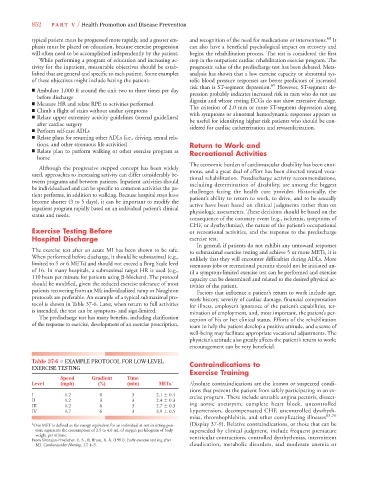
                  tocol is shown in Table 37-6. Later, when return to full activities  for illness, employer’s ignorance of the patient’s capabilities, ter-
                  is intended, the test can be symptom- and sign-limited.  mination of employment, and, most important, the patient’s per-
                     The predischarge test has many benefits, including clarification  ception of his or her clinical status. Efforts of the rehabilitation
                  of the response to exercise, development of an exercise prescription,  team to help the patient develop a positive attitude, and a sense of
                                                                      well-being may facilitate appropriate vocational adjustments. The
                                                                      physician’s attitude also greatly affects the patient’s return to work;
                                                                      encouragement can be very beneficial.


                  Table 37-6 ■ EXAMPLE PROTOCOL FOR LOW-LEVEL         Contraindications to
                  EXERCISE TESTING
                                                                      Exercise Training
                            Speed     Gradient    Time
                  Level     (mph)       (%)       (min)     METs*     Absolute contraindications are the known or suspected condi-
                                                                      tions that prevent the patient from safely participating in an ex-
                  I          1.2         0         3       2.1   0.4  ercise program. These include unstable angina pectoris, dissect-
                  II         1.2         3         3       2.4   0.3
                  III        1.2         6         3       2.7   0.3  ing aortic aneurysm, complete heart block, uncontrolled
                  IV         1.7         6         3       3.9   0.5  hypertension, decompensated CHF, uncontrolled dysrhyth-
                                                                      mias, thrombophlebitis, and other complicating illnesses 65,70
                  *One MET is defined as the energy equivalent for an individual at rest in sitting posi-  (Display 37-9). Relative contraindications, or those that can be
                    tion; represents the consumption of 3.5 to 4.0 mL of oxygen per kilogram of body  superseded by clinical judgment, include frequent premature
                    weight per minute.
                  From Sivarajan-Froelicher, E. S., & Bruce, R. A. (1981). Early exercise test ing after  ventricular contractions, controlled dysrhythmias, intermittent
                    MI. Cardiovascular Nursing, 17, 1–5.7 7           claudication, metabolic disorders, and moderate anemia or

