


Page 875 - Cardiac Nursing
P. 875
LWBK340-c37_p842-860.qxd  29/06/2009  09:40 PM  Page 851 Aptara


                                                                               C HAP TE R  37 / Exercise and Activity  851

                                                                       ■ To offset the deleterious physiologic and psychological effects of
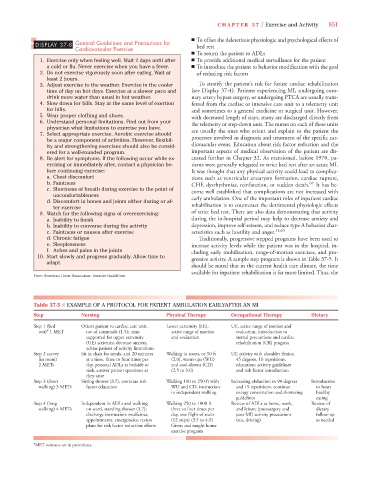
                    DISPLAY 37-8  General Guidelines and Precautions for  bed rest
                                 Cardiovascular Exercise
                                                                       ■ To return the patient to ADLs
                     1. Exercise only when feeling well. Wait 2 days until after  ■ To provide additional medical surveillance for the patient
                       a cold or flu. Never exercise when you have a fever.  ■ To introduce the patient to behavior modification with the goal
                     2. Do not exercise vigorously soon after eating. Wait at  of reducing risk factors
                       least 2 hours.
                     3. Adjust exercise to the weather. Exercise in the cooler  To stratify the patient’s risk for future cardiac rehabilitation
                       time of day on hot days. Exercise at a slower pace and  (see Display 37-4). Patients experiencing MI, undergoing coro-
                       drink more water than usual in hot weather.     nary artery bypass surgery, or undergoing PTCA are usually trans-
                     4. Slow down for hills. Stay at the same level of exertion  ferred from the cardiac or intensive care unit to a telemetry unit
                       for hills.                                      and sometimes to a general medicine or surgical unit. However,
                     5. Wear proper clothing and shoes.                with decreased length of stays, many are discharged directly from
                     6. Understand personal limitations. Find out from your  the telemetry or step-down unit. The nurses on each of these units
                       physician what limitations to exercise you have.
                     7. Select appropriate exercise. Aerobic exercise should  are usually the ones who orient and explain to the patient the
                       be a major component of activities. However, flexibil-  processes involved in diagnosis and treatment of the specific car-
                       ity and strengthening exercises should also be consid-  diovascular event. Education about risk factor reduction and the
                       ered for a well-rounded program.                important aspects of medical observation of the patient are dis-
                     8. Be alert for symptoms. If the following occur while ex-  cussed further in Chapter 32. As mentioned, before 1970, pa-
                       ercising or immediately after, contact a physician be-  tients were generally relegated to strict bed rest after an acute MI.
                       fore continuing exercise:                       It was thought that any physical activity could lead to complica-
                       a. Chest discomfort                             tions such as ventricular aneurysm formation, cardiac rupture,
                       b. Faintness                                    CHF, dysrhythmias, reinfarction, or sudden death. 67  It has be-
                       c. Shortness of breath during exercise to the point of  come well established that complications are not increased with
                         uncomfortableness
                       d. Discomfort in bones and joints either during or af-  early ambulation. One of the important roles of inpatient cardiac
                         ter exercise                                  rehabilitation is to counteract the detrimental physiologic effects
                     9. Watch for the following signs of overexercising:  of strict bed rest. There are also data demonstrating that activity
                       a. Inability to finish                           during the in-hospital period may help to decrease anxiety and
                       b. Inability to converse during the activity    depression, improve self-esteem, and reduce type A behavior char-
                       c. Faintness or nausea after exercise           acteristics such as hostility and anger. 11,65
                       d. Chronic fatigue                                Traditionally, progressive stepped programs have been used to
                       e. Sleeplessness                                increase activity levels while the patient was in the hospital, in-
                       f. Aches and pains in the joints                cluding early mobilization, range-of-motion exercises, and pro-
                    10. Start slowly and progress gradually. Allow time to  gressive activity. A sample step program is shown in Table 37-5. It
                       adapt.
                                                                       should be noted that in the current health care climate, the time
                                                                       available for inpatient rehabilitation is far more limited. Thus, the
                   From American Heart Association: Exercise Guidelines.


                   Table 37-5 ■ EXAMPLE OF A PROTOCOL FOR PATIENT AMBULATION EARLYAFTER AN MI
                   Step            Nursing                    Physical Therapy      Occupational Therapy      Dietary
                   Step 1 (bed     Orient patient to cardiac care unit,   Lower extremity (LE),   UE, active range of motion and
                     rest)* 1 MET   use of commode (1.5); arms   active range of motion   evaluation, introduction to
                                    supported for upper extremity   and evaluation   sternal precautions and cardiac
                                    (UE) activities, decrease anxiety,               rehabilitation (CR) progress
                                    advise patient of activity limitations
                   Step 2 survey   Sit in chair for meals, and 20 minutes   Walking in room, or 50 ft   UE activity with shoulder flexion
                     (in room)      at a time, three to four times per   (2.0), warm-ups (WU)   45 degrees, 10 repetitions,
                     2 METs         day, personal ADLs at bedside or   and cool-downs (CD)   education: activity guidelines
                                    sink, answer patient questions as   (2.5 to 3.0)  and risk factor introduction
                                    they arise
                   Step 3 (short   Sitting shower (3.5), continue risk  Walking 100 to 250 ft with  Increasing abduction to 90 degrees  Introduction
                     walking) 3 METs  factor education          WU and CD, instruction   and 15 repetitions, continue   to heart
                                                                in independent walking  energy conservation and showering  healthy
                                                                                     guidelines                eating
                   Step 4 (long    Independent in ADLs and walking  Walking 250 to 1000 ft  Review of ADLs at home, work,  Review of
                     walking) 4 METs  on ward, standing shower (3.7);   three to four times per   and leisure (postsurgery and   dietary
                                    discharge instruction: medicines,  day, one flight of stairs   post-MI) activity precautions   follow-up
                                    appointments, emergencies, review  (12 steps) (3.5 to 4.0)   (sex, driving)  as needed
                                    plans for risk factor reduction efforts  Given and taught home
                                                                exercise program

                   *MET estimates are in parentheses.

