


Page 874 - Cardiac Nursing
P. 874
LWBK340-c37_p842-860.qxd  29/06/2009  09:40 PM  Page 850 Aptara


                  850    PA R T  V / Health Promotion and Disease Prevention


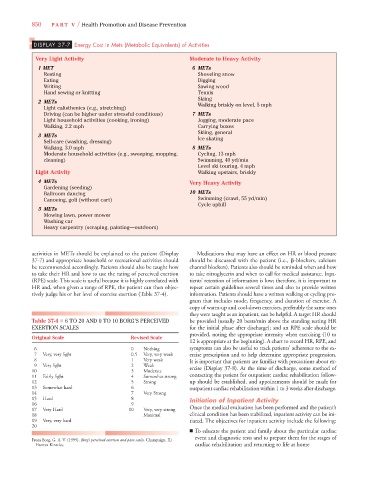
                   DISPLAY 37-7 Energy Cost in Mets (Metabolic Equivalents) of Activities

                    Very Light Activity                               Moderate to Heavy Activity
                    1 MET                                              6 METs
                      Resting                                            Shoveling snow
                      Eating                                             Digging
                      Writing                                            Sawing wood
                      Hand sewing or knitting                            Tennis
                                                                         Skiing
                    2 METs                                               Walking briskly on level, 5 mph
                      Light calisthenics (e.g., stretching)
                      Driving (can be higher under stressful conditions)  7 METs
                      Light household activities (cooking, ironing)      Jogging, moderate pace
                      Walking, 2.2 mph                                   Carrying boxes
                                                                         Skiing, general
                    3 METs                                               Ice skating
                      Self-care (washing, dressing)
                      Walking, 3.0 mph                                 8 METs
                      Moderate household activities (e.g., sweeping, mopping,  Cycling, 13 mph
                      cleaning)                                          Swimming, 40 yd/min
                                                                         Level ski touring, 4 mph
                    Light Activity                                       Walking upstairs, briskly
                    4 METs                                            Very Heavy Activity
                      Gardening (seeding)
                      Ballroom dancing                                10 METs
                      Canoeing, golf (without cart)                      Swimming (crawl, 55 yd/min)
                                                                         Cycle uphill
                    5 METs
                      Mowing lawn, power mower
                      Washing car
                      Heavy carpentry (scraping, painting—outdoors)


                  activities in METs should be explained to the patient (Display   Medications that may have an effect on HR or blood pressure
                  37-7) and appropriate household or recreational activities should  should be discussed with the patient (i.e.,  -blockers, calcium
                  be recommended accordingly. Patients should also be taught how  channel blockers). Patients also should be reminded when and how
                  to take their HR and how to use the rating of perceived exertion  to take nitroglycerin and when to call for medical assistance. Inpa-
                  (RPE) scale. This scale is useful because it is highly correlated with  tients’ retention of information is low; therefore, it is important to
                  HR and, when given a range of RPE, the patient can then objec-  repeat certain guidelines several times and also to provide written
                  tively judge his or her level of exercise exertion (Table 37-4).  information. Patients should have a written walking or cycling pro-
                                                                      gram that includes mode, frequency, and duration of exercise. A
                                                                      copy of warm-up and cool-down exercises, preferably the same ones
                                                                      they were taught as an inpatient, can be helpful. A target HR should
                  Table 37-4 ■ 6 TO 20 AND 0 TO 10 BORG’S PERCEIVED   be provided (usually 20 beats/min above the standing resting HR
                  EXERTION SCALES                                     for the initial phase after discharge); and an RPE scale should be
                                                                      provided, noting the appropriate intensity when exercising (10 to
                  Original Scale                   Revised Scale
                                                                      12 is appropriate at the beginning). A chart to record HR, RPE, and
                   6                               0   Nothing        symptoms can also be useful to track patients’ adherence to the ex-
                   7  Very, very light             0.5  Very, very weak  ercise prescription and to help determine appropriate progression.
                   8                               1   Very weak      It is important that patients are familiar with precautions about ex-
                   9  Very light                   2   Weak
                  10                               3   Moderate       ercise (Display 37-8). At the time of discharge, some method of
                  11  Fairly light                 4   Somewhat strong  contacting the patient for outpatient cardiac rehabilitation follow-
                  12                               5   Strong         up should be established, and appointments should be made for
                  13  Somewhat hard                6                  outpatient cardiac rehabilitation within 1 to 3 weeks after discharge.
                  14                               7   Very Strong
                  15  Hard                         8                  Initiation of Inpatient Activity
                  16                               9
                  17  Very Hard                   10   Very, very strong  Once the medical evaluation has been performed and the patient’s
                  18                                   Maximal        clinical condition has been stabilized, inpatient activity can be ini-
                  19  Very, very hard                                 tiated. The objectives for inpatient activity include the following:
                  20
                                                                      ■ To educate the patient and family about the particular cardiac
                                                                        event and diagnostic tests and to prepare them for the stages of
                  From Borg, G. A. V. (1999). Borg’s perceived exertion and pain scales. Champaign, IL:
                    Human Kinetics.                                     cardiac rehabilitation and returning to life at home

