


Page 873 - Cardiac Nursing
P. 873
9:4
                                               0 P
                                                  M
                                             9:4
                                        009
                                        009
                                            0
                                                            Apt
                                                              ar
                                                                a
                                                         49
                                                    Pa
                                                      g
                                                       e 8
                                 2
                               d
                             qx
                                  9
                                    0
                                   /
                                  9
                                     6
                     p84
                                       2
                        2-8
                          60.
                          60.
                        2-8
            K34
                0-c
                  37_
            K34
         LWBK340-c37_p842-860.qxd  29/06/2009  09:40 PM  Page 849 Aptara
         LWB K34 0-c 37_ p84 2-8 60. qx d  2 9 / 0 6 / / 2 009  0 9:4 0 P M  Pa g e 8 49  Apt ar a
         LWB
                                                                               C HAPTER  37 / Exercise and Activity  849
                                                                       differ. In addition, nearly all patients will have one or more co-
                    DISPLAY 37-5  Characteristics that Classify an MI as  morbidities, and any of these may require different clinical con-
                                 Being Complicated
                                                                       siderations and may also have a different psychosocial impact. For
                    • Congestive heart failure                         example, an increasing percentage of patients today will have obe-
                    • Cardiogenic shock                                sity, diabetes, or both, and many will have musculoskeletal prob-
                    • Large MI—as determined by creatine phosphokinase,  lems or other metabolic disorders. Triaging or management of
                      troponin, and/or ECG                             these comorbidities often is within the purview of the cardiac
                    •Pericarditis                                      rehabilitation team.
                    • Dangerous arrhythmias, including conduction problems.
                    • Concurrent illnesses                             Education of the Patient
                    • Pulmonary embolus
                    • Continued ischemia                               Education should be initiated before physical activities are begun;
                    • Stroke or transient ischemic attack              the patient may lack self-confidence and need affirmation that the
                                                                       activities are safe. Patient education during the acute phase usually
                                                                       consists of an explanation of the coronary care unit, the cardiac
                                                                       rehabilitation program, and the delivery of routine diagnostic and
                                                                       therapeutic modalities. The patient should be educated about the
                   among those with uncomplicated MIs. The most important clin-  limitations imposed by the disease, the potential for improve-
                   ical predictors of complicated infarctions have been previous MI  ment, and precautions to be observed. The program should be
                   and the presence of CHF and/or cardiogenic shock. It is possible  individualized for the patient depending on his or her clinical
                   to assess risk at different temporal points, from presentation in the  and psychosocial status. The medical status is determined largely
                   emergency department through the coronary care unit, as well as  by the severity of the MI, but the medical history must also be
                   before discharge and during later follow-up. This is important be-  considered.
                   cause the clinical picture can change over time; a low-risk patient  The activity and exercise component of inpatient education
                   can become a high-risk patient and vice versa. These changes in  should involve teaching patients about activities they can do, as
                   risk are partially caused by the vicissitudes of the atherosclerosis  well as those they should be more cautious in doing, during the
                   process, reformation of thrombus, interventions, and disease–host  first few weeks of their rehabilitation. This differs somewhat be-
                   interactions. For instance, a patient may present with premature  tween patients having cardiac surgery versus those with MI. The
                   ventricular contractions that can then disappear or worsen, chest  activity limitations after cardiac surgery involve sternal precau-
                   pain may come and go, the ECG may change, or the enzymes  tions and psychological adjustment to a major surgery. Those ac-
                   may have a late peak. This makes it difficult to classify a patient  tivities that put stress on the sternal incision are listed in Display
                   strictly as high- or low-risk; risk stratification often requires good  37-6. It is advisable for cardiac surgery patients to wait at least 4
                   judgment by the patient’s physician, along with that of the nurs-  to 6 weeks before driving a vehicle, partly because the sternal in-
                   ing staff. In addition, indicators signifying progress or regression  cision would be at risk in an impact. There is also some cognitive
                   of the patient’s condition can change quickly during hospitaliza-  adjustment that needs to take place after a major surgery before
                   tion. Importantly, any change in clinical status must be consid-  the patient’s reflexes are fully intact. Patients with MI have slightly
                   ered before initiating physical activity. The pace of rehabilitative  different reasons for activity limitations. It may be necessary to re-
                   steps must often be adjusted for a particular patient.  turn to activities gradually because of the added work placed on
                                                                       the healing myocardium. As mentioned, early mobilization of the
                   Psychosocial Considerations                         patient with acute MI is now well accepted; however, there are im-
                   Hospital admission for an acute MI is a stressful experience with  portant reasons to avoid sudden increases in myocardial oxygen
                   a powerful impact. However, hospital discharge can be equally  demand during the first few weeks of rehabilitation. In addition,
                   stressful after the patient has relied on the highly protective hos-  those patients who have undergone PTCA and stent placement
                   pital support systems. Discharge into an uncertain future and into  are often cautioned to refrain from strenuous activity for a some-
                   a home and work setting in which the patient may be considered  what longer period, for example, approximately 6 weeks. A maxi-
                   a helpless invalid can be as damaging to the patient’s self-esteem  mal exercise test is usually postponed until that time as well.
                   as the acute event itself. The nurse is faced with the difficult tasks  Patients should understand that the conditioning program for
                   of not only supervising the physical recovery of the patient but  patients after MI and surgery should be gradual. Those in a walk-
                   also maintaining morale, providing education, helping the family  ing program are usually instructed to continue the walking they
                   cope, providing support, and facilitating the return to a gratifying  have been doing in the hospital. In addition, the energy cost of
                   lifestyle. Studies have shown that psychosocial interventions, in-
                   cluding such things as counseling, group therapy, behavior modi-
                   fication, stress management, and relaxation techniques, are effec-
                   tive in improving psychological well-being, reducing stress, and
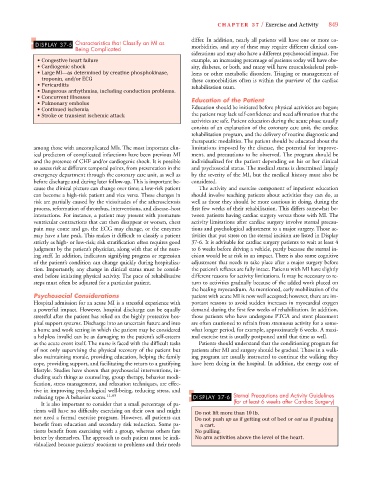
                   reducing type A behavior scores. 11,65              DISPLAY 37-6  Sternal Precautions and Activity Guidelines
                     It is also important to consider that a small percentage of pa-  (for at least 6 weeks after Cardiac Surgery)
                   tients will have no difficulty exercising on their own and might  Do not lift more than 10 lb.
                   not need a formal exercise program. However, all patients can  Do not push up as if getting out of bed or out as if pushing
                   benefit from education and secondary risk reduction. Some pa-  a cart.
                   tients benefit from exercising with a group, whereas others fare  No pulling.
                   better by themselves. The approach to each patient must be indi-  No arm activities above the level of the heart.
                   vidualized because patients’ reactions to problems and their needs

