


Page 204 - Color Atlas Of Pathophysiology (S Silbernagl Et Al, Thieme 2000)
P. 204
Mitral Stenosis
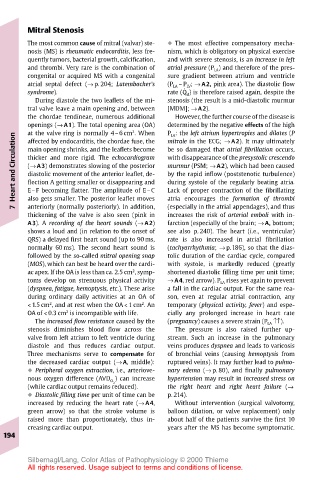
       The most common cause of mitral (valvar) ste-  ! The most effective compensatory mecha-
       nosis (MS) is rheumatic endocarditis, less fre-  nism, which is obligatory on physical exercise
       quently tumors, bacterial growth, calcification,  and with severe stenosis, is an increase in left
       and thrombi. Very rare is the combination of  atrial pressure (P LA ) and therefore of the pres-
       congenital or acquired MS with a congenital  sure gradient between atrium and ventricle
       atrial septal defect (→ p. 204; Lutembacher’s  (P LA – P LV ; → A2, pink area). The diastolic flow
       syndrome).                      rate (Q ˙ ) is therefore raised again, despite the
                                           d
         During diastole the two leaflets of the mi-  stenosis (the result is a mid-diastolic murmur
       tral valve leave a main opening and, between  [MDM]; → A2).
       the chordae tendineae, numerous additional  However, the further course of the disease is
       openings (→ A1). The total opening area (OA)  determined by the negative effects of the high
                                       P LA : the left atrium hypertropies and dilates (P
                               2
       at the valve ring is normally 4–6 cm . When
    Heart and Circulation  main opening shrinks, and the leaflets become  be so damaged that atrial fibrillation occurs,
                                       mitrale in the ECG; → A2). It may ultimately
       affected by endocarditis, the chordae fuse, the
                                       with disappearance of the presystolic crescendo
       thicker and more rigid. The echocardiogram
       (→ A3) demonstrates slowing of the posterior
                                       murmur (PSM; → A2), which had been caused
                                       by the rapid inflow (poststenotic turbulence)
       diastolic movement of the anterior leaflet, de-
       flection A getting smaller or disappearing and
                                       during systole of the regularly beating atria.
                                       atria encourages the formation of thrombi
       also gets smaller. The posterior leaflet moves
                                       (especially in the atrial appendages), and thus
       anteriorly (normally posteriorly). In addition,
    7  E–F becoming flatter. The amplitude of E–C  Lack of proper contraction of the fibrillating
       thickening of the valve is also seen (pink in  increases the risk of arterial emboli with in-
       A3). A recording of the heart sounds (→ A2)  farction (especially of the brain; → A, bottom;
       shows a loud and (in relation to the onset of  see also p. 240). The heart (i.e., ventricular)
       QRS) a delayed first heart sound (up to 90 ms,  rate is also increased in atrial fibrillation
       normally 60 ms). The second heart sound is  (tachyarrhythmia; → p.186), so that the dias-
       followed by the so-called mitral opening snap  tolic duration of the cardiac cycle, compared
       (MOS), which can best be heard over the cardi-  with systole, is markedly reduced (greatly
                               2
       ac apex. If the OA is less than ca. 2.5 cm , symp-  shortened diastolic filling time per unit time;
       toms develop on strenuous physical activity  → A4, red arrow). P LA rises yet again to prevent
       (dyspnea, fatigue, hemoptysis, etc.). These arise  a fall in the cardiac output. For the same rea-
       during ordinary daily activities at an OA of  son, even at regular atrial contraction, any
            2
                                 2
       < 1.5 cm , and at rest when the OA < 1 cm . An  temporary (physical activity, fever) and espe-
                2
       OA of < 0.3 cm is incompatible with life.  cially any prolonged increase in heart rate
         The increased flow resistance caused by the  (pregnancy) causes a severe strain (P LA ↑↑).
       stenosis diminishes blood flow across the  The pressure is also raised further up-
       valve from left atrium to left ventricle during  stream. Such an increase in the pulmonary
       diastole and thus reduces cardiac output.  veins produces dyspnea and leads to varicosis
       Three mechanisms serve to compensate for  of bronchial veins (causing hemoptysis from
       the decreased cardiac output (→ A, middle):  ruptured veins). It may further lead to pulmo-
       ! Peripheral oxygen extraction, i.e., arteriove-  nary edema (→ p. 80), and finally pulmonary
       nous oxygen difference (AVD O ) can increase  hypertension may result in increased stress on
                          2
       (while cardiac output remains reduced).  the right heart and right heart failure (→
       ! Diastolic filling time per unit of time can be  p. 214).
       increased by reducing the heart rate (→ A4,  Without intervention (surgical valvotomy,
       green arrow) so that the stroke volume is  balloon dilation, or valve replacement) only
       raised more than proportionately, thus in-  about half of the patients survive the first 10
       creasing cardiac output.        years after the MS has become symptomatic.
  194
       Silbernagl/Lang, Color Atlas of Pathophysiology © 2000 Thieme
       All rights reserved. Usage subject to terms and conditions of license.

