


Page 218 - Color Atlas Of Pathophysiology (S Silbernagl Et Al, Thieme 2000)
P. 218
Hypertension
       Hypertension (H.), used as a term by itself,  nism). Similarly, an increase in sympathetic ac-
       refers to an abnormally high arterial pressure  tivity of central nervous system origin and/or
       in the systemic circulation (for pulmonary  raised responsiveness to catecholamines (e.g.,
       hypertension, → p. 214). In the industrialized  caused by cortisol or thyroid hormone) can
       countries it affects about 20% of the popula-  cause an increase in cardiac output (→ A, left).
       tion. As H. almost always begins insidiously,  Resistance hypertension is caused mainly
       yet can be treated effectively, the upper limit  by abnormally high peripheral vasoconstriction
       of normal blood pressure needs to be deter-  (arterioles) or some other narrowing of pe-
       mined. The World Health Organisation (WHO)  ripheral vessels (→ A, right), but may also be
       has proposed the following values for all age  due to an increased blood viscosity (increased
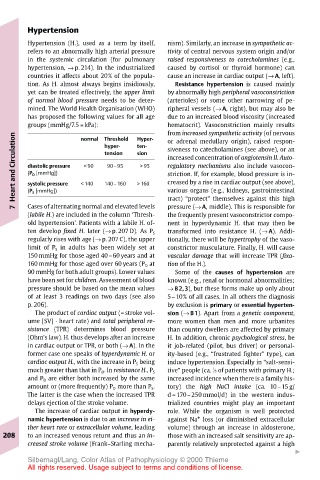
       groups (mmHg/7.5 = kPa):  Threshold  Hyper-  hematocrit). Vasoconstriction mainly results
                                       from increased sympathetic activity (of nervous
    Heart and Circulation  diastolic pressure  < 140  tension  sion  siveness to catecholamines (see above), or an
                   normal
                                       or adrenal medullary origin), raised respon-
                                ten-
                         hyper-
                                       increased concentration of angiotensin II. Auto-
                                       regulatory mechanisms also include vasocon-
                                 > 95
                    < 90
                         90–95
       (P D [mmHg])
                                       striction. If, for example, blood pressure is in-
                                       creased by a rise in cardiac output (see above),
                         140–160
                                > 160
       systolic pressure
                                       tract) “protect” themselves against this high
       Cases of alternating normal and elevated levels
                                       pressure (→ A, middle). This is responsible for
    7  (P S [mmHg])                    various organs (e.g., kidneys, gastrointestinal
       (labile H.) are included in the column ‘Thresh-  the frequently present vasoconstrictor compo-
       old hypertension’. Patients with a labile H. of-  nent in hyperdynamic H. that may then be
                                       transformed into resistance H. (→ A). Addi-
       ten develop fixed H. later (→ p. 207 D). As P S
       regularly rises with age (→ p. 207 C), the upper  tionally, there will be hypertrophy of the vaso-
       limit of P S in adults has been widely set at  constrictor musculature. Finally, H. will cause
       150 mmHg for those aged 40–60 years and at  vascular damage that will increase TPR (fixa-
       160 mmHg for those aged over 60 years (P D at  tion of the H.).
       90 mmHg for both adult groups). Lower values  Some of the causes of hypertension are
       have been set for children. Assessment of blood  known (e.g., renal or hormonal abnormalities;
       pressure should be based on the mean values  → B2,3), but these forms make up only about
       of at least 3 readings on two days (see also  5–10% of all cases. In all others the diagnosis
       p. 206).                        by exclusion is primary or essential hyperten-
         The product of cardiac output (= stroke vol-  sion (→ B1). Apart from a genetic component,
       ume [SV] · heart rate) and total peripheral re-  more women than men and more urbanites
       sistance (TPR) determines blood pressure  than country dwellers are affected by primary
       (Ohm’s law). H. thus develops after an increase  H. In addition, chronic psychological stress, be
       in cardiac output or TPR, or both (→ A). In the  it job-related (pilot, bus driver) or personal-
       former case one speaks of hyperdynamic H. or  ity-based (e.g., “frustrated fighter” type), can
       cardiac output H., with the increase in P S being  induce hypertension. Especially in “salt-sensi-
                                       tive” people (ca. ⁄3 of patients with primary H.;
                                                 1
       much greater than that in P D . In resistance H., P S
       and P D are either both increased by the same  increased incidence when there is a family his-
       amount or (more frequently) P D more than P S .  tory) the high NaCl intake (ca. 10–15 g/
       The latter is the case when the increased TPR  d = 170–250 mmol/d) in the western indus-
       delays ejection of the stroke volume.  trialized countries might play an important
         The increase of cardiac output in hyperdy-  role. While the organism is well protected
                                             +
       namic hypertension is due to an increase in ei-  against Na loss (or diminished extracellular
       ther heart rate or extracellular volume, leading  volume) through an increase in aldosterone,
  208  to an increased venous return and thus an in-  those with an increased salt sensitivity are ap-
       creased stroke volume (Frank–Starling mecha-  parently relatively unprotected against a high
                                                                   "
       Silbernagl/Lang, Color Atlas of Pathophysiology © 2000 Thieme
       All rights reserved. Usage subject to terms and conditions of license.

