


Page 274 - Color Atlas Of Pathophysiology (S Silbernagl Et Al, Thieme 2000)
P. 274
Adrenocortical Hormones: Enzyme Defects in Formation
       The most important adrenocortical hormones  By using ACTH to stimulate adrenocorticoid
       (corticoids) are the glucocorticoids and miner-  hormone production, glucococorticoid pro-
       alocorticoids. Androgens, progestogens, and  duction can be (practically) normalized, in
       estrogens are also formed in the adrenal cor-  spite of an enzyme defect. More frequently,
       tex.                            though, the glucocorticoid action decreases
         All adrenocortical hormones (see also  (→ p. 270). If there is an excess of gestagenic
       p. 272ff.) are formed from cholesterol. The  metabolites, their weak antimineralocorticoid
       transport of cholesterol to the mitochondria  effect can trigger natriuresis (→ p. 276). Some
       and subsequent transformation in pregneno-  enzyme defects increase concentrations of an-
       lone can be impaired by a deficiency in ste-  drogenic metabolites, with the corresponding
       roidogenic acute regulatory protein (StAR).  consequences  for  sexual  development
       Several enzymes, which may be absent in ge-  (→ p. 272f.). If there is a 3β-hydroxydehydro-
       netic defects, are necessary for the formation  genase  defect  (→ A3),  then  insufficient
       of the various hormones.        amounts of androgens are formed for normal
         Enzyme defects lead to decreased synthesis  male sexual development to take place; too
       of enzyme products, and thus also of the hor-  many androgens are formed for normal female
    Hormones  reduced glucocorticoid synthesis leads to dis-  of the sexual hormones in the adrenal cortex
                                       sexual development. Limiting the production
       mones formed through their action. However,
                                       does not, however, generally impair sexual de-
       inhibition of the formation of corticoliberins
       pic hormone [ACTH]). Corticotropin, in turn,
                                       mally mainly formed in the gonads.
    9  (CRH) and of corticotropin (adrenocorticotro-  velopment, since the sexual hormones are nor-
       stimulates the growth of the adrenal cortex,  The most common enzyme defect is a
       the release of cholesterol and the expression  deficiency of 21β-hydroxylase (cytochrome
       of several enzymes involved in the synthesis  P450c21). Such a deficiency impairs transfor-
       of adrenocorticoid hormones. As a result of  mation of progesterone into 11-desoxycorti-
       this action, there is a rise in the concentration  costerone and of 17-hydroxyprogesterone into
       of enzyme substrates, their precursors, and  11-desoxycortisol (→ A5). Depending on the
       metabolites as well as of steroids which are ac-  extent to which enzyme activity is impaired,
       tive preceding the enzyme defect in the meta-  there will be a moderate to severe cortisol de-
       bolic chain. These steroids have partly hor-  ficiency. Increased formation of androstendion
       monal effects, namely glucocorticoid (blue),  and testosterone leads to virilization of girls
       mineralocorticoid (green), androgenic (red),  and premature development of male sex char-
       progestogenic (orange), and estrogenic (violet)  acteristics (incomplete precocious puberty) in
       ones, as illustrated in Figs. 9.7–9.10. Depend-  boys  (adrenogenital  syndrome;  see  also
       ing on what activity those products, sub-  p. 272). These effects can already be detected
       strates, precursors, and metabolites possess,  at birth, since the excess androgens are formed
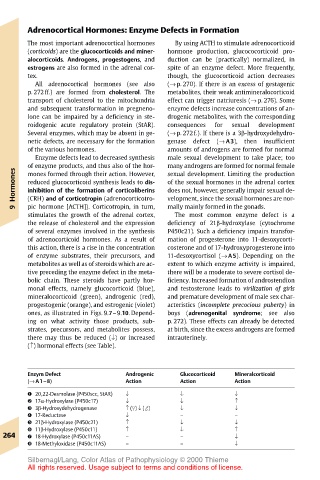
       there may thus be reduced (↓) or increased  intrauterinely.
       (↑) hormonal effects (see Table).


       Enzym Defect          Androgenic   Glucocorticoid  Mineralcorticoid
       (→ A1–8)              Action       Action      Action
       ! 20,22-Desmolase (P450scc, StAR)  ↓  ↓        ↓
       " 17α-Hydroxylase (P450c17)  ↓     ↓           ↑
       # 3β-Hydroxydehydrogenase  ↑ (,) ↓ (<)  ↓      ↓
       $ 17-Reductase        ↓            –           –
       % 21β-Hydroxylase (P450c21)  ↑     ↓           ↓
       & 11β-Hydroxylase (P450c11)  ↑     ↓           ↑
  264  ' 18-Hydroxylase (P450c11AS)  –    –           ↓
       ( 18-Methyloxidase (P450c11AS)  –  –           ↓
       Silbernagl/Lang, Color Atlas of Pathophysiology © 2000 Thieme
       All rights reserved. Usage subject to terms and conditions of license.

