


Page 48 - Color Atlas Of Pathophysiology (S Silbernagl Et Al, Thieme 2000)
P. 48
Iron Deficiency Anemias
       Of the iron (Fe) content in the body (2 g in fe-  and plasma), which has a “pocket” for
       males, 5 g in males) ca. ⁄3 is bound to hemoglo-  4500 Fe 3+  ions, is a rapidly available iron re-
                      2
       bin (Hb), ⁄4 is stored iron (ferritin, hemosider-  serve (ca. 600 mg), while Fe from hemosiderin
             1
       in), the rest is iron with diverse functions (myo-  is more difficult to mobilize (250 mg Fe in
       globin, Fe-containing enzymes). Loss of iron is  macrophages from liver and bone marrow).
       ca. 1 mg/d in males and up to 2 mg/d in fe-  Hb-Fe and heme-Fe, released from malformed
       males (menstruation, pregnancy, birth). Of Fe  erythroblasts (so-called inefficient erythropoi-
       taken up in food, 3–15% is absorbed in the  esis) and hemolyzed erythroblasts, is bound to
       duodenum (→ A); in cases of Fe deficiency it  haptoglobin and hemopexin respectively, and
       can be up to 25% (see below). Iron intake with  taken up by the macrophages in bone marrow
       food should therefore be at least 10–20 mg/d  or by liver and spleen by endocytosis, 97%
       (women > children > men).       being reused.
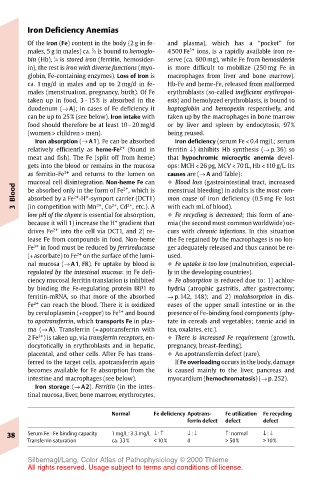
         Iron absorption (→ A1). Fe can be absorbed  Iron deficiency (serum Fe < 0.4 mg/L; serum
       relatively efficiently as heme-Fe 2+ (found in  ferritin ↓) inhibits Hb synthesis (→ p. 36) so
       meat and fish). The Fe (split off from heme)  that hypochromic microcytic anemia devel-
       gets into the blood or remains in the mucosa  ops: MCH < 26 pg, MCV < 70 fL, Hb < 110 g/L. Its
       as ferritin-Fe 3+  and returns to the lumen on  causes are (→ A and Table):
       mucosal cell disintegration. Non-heme Fe can  ! Blood loss (gastrointestinal tract, increased
    Blood  be absorbed only in the form of Fe , which is  menstrual bleeding) in adults is the most com-
                             2+
                    +
                  2+
                                       mon cause of iron deficiency (0.5 mg Fe lost
       absorbed by a Fe -H -symport carrier (DCT1)
                       2+
                              2+
                          2+
    3  (in competition with Mn , Co , Cd , etc.). A  with each mL of blood).
       low pH of the chyme is essential for absorption,  ! Fe recycling is decreased; this form of ane-
                           +
       because it will 1) increase the H gradient that  mia (the second most common worldwide) oc-
       drives Fe 2+  into the cell via DCT1, and 2) re-  curs with chronic infections. In this situation
       lease Fe from compounds in food. Non-heme  the Fe regained by the macrophages is no lon-
       Fe 3+  in food must be reduced by ferrireductase  ger adequately released and thus cannot be re-
       (+ascorbate) to Fe 2+ on the surface of the lumi-  used.
       nal mucosa (→ A1, FR). Fe uptake by blood is  ! Fe uptake is too low (malnutrition, especial-
       regulated by the intestinal mucosa: in Fe defi-  ly in the developing countries).
       ciency mucosal ferritin translation is inhibited  ! Fe absorption is reduced due to: 1) achlor-
       by binding the Fe-regulating protein IRP1 to  hydria (atrophic gastritis, after gastrectomy;
       ferritin-mRNA, so that more of the absorbed  → p.142, 148); and 2) malabsorption in dis-
       Fe 2+  can reach the blood. There it is oxidized  eases of the upper small intestine or in the
       by ceruloplasmin (+copper) to Fe 3+  and bound  presence of Fe-binding food components (phy-
       to apotransferrin, which transports Fe in plas-  tate in cereals and vegetables; tannic acid in
       ma (→ A). Transferrin (= apotransferrin with  tea, oxalates, etc.).
          3+
       2 Fe ) is taken up, via transferrin receptors, en-  ! There is increased Fe requirement (growth,
       docytotically in erythroblasts and in hepatic,  pregnancy, breast-feeding).
       placental, and other cells. After Fe has trans-  ! An apotransferrin defect (rare).
       ferred to the target cells, apotransferrin again  If Fe overloading occurs in the body, damage
       becomes available for Fe absorption from the  is caused mainly to the liver, pancreas and
       intestine and macrophages (see below).  myocardium (hemochromatosis) (→ p. 252).
         Iron storage (→ A2). Ferritin (in the intes-
       tinal mucosa, liver, bone marrow, erythrocytes,
                          Normal    Fe deficiency Apotrans-  Fe utilization  Fe recycling
                                           ferrin defect  defect  defect
   38  Serum Fe : Fe binding capacity  1 mg/L:3.3 mg/L ↓ : ↑  ↓ : ↓  ↑: normal  ↓ : ↓
       Transferrin saturation  ca. 33%  < 10%  0    > 50%   > 10%
       Silbernagl/Lang, Color Atlas of Pathophysiology © 2000 Thieme
       All rights reserved. Usage subject to terms and conditions of license.

