


Page 76 - Color Atlas Of Pathophysiology (S Silbernagl Et Al, Thieme 2000)
P. 76
4    Respiration, Acid–Base Balance             F. Lang


       Overview                        of diffusion can also be caused by an increased
                                       distance between alveoli and blood capillaries
       Breathing through the lungs has two func-  (→ A2; → p. 70,80). If alveoli and capillaries
       tions: firstly, to supply O 2 to the blood and,  are completely separated from one another,
       secondly, to regulate the acid–base balance  this results in both a functional dead space
       via the CO 2 concentration in the blood. The  (nonperfused alveoli) and an arteriovenous
       mechanics of breathing serve to ventilate the  shunt.
       alveoli, through whose walls O 2 can diffuse  Restrictive and obstructive lung disease as
       into the blood and CO 2 can diffuse out. Respira-  well as cardiovascular disease may affect lung
       tory gases in the blood are largely transported  perfusion (→ A3; → p. 80). Decreased perfu-
       in bound form. The amount transported de-  sion results in a reduced amount of gases
       pends, among other factors, on the concentra-  being transported in blood, despite adequate
       tion in blood and on pulmonary blood flow  O 2 saturation and CO 2 removal in the alveoli. If
       (perfusion). It is the task of respiratory regula-  flow resistance is increased, severe conse-
       tion to adapt ventilation to the specific re-  quences for the circulation are possible, be-
       quirements.                     cause the entire cardiac output (CO) must
         A number of disorders can affect breathing  pass through the lungs (→ p. 80).
                                        Breathing is also impaired in dysfunction of
       in such a manner that ultimately sufficient O 2
       uptake and CO 2 release can no longer be guar-  the respiratory neurons (→ p. 82) as well as of
       anteed.                         the motoneurons, nerves, and muscles that are
         In obstructive lung disease (→ p. 76) flow  controlled by them (→ p. 68). The changes in
       resistance in the respiratory tract is raised and  breathing movement that occur when the
       ventilation of the alveoli is thus impaired  breathing regulation is abnormal (→ Table 1)
       (→ A1). The primary consequence is hypo-  do not, however, necessarily lead to corre-
       ventilation in some alveoli (abnormal distri-  sponding changes of alveolar ventilation.
       bution; → p. 72) or of all alveoli (global hypo-  Consequences of inadequate breathing can
       ventilation). If alveolar ventilation ceases  be hypoxemia (→ A5; → p. 84), hypercapnia or
       completely, a functional arteriovenous shunt  hypocapnia (increased or decreased CO 2 con-
       occurs. However, hypoxia leads to constriction  tent, respectively; → A4; → p. 86ff.) in arterial-
       of the supplying vessels, thus diminishing  ized blood. The supply of O 2 to the cells as well
       blood flow to the underventilated alveoli.  as the removal of CO 2 from the periphery do
         In restrictive lung disease (→ p. 74) the loss  not only depend on adequate respiration but
       of functioning lung tissue reduces the area of  also on unimpaired oxygen transport in the
       diffusion and in this way impairs gaseous ex-  blood (→ chap. 3) and on intact circulation
       change. There is also a reduced area of diffu-  (→ chap. 7).
       sion in emphysema (→ p. 78), a condition char-
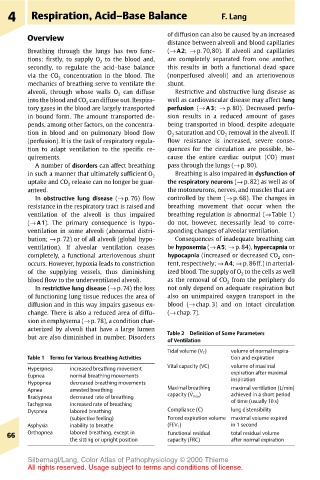
       acterized by alveoli that have a large lumen  Table 2  Definition of Some Parameters
       but are also diminished in number. Disorders  of Ventilation
                                       Tidal volume (V T )  volume of normal inspira-
       Table 1  Terms for Various Breathing Activities  tion and expiration
       Hyperpnea  increased breathing movement  Vital capacity (VC)  volume of maximal
                                                     expiration after maximal
       Eupnea    normal breathing movements          inspiration
       Hypopnea  decreased breathing movements
       Apnea     arrested breathing    Maximal breathing  maximal ventilation (L/min)
       Bradypnea  decreased rate of breathing  capacity (V ˙ max )  achieved in a short period
                                                     of time (usually 10 s)
       Tachypnea  increased rate of breathing
       Dyspnea   labored breathing     Compliance (C)  lung distensibility
                 (subjective feeling)  Forced expiration volume  maximal volume expired
       Asphyxia  inability to breathe  (FEV 1 )      in 1 second
   66  Orthopnea  labored breathing, except in  Functional residual  total residual volume
                 the sitting or upright position  capacity (FRC)  after normal expiration
       Silbernagl/Lang, Color Atlas of Pathophysiology © 2000 Thieme
       All rights reserved. Usage subject to terms and conditions of license.

