


Page 289 - Encyclopedia of Nursing Research
P. 289
256  n  InSTITUTIonaL ReVIeW BoaRD anD InFoRMeD ConSenT


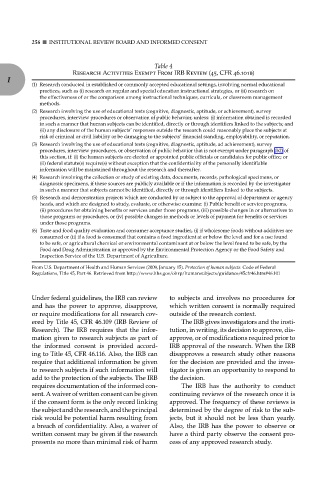
                                               Table 4
                       Research activities exempt From IRB Review (45, CFR 46.101b)
   I
           (1)   Research conducted in established or commonly accepted educational settings, involving normal educational
             practices, such as (i) research on regular and special education instructional strategies, or (ii) research on
             the effectiveness of or the comparison among instructional techniques, curricula, or classroom management
             methods.
           (2)   Research involving the use of educational tests (cognitive, diagnostic, aptitude, or achievement), survey
             procedures, interview procedures or observation of public behavior, unless: (i) information obtained is recorded
             in such a manner that human subjects can be identified, directly or through identifiers linked to the subjects; and
             (ii) any disclosure of the human subjects’ responses outside the research could reasonably place the subjects at
             risk of criminal or civil liability or be damaging to the subjects’ financial standing, employability, or reputation.
           (3)   Research involving the use of educational tests (cognitive, diagnostic, aptitude, ad achievement), survey
             procedures, interview procedures, or observation of public behavior that is not exempt under paragraph (b2) of
             this section, if: (i) the human subjects are elected or appointed public officials or candidates for public office; or
             (ii) federal statute(s) require(s) without exception that the confidentiality of the personally identifiable
             information will be maintained throughout the research and thereafter.
           (4)   Research involving the collection or study of existing data, documents, records, pathological specimens, or
             diagnostic specimens, if these sources are publicly available or if the information is recorded by the investigator
             in such a manner that subjects cannot be identified, directly or through identifiers linked to the subjects.
           (5)   Research and demonstration projects which are conducted by or subject to the approval of department or agency
             heads, and which are designed to study, evaluate, or otherwise examine: (i) Public benefit or service programs,
             (ii) procedures for obtaining benefits or services under those programs, (iii) possible changes in or alternatives to
             those programs or procedures, or (iv) possible changes in methods or levels of payment for benefits or services
             under those programs.
           (6)   Taste and food quality evaluation and consumer acceptance studies, (i) if wholesome foods without additives are
             consumed or (ii) if a food is consumed that contains a food ingredient at or below the level and for a use found
             to be safe, or agricultural chemical or environmental contaminant at or below the level found to be safe, by the
             Food and Drug administration or approved by the environmental Protection agency or the Food Safety and
             Inspection Service of the U.S. Department of agriculture.

           From U.S. Department of Health and Human Services (2009, January 15). Protection of human subjects. Code of Federal
           Regulations, Title 45, Part 46. Retrieved from http://www.hhs.gov/ohrp/humansubjects/guidance/45cfr46.htm#46.101


           Under federal guidelines, the IRB can review   to  subjects  and  involves  no  procedures  for
           and  has  the  power  to  approve,  disapprove,   which written consent is normally required
           or require modifications for all research cov-  outside of the research context.
           ered by Title 45, CFR 46.109 (IRB Review of   The IRB gives investigators and the insti-
           Research).  The  IRB  requires  that  the  infor-  tution, in writing, its decision to approve, dis-
           mation given to research subjects as part of   approve, or of modifications required prior to
           the  informed  consent  is  provided  accord-  IRB approval of the research. When the IRB
           ing to Title 45, CFR 46.116. also, the IRB can   disapproves a research study other reasons
           require that additional information be given   for the decision are provided and the inves-
           to research subjects if such information will   tigator is given an opportunity to respond to
           add to the protection of the subjects. The IRB   the decision.
           requires documentation of the informed con-  The  IRB  has  the  authority  to  conduct
           sent. a waiver of written consent can be given   continuing reviews of the research once it is
           if the consent form is the only record linking   approved. The frequency of these reviews is
           the subject and the research, and the principal   determined by the degree of risk to the sub-
           risk would be potential harm resulting from   jects,  but  it  should  not  be  less  than  yearly.
           a breach of confidentiality. also, a waiver of   also,  the  IRB  has  the  power  to  observe  or
           written consent may be given if the research   have a third party observe the consent pro-
           presents no more than minimal risk of harm   cess of any approved research study.

