


Page 129 - ACCCN's Critical Care Nursing
P. 129
106  P R I N C I P L E S   A N D   P R A C T I C E   O F   C R I T I C A L   C A R E


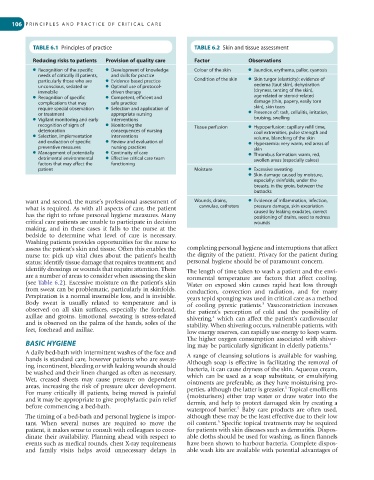
            TABLE 6.1  Principles of practice                    TABLE 6.2  Skin and tissue assessment

            Reducing risks to patients  Provision of quality care  Factor         Observations
            ●  Recognition of the specific   ●  Development of knowledge   Colour of the skin  ●  Jaundice, erythema, pallor, cyanosis
              needs of critically ill patients,   and skills for practice
              particularly those who are   ●  Evidence based practice  Condition of the skin  ●  Skin turgor (elasticity): evidence of
              unconscious, sedated or   ●  Optimal use of protocol-                 oedema (taut skin), dehydration
              immobile               driven therapy                                 (dryness, tenting of the skin),
            ●  Recognition of specific   ●  Competent, efficient and                age-related or steroid-related
              complications that may   safe practice                                damage (thin, papery, easily torn
              require special observation   ●  Selection and application of         skin), skin tears
              or treatment           appropriate nursing                          ●  Presence of: rash, cellulitis, irritation,
            ●  Vigilant monitoring and early   interventions                        bruising, swelling
              recognition of signs of   ●  Monitoring the        Tissue perfusion  ●  Hypoperfusion: capillary refill time,
              deterioration          consequences of nursing                        cool extremities, pulse strength and
            ●  Selection, implementation   interventions                            volume, blanching of the skin
              and evaluation of specific   ●  Review and evaluation of            ●  Hyperaemia: very warm, red areas of
              preventive measures    nursing practices                              skin
            ●  Management of potentially   ●  Continuity of care                  ●  Thrombus formation: warm, red,
              detrimental environmental   ●  Effective critical care team           swollen areas (especially calves)
              factors that may affect the   functioning
              patient                                            Moisture         ●  Excessive sweating
                                                                                  ●  Skin damage caused by moisture,
                                                                                    especially: skinfolds, under the
                                                                                    breasts, in the groin, between the
                                                                                    buttocks
         want and second, the nurse’s professional assessment of   Wounds, drains,   ●  Evidence of inflammation, infection,
         what is required. As with all aspects of care, the patient   cannulae, catheters  pressure damage, skin excoriation
         has the right to refuse personal hygiene measures. Many                    caused by leaking exudates, correct
                                                                                    positioning of drains, need to redress
         critical care patients are unable to participate in decision               wounds
         making,  and  in  these  cases  it  falls  to  the  nurse  at  the
         bedside  to  determine  what  level  of  care  is  necessary.
         Washing patients provides opportunities for the nurse to
         assess the patient’s skin and tissue. Often this enables the   completing personal hygiene and interruptions that affect
         nurse  to:  pick  up  vital  clues  about  the  patient’s  health   the dignity of the patient. Privacy for the patient during
         status; identify tissue damage that requires treatment; and   personal hygiene should be of paramount concern.
         identify dressings or wounds that require attention. There   The length of time taken to wash a patient and the envi-
         are a number of areas to consider when assessing the skin   ronmental  temperature  are  factors  that  affect  cooling.
         (see Table 6.2). Excessive moisture on the patient’s skin   Water  on  exposed  skin  causes  rapid  heat  loss  through
         from sweat can be problematic, particularly in skinfolds.   conduction,  convection  and  radiation,  and  for  many
         Perspiration is a normal insensible loss, and is invisible.   years tepid sponging was used in critical care as a method
         Body  sweat  is  usually  related  to  temperature  and  is   of  cooling  pyrexic  patients.   Vasoconstriction  increases
                                                                                       3
         observed  on  all  skin  surfaces,  especially  the  forehead,   the  patient’s  perception  of  cold  and  the  possibility  of
         axillae  and  groins.  Emotional  sweating  is  stress-related   shivering,   which  can  affect  the  patient’s  cardiovascular
                                                                       4
         and is observed on the palms of the hands, soles of the   stability. When shivering occurs, vulnerable patients, with
         feet, forehead and axillae.                          low energy reserves, can rapidly use energy to keep warm.
                                                              The higher oxygen consumption associated with shiver-
         BASIC HYGIENE                                        ing may be particularly significant in elderly patients. 4
         A daily bed-bath with intermittent washes of the face and   A range of cleansing solutions is available for washing.
         hands is standard care, however patients who are sweat-  Although soap is effective in facilitating the removal of
         ing, incontinent, bleeding or with leaking wounds should   bacteria, it can cause dryness of the skin. Aqueous cream,
         be washed and their linen changed as often as necessary.   which can be used as a soap substitute, or emulsifying
         Wet,  creased  sheets  may  cause  pressure  on  dependent   ointments are preferable, as they have moisturising pro-
         areas, increasing the risk of pressure ulcer development.   perties, although the latter is greasier.  Topical emollients
                                                                                              5
         For  many  critically  ill  patients,  being  moved  is  painful   (moisturisers)  either  trap  water  or  draw  water  into  the
         and it may be appropriate to give prophylactic pain relief   dermis, and help to protect damaged skin by creating a
         before commencing a bed-bath.
                                                                               5
                                                              waterproof  barrier.   Baby  care  products  are  often  used,
         The timing of a bed-bath and personal hygiene is impor-  although these may be the least effective due to their low
                                                                        5
         tant.  When  several  nurses  are  required  to  move  the   oil content.  Specific topical treatments may be required
         patient, it makes sense to consult with colleagues to coor-  for patients with skin diseases such as dermatitis. Dispos-
         dinate their availability. Planning ahead with respect to   able cloths should be used for washing, as linen flannels
         events such as medical rounds, chest X-ray requirements   have been shown to harbour bacteria. Complete dispos-
         and  family  visits  helps  avoid  unnecessary  delays  in   able wash kits are available with potential advantages of

