


Page 131 - ACCCN's Critical Care Nursing
P. 131
108  P R I N C I P L E S   A N D   P R A C T I C E   O F   C R I T I C A L   C A R E

         EYE ASSESSMENT                                       benefit from regular 4-hourly administration of artificial
                                                                                    9
         Eye  assessment  should  be  undertaken  at  least  every  12   tears to lubricate the eyes,  although this may be unneces-
         hours,  even  for  the  conscious  patients  who  are  able  to   sary while they are sleeping.
         blink  spontaneously  and  usually  require  minimal  eye   Dawson  offers  an  eye  care  protocol  for  critically  ill
         care. The risk of corneal abrasion or iatrogenic trauma is   patients,  which  clarifies  the  type  of  eye  care  required
         greatest when patients are unable to close their eyes spon-  according to the patient’s ability to maintain eye closure.
                                                                                                              14
         taneously,  so these patients are at greatest risk of injury.   The protocol requires an assessment to be made once per
                  14
         The second at-risk group is those patients receiving posi-  shift. Initially, eye closure is assessed to determine whether
         tive pressure ventilation, who may develop conjunctival   it  is  complete  or  whether  the  conjunctiva  and/or  the
         oedema (chemosis), sometimes referred to as ‘ventilator   cornea  are  exposed.  Suggested  treatment  is  1–4-hourly
         eye’.  Third, patients who are exposed to high flows of air/  eyedrops, with further assessment to exclude keratitis or
             9
         oxygen,  such  as  that  with  continuous  positive  airway   conjunctivitis.  Unconscious  or  paralysed  patients  are
         pressure (CPAP) systems, may be vulnerable to its drying   likely to require more eye care than conscious patients.
         effects. Finally, all patients are at risk of eye inflammation   Basic  eye  care  consists  of  cleaning  the  sclera  and  sur-
         and  infection.  Serious  infections  with  bacteria  such  as   rounding tissue and moistening the eyes by administer-
         pseudomonas can progress rapidly, resulting in blindness   ing artificial tears.
         if not treated promptly.
                                                              For at-risk patients, the general consensus is that eye care
         Initial assessment should focus on whether the patient   should be performed using a sterile technique, cleansing
         belongs to an at-risk group. Most critically ill patients are   the eye from the inside to the outside usually with saline
         at  some  risk,  but  particularly  those  who  are  unable  to   and  gauze;  however,  eye  care  regimens  have  not  been
                                                                                 9
         close their eyes adequately. If the cornea is exposed, the   rigorously researched.  Cotton wool is not recommended
                                                    14
         patient is considered to be in a high-risk group.  Based   because  of  the  presence  of  particulates  that  may  cause
         on the groups identified above, initial assessment should   corneal  abrasions.  Eyedrops  should  be  administered
         help determine how often eye assessment and eye care is   gently, inserting the drop in the uppermost part of the
         required.                                            opened eye and as close to the eye as possible without
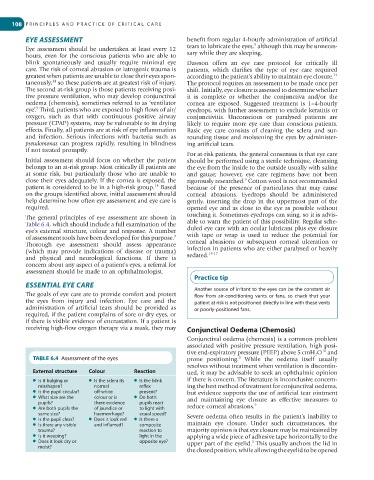
         The  general  principles  of  eye  assessment  are  shown  in   touching it. Sometimes eyedrops can sting, so it is advis-
         Table 6.4, which should include a full examination of the   able to warn the patient of this possibility. Regular sche-
         eye’s external structure, colour and response. A number   duled eye care with an ocular lubricant plus eye closure
                                                          9
         of assessment tools have been developed for this purpose.    with  tape  or  wrap  is  used  to  reduce  the  potential  for
         Thorough  eye  assessment  should  assess  appearance   corneal  abrasions  or  subsequent  corneal  ulceration  or
         (which  may  provide  indications  of  disease  or  trauma)   infection in patients who are either paralysed or heavily
                                                                     15-17
         and  physical  and  neurological  functions.  If  there  is   sedated.
         concern about any aspect of a patient’s eyes, a referral for
         assessment should be made to an ophthalmologist.
                                                                 Practice tip
         ESSENTIAL EYE CARE                                      Another source of irritant to the eyes can be the constant air
         The goals of eye care are to provide comfort and protect   flow  from  air-conditioning  vents  or  fans,  so  check  that  your
         the  eyes  from  injury  and  infection.  Eye  care  and  the   patient at risk is not positioned directly in line with these vents
         administration  of  artificial  tears  should  be  provided  as   or poorly-positioned fans.
         required, if the patient complains of sore or dry eyes, or
         if there is visible evidence of encrustation. If a patient is
         receiving high-flow oxygen therapy via a mask, they may   Conjunctival Oedema (Chemosis)
                                                              Conjunctival oedema (chemosis) is a common problem
                                                              associated with positive pressure ventilation, high posi-
                                                              tive end-expiratory pressure (PEEP) above 5 cmH 2 O  and
                                                                                                          18
            TABLE 6.4  Assessment of the eyes                 prone  positioning.   While  the  oedema  itself  usually
                                                                               9
                                                              resolves without treatment when ventilation is discontin-
            External structure  Colour       Reaction         ued, it may be advisable to seek an ophthalmic opinion
            ●  Is it bulging or   ●  Is the sclera its   ●  Is the blink   if there is concern. The literature is inconclusive concern-
              misshapen?        normal         reflex         ing the best method of treatment for conjunctival oedema,
            ●  Is the pupil circular?  off-white   present?   but evidence supports the use of artificial tear ointment
            ●  What size are the   colour or is   ●  Do both   and  maintaining  eye  closure  as  effective  measures  to
              pupils?           there evidence   pupils react                       9
            ●  Are both pupils the   of jaundice or   to light with   reduce corneal abrasions.
              same size?        haemorrhage?   equal speed?   Severe oedema often results in the patient’s inability to
            ●  Is the pupil clear?  ●  Does it look red   ●  Is there a
            ●  Is there any visible   and inflamed?  composite   maintain  eye  closure.  Under  such  circumstances,  the
              trauma?                          reaction to    majority opinion is that eye closure may be maintained by
            ●  Is it weeping?                  light in the   applying a wide piece of adhesive tape horizontally to the
            ●  Does it look dry or             opposite eye?  upper part of the eyelid.  This usually anchors the lid in
                                                                                   9
              moist?
                                                              the closed position, while allowing the eyelid to be opened

