


Page 132 - ACCCN's Critical Care Nursing
P. 132
Essential Nursing Care of the Critically Ill Patient  109

             for pupil assessment and access for eye care. It is not neces-
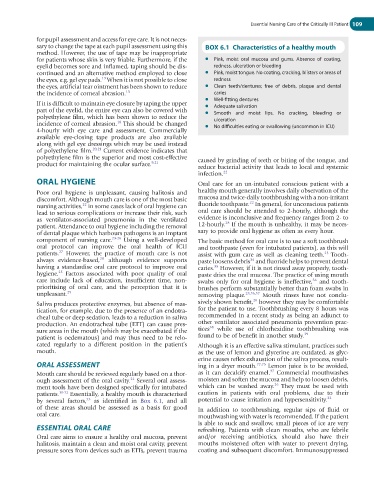
             sary to change the tape at each pupil assessment using this   BOX 6.1  Characteristics of a healthy mouth
             method. However, the use of tape may be inappropriate
             for patients whose skin is very friable. Furthermore, if the   ●  Pink,  moist  oral  mucosa  and  gums.  Absence  of  coating,
             eyelid becomes sore and inflamed, taping should be dis-   redness, ulceration or bleeding
             continued and an alternative method employed to close   ●  Pink, moist tongue. No coating, cracking, blisters or areas of
                                  19
             the eyes, e.g. gel eye pads.  When it is not possible to close   redness
             the eyes, artificial tear ointment has been shown to reduce   ●  Clean  teeth/dentures;  free  of  debris,  plaque  and  dental
             the incidence of corneal abrasion. 15                     caries
                                                                    ●  Well-fitting dentures
             If it is difficult to maintain eye closure by taping the upper   ●  Adequate salivation
             part of the eyelid, the entire eye can also be covered with   ●  Smooth  and  moist  lips.  No  cracking,  bleeding  or
             polyethylene film, which has been shown to reduce the     ulceration
             incidence of corneal abrasion.  This should be changed   ●  No difficulties eating or swallowing (uncommon in ICU)
                                       18
             4-hourly  with  eye  care  and  assessment.  Commercially
             available  eye-closing  tape  products  are  also  available
             along with gel eye dressings which may be used instead
             of polyethylene film. 20,21  Current evidence indicates that
             polyethylene film is the superior and most cost-effective   caused by grinding of teeth or biting of the tongue, and
             product for maintaining the ocular surface. 9,21     reduce bacterial activity that leads to local and systemic
                                                                  infection. 22
             ORAL HYGIENE                                         Oral care for an un-intubated conscious patient with a

             Poor  oral  hygiene  is  unpleasant,  causing  halitosis  and   healthy mouth generally involves daily observation of the
             discomfort. Although mouth care is one of the most basic   mucosa and twice-daily toothbrushing with a non-irritant
                                                                                   22
                            22
             nursing activities,  in some cases lack of oral hygiene can   fluoride toothpaste.  In general, for unconscious patients
             lead to serious complications or increase their risk, such   oral care should be attended to 2-hourly, although the
             as  ventilator-associated  pneumonia  in  the  ventilated   evidence is inconclusive and frequency ranges from 2- to
                                                                           28
             patient. Attendance to oral hygiene including the removal   12-hourly.  If the mouth is unhealthy, it may be neces-
             of dental plaque which harbours pathogens is an imptant   sary to provide oral hygiene as often as every hour.
             component of nursing care. 23-26  Using a well-developed   The basic method for oral care is to use a soft toothbrush
             oral  protocol  can  improve  the  oral  health  of  ICU   and toothpaste (even for intubated patients), as this will
                    27
             patients.   However,  the  practice  of  mouth  care  is  not   assist with gum care as well as cleaning teeth.  Tooth-
                                                                                                           25
                                  28
             always  evidence-based,   although  evidence  supports   paste loosens debris  and fluoride helps to prevent dental
                                                                                   34
             having a standardise oral care protocol to improve oral   caries.  However, if it is not rinsed away properly, tooth-
                                                                       35
                    25
             hygiene.   Factors  associated  with  poor  quality  of  oral   paste dries the oral mucosa. The practice of using mouth
             care  include  lack  of  education,  insufficient  time,  non-  swabs  only  for  oral  hygiene  is  ineffective,   and  tooth-
                                                                                                       36
             prioritising  of  oral  care,  and  the  perception  that  it  is   brushes perform substantially better than foam swabs in
             unpleasant. 29                                       removing  plaque. 25,36,37   Mouth  rinses  have  not  conclu-
                                                                                    26
             Saliva produces protective enzymes, but absence of mas-  sively shown benefit,  however they may be comfortable
             tication, for example, due to the presence of an endotra-  for the patient to use. Toothbrushing every 8 hours was
             cheal tube or deep sedation, leads to a reduction in saliva   recommended in a recent study as being an adjunct to
             production. An endotracheal tube (ETT) can cause pres-  other ventilator associated pneumonia prevention prac-
                                                                      38
             sure areas in the mouth (which may be exacerbated if the   tices   while  use  of  chlorhexidine  toothbrushing  was
                                                                                                     39
             patient  is  oedematous)  and  may  thus  need  to  be  relo-  found to be of benefit in another study.
             cated  regularly  to  a  different  position  in  the  patient’s   Although it is an effective saliva stimulant, practices such
             mouth.                                               as the use of lemon and glycerine are outdated, as glyc-
                                                                  erine causes reflex exhaustion of the saliva process, result-
             ORAL ASSESSMENT                                      ing in a dryer mouth. 22,25  Lemon juice is to be avoided,
                                                                                         37
             Mouth care should be reviewed regularly based on a thor-  as it can decalcify enamel.  Commercial mouthwashes
             ough assessment of the oral cavity.  Several oral assess-  moisten and soften the mucosa and help to loosen debris,
                                            22
                                                                                           26
             ment tools have been designed specifically for intubated   which  can  be  washed  away.   They  must  be  used  with
             patients. 30-32  Essentially, a healthy mouth is characterised   caution  in  patients  with  oral  problems,  due  to  their
             by  several  factors,   as  identified  in  Box  6.1,  and  all   potential to cause irritation and hypersensitivity. 22
                             33
             of  these  areas  should  be  assessed  as  a  basis  for  good    In  addition  to  toothbrushing,  regular  sips  of  fluid  or
             oral care.                                           mouthwashing with water is recommended. If the patient
                                                                  is able to suck and swallow, small pieces of ice are very
             ESSENTIAL ORAL CARE                                  refreshing.  Patients  with  clean  mouths,  who  are  febrile
             Oral care aims to ensure a healthy oral mucosa, prevent   and/or  receiving  antibiotics,  should  also  have  their
             halitosis, maintain a clean and moist oral cavity, prevent   mouths  moistened  often  with  water  to  prevent  drying,
             pressure sores from devices such as ETTs, prevent trauma   coating and subsequent discomfort. Immunosuppressed

