


Page 134 - ACCCN's Critical Care Nursing
P. 134
Essential Nursing Care of the Critically Ill Patient  111

             moved, patients who are in critical care for a long time,   assessment, which should include a visual and physical
             elderly and frail or malnourished patients, and patients   assessment of all limbs and joints. Provided there are no
             who are unable to move themselves (e.g. due to sedation,   contraindications,  function  should  be  stimulated  by
             trauma,  surgery  or  obesity)  are  all  at  risk.  Batson  et al.   regular passive then active movements of all limbs and
             identified several significant risk factors: patients receiv-  joints  to  maintain  both  flexibility  and  comfort  (see
             ing adrenaline and/or noradrenaline infusions; patients   below).
             with  restricted  movement;  and  diabetic  and  unstable
                    57
             patients.   However,  even  previously  fit  patients  who
             experience a critical illness can develop severe limitations
             in  their  mobility.  The  common  short-  and  long-term   Practice tip
             complications of immobility are pressure ulcers, venous   From  the  perspective  of  patient  comfort,  even  small  re-
             thromboembolism and pulmonary dysfunction, each of     adjustments  in  positioning  may  be  advantageous,  and  often
             which carries a significant co-morbidity. 56           can be made without much effort by the nurse or disturbance
                                                                    to  the  resting  patient.  Most  electric  beds  provide  for  adjust-
             POSITIONING AND MOBILISING PATIENTS                    ments to the backrest angle, knee bend and bed tilt and adjust-
             Positioning  the  patient  to  achieve  maximum  comfort,   ments  can  be  easily  made.  In  addition  to  comfort,  these
             therapeutic benefit and pressure area relief and employ-  adjustments will aid in pressure changes between re-positioning
             ing active and passive exercises to maintain muscle and   of the patient.
             joint  integrity  and  progress  to  regaining  mobility  are
             important nursing activities. Provided there are no spe-
             cific contraindications, the immobile patient should be
             positioned with the head raised by 30 degrees or more,
                                                             58
             as research has demonstrated that it improves mortality    Practice tip
                                                             59
             and  helps  reduce  ventilator-associated  pneumonia.
             When  combined  with  thromboembolic  pro phylaxis,    When planning to reposition the patient, ensure that there are
             gastric ulcer prophylaxis and daily sedation assessment,   enough staff to give the patient a feeling of security during the
             ventilator-associated  pneumonia  may  be  reduced  by   procedure and that all the patient’s devices (e.g. IV lines) are
                         59
             around  45%.   Good  body  positioning  and  alignment   managed. Check that all devices are placed to accommodate
             helps  prevent  muscle  contracture,  pressure  ulcers  and   the repositioning before you begin to move the patient.
             unnecessary pain or discomfort for the patient. 60,61
             Mobilisation for the critically ill patient can be described
             as a graduated increase in range of activity from position-  Active and Passive Exercises
             ing, passive movement, sitting upright in bed, sitting in   It takes only seven days of bed rest to reduce muscle mass
             a chair to actually ambulating. 49-51,53  Stiller  describes a   by up to 30%,  and physical activity is essential to healthy
                                                                              64
                                                   62
             range of safety factors that need to be considered prior to   functioning and beneficial for the cardiovascular system.
                                                                                                                  54
             mobilising  the  critically  ill  patient,  which  fall  into  two   Active exercises are those that can be performed by the
             groups;  those  specific  to  the  patient  and  their  physical   patient with no, or minimal, assistance. Passive exercises
             and  physiological  condition,  and  those  extrinsic  to  the   are performed when patients are either too weak or inca-
             patient  such  as  the  environment,  staffing  and  patient   pable of active exercise. Exercises can be employed to help
             devices  attached.  Creating  an  individualised  mobility   the  recovering  patient  develop  power  and  regain  func-
             plan which can be adapted according to patient assess-  tion, to assist in venous return and maintain the normal
             ment  and  general  health  progress,  will  optimise  early   sensation of movement.  They should be performed at
                                                                                       64
             movement and mobilisation. 53,54,62,63               least daily. Passive exercises put the main joints through
                                                                  their range of movement, which helps reduce joint stiff-
             Regular  musculoskeletal  assessment  should  be  made,
             focusing on the patient’s major muscles and joints and   ness and maintain muscle integrity, preventing contrac-
             the degree of mobility. Table 6.5 offers a simple guide to   tures. Shoulders, hands, hips and ankles are particularly
                                                                                                       64
                                                                  at risk of stiffness and muscle contracture.  It is impor-
                                                                  tant, however, to ensure that joints and muscles are not
                                                                  overstretched, as this is painful for patients and can cause
                                                                  permanent injury. Splints may be used when the patient
                                                                                                              64
                                                                  is resting, to maintain joints in a neutral position.  The
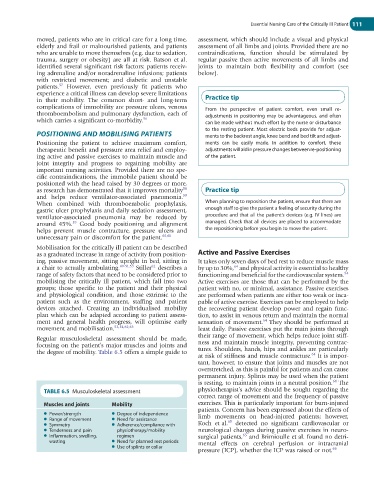
               TABLE 6.5  Musculoskeletal assessment              physiotherapist’s advice should be sought regarding the
                                                                  correct range of movement and the frequency of passive
               Muscles and joints     Mobility                    exercises. This is particularly important for burn-injured
                                                                  patients. Concern has been expressed about the effects of
               ●  Power/strength      ●  Degree of independence   limb  movements  on  head-injured  patients;  however,
               ●  Range of movement   ●  Need for assistance                65
               ●  Symmetry            ●  Adherence/compliance with   Koch  et al.   detected  no  significant  cardiovascular  or
               ●  Tenderness and pain  physiotherapy/mobility     neurological changes during passive exercises in neuro-
               ●  Inflammation, swelling,   regimen               surgical patients,  and Brimioulle et al. found no detri-
                                                                                65
                 wasting              ●  Need for planned rest periods  mental  effects  on  cerebral  perfusion  or  intracranial
                                      ●  Use of splints or collar                                             66
                                                                  pressure (ICP), whether the ICP was raised or not.

