


Page 135 - ACCCN's Critical Care Nursing
P. 135
112  P R I N C I P L E S   A N D   P R A C T I C E   O F   C R I T I C A L   C A R E

         Changing Body Position                               to  fully  consider  the  individual  needs  of  patients:  they
         Mobility is defined as the ability to change and control   may  have  a  history  of  back  or  neck  problems,  and  the
                      67
         body position.  The complications of immobilisation in   selective use of soft or firm pillows and mattresses may
         critically  ill  patients  are  well  documented,  and  include   be relevant. Pillows can optimise the patient’s position so
         decubitus ulcer, venous thromboembolism and pulmo-   that the shoulders and chest are squared, and may reduce
         nary dysfunction such as atelectasis, retained secretions,   the work of breathing for patients with chronic airways
                                                                     42
                                         56
         pneumonia, dysoxia and aspiration.  The routine stan-  disease.   Some  pressure-relieving  mattresses  have  an
         dard for immobilised patients in ICU is 2-hourly body   adjustable pressure control, which can be changed accord-
                                                                                                              42
         repositioning,  although  this  does  not  always  happen,    ing to pressure relief assessment and patient comfort.
                                                         56
         and the optimal interval for turning critically ill patients   When patients are positioned lying on one side, consid-
                    68
         is unknown.  In addition to providing pressure relief, it   eration  should  be  given  to  their  feeling  of  security;  for
         is recommended that the patient’s position be changed   example, ensuring that they are well supported by pillows
         often  to  ensure  comfort,  relaxation  and  rest,  to  inflate   and the bed rails are raised. Provided cerebral perfusion
         both  lungs,  improve  oxygenation   and  help  mobilise   pressure  is  maintained  above  50 mmHg,  even  severely
                                        69
                                                                                                    66
         airway secretions, to orient the patient to the surround-  head-injured patients can be moved safely,  however it
         ings and for a change of view, and to improve circulation   is  important  to  maintain  the  neck  in  alignment  to
                                    50
         to  limbs  through  movement.   The  frequency  of  body   promote venous drainage (see Chapter 17), and for those
         repositioning  should  be  determined  according  to  the   with  spinal  injuries,  log-rolling  may  be  required  (see
         patient’s pressure ulcer risk (preferably using one of the   Chapter 17).
         assessment tools described below), clinical stability and
         comfort.                                             Pressure Area Care
                                                              The prevalence of pressure ulcers in an ICU ranges from
         Good body alignment helps prevent pressure points, con-  5% to 18%  and the risk of developing a pressure sore
                                                                        72
         tractures  and  unnecessary  pain  or  discomfort  for  the   is cumulative: 5% risk after 5 days; 30% risk after 10 days;
                60
         patient.  The nurse caring for the immobile critically ill   and 50% risk after 20 days in the ICU.  Pressure area risk
                                                                                               72
         patient is most often responsible for determining patient   for critically ill patients can be attributed to their immo-
                    70
         positioning.  Here, careful consideration should be given   bility, lack of sensory protective mechanisms, suboptimal
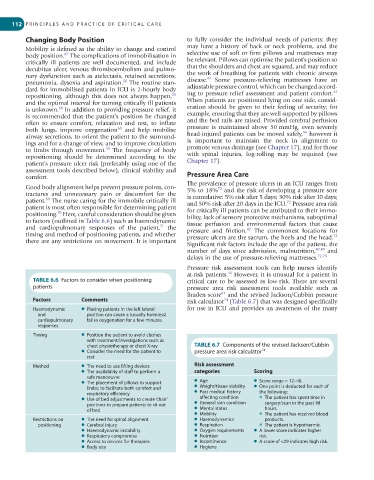
         to factors (outlined in Table 6.6) such as haemodynamic   tissue  perfusion  and  environmental  factors  that  cause
                                                     71
         and  cardiopulmonary  responses  of  the  patient,   the   pressure  and  friction.   The  commonest  locations  for
                                                                                  42
         timing and method of positioning patients, and whether   pressure ulcers are the sacrum, the heels and the head.
                                                                                                              72
         there are any restrictions on movement. It is important
                                                              Significant risk factors include the age of the patient, the
                                                              number  of  days  since  admission,  malnutrition, 42,49   and
                                                              delays in the use of pressure-relieving mattresses. 72,73
                                                              Pressure  risk  assessment  tools  can  help  nurses  identify
                                                              at-risk patients.  However, it is unusual for a patient in
                                                                            42
            TABLE 6.6  Factors to consider when positioning   critical care to be assessed as low-risk. There are several
            patients                                          pressure  area  risk  assessment  tools  available  such  as
                                                              Braden score  and the revised Jackson/Cubbin pressure
                                                                         67
            Factors         Comments                          risk calculator  (Table 6.7) that was designed specifically
                                                                          74
            Haemodynamic    ●  Placing patients in the left lateral   for use in ICU and provides an awareness of the many
             and             position can cause a (usually harmless)
             cardiopulmonary   fall in oxygenation for a few minutes
             responses
            Timing          ●  Position the patient to avoid clashes
                             with treatment/investigations such as
                             chest physiotherapy or chest X-ray  TABLE 6.7  Components of the revised Jackson/Cubbin
                            ●  Consider the need for the patient to   pressure area risk calculator 74
                             rest
            Method          ●  The need to use lifting devices   Risk assessment
                            ●  The availability of staff to perform a   categories  Scoring
                             safe manoeuvre
                            ●  The placement of pillows to support   ●  Age         ●  Score range = 12–48.
                             limbs; to facilitate both comfort and   ●  Weight/tissue viability  ●  One point is deducted for each of
                             respiratory efficiency              ●  Past medical history   the following:
                            ●  Use of bed adjustments to create ‘chair’   affecting condition  ●  The patient has spent time in
                             positions to prepare patients to sit out   ●  General skin condition  surgery/scan in the past 48
                             of bed                              ●  Mental status       hours.
                                                                 ●  Mobility          ●  The patient has received blood
            Restrictions on   ●  The need for spinal alignment   ●  Haemodynamics       products.
             positioning    ●  Cerebral injury                   ●  Respiration       ●  The patient is hypothermic.
                            ●  Haemodynamic instability          ●  Oxygen requirements  ●  A lower score indicates higher
                            ●  Respiratory compromise            ●  Nutrition         risk.
                            ●  Access to devices for therapies   ●  Incontinence    ●  A score of <29 indicates high risk.
                            ●  Body size                         ●  Hygiene

