


Page 157 - ACCCN's Critical Care Nursing
P. 157
134  P R I N C I P L E S   A N D   P R A C T I C E   O F   C R I T I C A L   C A R E


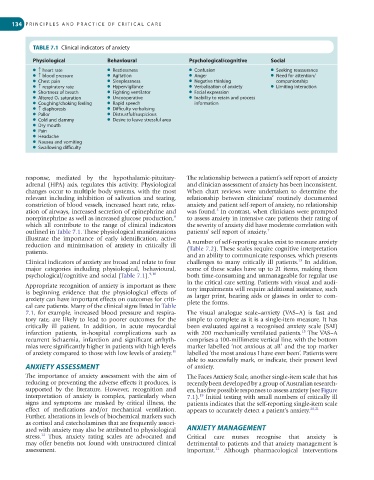
            TABLE 7.1  Clinical indicators of anxiety

            Physiological           Behavioural                Psychological/cognitive    Social
            ●  ↑ heart rate         ●  Restlessness            ●  Confusion               ●  Seeking reassurance
            ●  ↑ blood pressure     ●  Agitation               ●  Anger                   ●  Need for attention/
            ●  Chest pain           ●  Sleeplessness           ●  Negative thinking        companionship
            ●  ↑ respiratory rate   ●  Hypervigilance          ●  Verbalisation of anxiety  ●  Limiting interaction
            ●  Shortness of breath  ●  Fighting ventilator     ●  Facial expression
            ●  Altered O 2  saturation  ●  Uncooperative       ●  Inability to retain and process
            ●  Coughing/choking feeling  ●  Rapid speech         information
            ●  ↑ diaphoresis        ●  Difficulty verbalising
            ●  Pallor               ●  Distrustful/suspicious
            ●  Cold and clammy      ●  Desire to leave stressful area
            ●  Dry mouth
            ●  Pain
            ●  Headache
            ●  Nausea and vomiting
            ●  Swallowing difficulty


         response,  mediated  by  the  hypothalamic-pituitary-   The relationship between a patient’s self report of anxiety
         adrenal (HPA) axis, regulates this activity. Physiological   and clinician assessment of anxiety has been inconsistent.
         changes occur to multiple body systems, with the most   When  chart  reviews  were  undertaken  to  determine  the
         relevant  including  inhibition  of  salivation  and  tearing,   relationship  between  clinicians’  routinely  documented
         constriction of blood vessels, increased heart rate, relax-  anxiety and patient self-report of anxiety, no relationship
                                                                        5
         ation of airways, increased secretion of epinephrine and   was found.  In contrast, when clinicians were prompted
         norepinephrine as well as increased glucose production,    to assess anxiety in intensive care patients their rating of
                                                          8
         which  all  contribute  to  the  range  of  clinical  indicators   the severity of anxiety did have moderate correlation with
         outlined in Table 7.1. These physiological manifestations   patients’ self report of anxiety. 7
         illustrate  the  importance  of  early  identification,  active
         reduction  and  minimisation  of  anxiety  in  critically  ill   A number of self-reporting scales exist to measure anxiety
         patients.                                            (Table 7.2). These scales require cognitive interpretation
                                                              and an ability to communicate responses, which presents
                                                                                                   13
         Clinical indicators of anxiety are broad and relate to four   challenges  to  many  critically  ill  patients.   In  addition,
         major  categories  including  physiological,  behavioural,   some of these scales have up to 21 items, making them
         psychological/cognitive and social (Table 7.1). 9,10  both time-consuming and unmanageable for regular use
                                                              in the critical care setting. Patients with visual and audi-
         Appropriate recognition of anxiety is important as there
         is  beginning  evidence  that  the  physiological  effects  of   tory impairments will require additional assistance, such
         anxiety can have important effects on outcomes for criti-  as larger print, hearing aids or glasses in order to com-
         cal care patients. Many of the clinical signs listed in Table   plete the forms.
         7.1, for example, increased blood pressure and respira-  The  visual  analogue  scale–anxiety  (VAS–A)  is  fast  and
         tory  rate,  are  likely  to  lead  to  poorer  outcomes  for  the   simple to complete as it is a single-item measure. It has
         critically  ill  patient.  In  addition,  in  acute  myocardial   been evaluated against a recognised anxiety scale (SAI)
         infarction  patients,  in-hospital  complications  such  as   with 200 mechanically ventilated patients.  The VAS–A
                                                                                                    13
         recurrent  ischaemia,  infarction  and  significant  arrhyth-  comprises a 100-millimetre vertical line, with the bottom
         mias were significantly higher in patients with high levels   marker labelled ‘not anxious at all’ and the top marker
         of anxiety compared to those with low levels of anxiety. 11  labelled ‘the most anxious I have ever been’. Patients were
                                                              able to successfully mark, or indicate, their present level
         ANXIETY ASSESSMENT                                   of anxiety.
         The  importance  of  anxiety  assessment  with  the  aim  of   The Faces Anxiety Scale, another single-item scale that has
         reducing or preventing the adverse effects it produces, is   recently been developed by a group of Australian research-
         supported  by  the  literature.  However,  recognition  and   ers, has five possible responses to assess anxiety (see Figure
         interpretation  of  anxiety  is  complex,  particularly  when   7.1).  Initial testing with small numbers of critically ill
                                                                  19
         signs  and  symptoms  are  masked  by  critical  illness,  the   patients indicates that the self-reporting single-item scale
         effect  of  medications  and/or  mechanical  ventilation.   appears to accurately detect a patient’s anxiety. 20,21
         Further, alterations in levels of biochemical markers such
         as cortisol and catecholamines that are frequently associ-
         ated with anxiety may also be attributed to physiological   ANXIETY MANAGEMENT
              12
         stress.   Thus,  anxiety  rating  scales  are  advocated  and   Critical  care  nurses  recognise  that  anxiety  is
         may offer benefits not found with unstructured clinical   detrimental to patients and that anxiety management is
                                                                       22
         assessment.                                          important.   Although  pharmacological  interventions

