


Page 162 - ACCCN's Critical Care Nursing
P. 162
Psychological Care 139

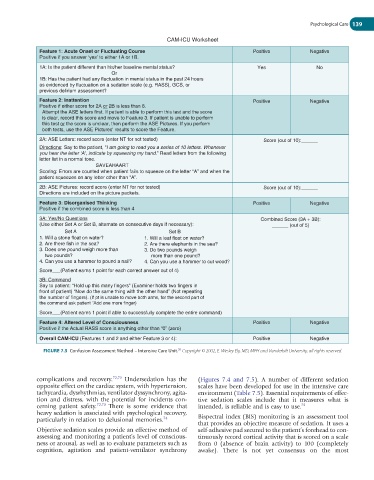
                                                        CAM-ICU Worksheet

              Feature 1: Acute Onset or Fluctuating Course                          Positive          Negative
              Positive if you answer ‘yes’ to either 1A or 1B.
              1A: Is the patient different than his/her baseline mental status?      Yes                 No
                                                                   Or
              1B: Has the patient had any fluctuation in mental status in the past 24 hours
              as evidenced by fluctuation on a sedation scale (e.g. RASS), GCS, or
              previous delirium assessment?
              Feature 2: Inattention                                                Positive          Negative
              Positive if either score for 2A or 2B is less than 8.
                Attempt the ASE letters first. If patient is able to perform this test and the score
                is clear, record this score and move to Feature 3. If patient is unable to perform
                this test or the score is unclear, then perform the ASE Pictures. If you perform
                both tests, use the ASE Pictures’ results to score the Feature.
              2A: ASE Letters: record score (enter NT for not tested)                  Score (out of 10):______
              Directions: Say to the patient, “I am going to read you a series of 10 letters. Whenever
              you hear the letter ‘A’, indicate by squeezing my hand.” Read letters from the following
              letter list in a normal tone.
                                SAVEAHAART
              Scoring: Errors are counted when patient fails to squeeze on the letter “A” and when the
              patient squeezes on any letter other than “A”.
              2B: ASE Pictures: record score (enter NT for not tested)                 Score (out of 10):______
              Directions are included on the picture packets.
              Feature 3: Disorganised Thinking                                      Positive          Negative
              Positive if the combined score is less than 4
              3A: Yes/No Questions                                                    Combined Score (3A + 3B):
              (Use either Set A or Set B, alternate on consecutive days if necessary):    ______ (out of 5)
                      Set A                             Set B
              1. Will a stone float on water?   1. Will a leaf float on water?
              2. Are there fish in the sea?     2. Are there elephants in the sea?
              3. Does one pound weigh more than  3. Do two pounds weigh
                  two pounds?                        more than one pound?
              4. Can you use a hammer to pound a nail?  4. Can you use a hammer to cut wood?
              Score___(Patient earns 1 point for each correct answer out of 4)
              3B: Command
              Say to patient: “Hold up this many fingers” (Examiner holds two fingers in
              front of patient) “Now do the same thing with the other hand” (Not repeating
              the number of fingers). (If pt is unable to move both arms, for the second part of
              the command ask patient “Add one more finger)
              Score___(Patient earns 1 point if able to successfully complete the entire command)
              Feature 4: Altered Level of Consciousness                             Positive          Negative
              Positive if the Actual RASS score is anything other than “0” (zero)
              Overall CAM-ICU (Features 1 and 2 and either Feature 3 or 4):         Positive          Negative

                                                           58
               FIGURE 7.3  Confusion Assessment Method – Intensive Care Unit.  Copyright © 2002, E. Wesley Ely, MD, MPH and Vanderbilt University, all rights reserved.


             complications  and  recovery. 72,73   Undersedation  has  the   (Figures  7.4  and  7.5).  A  number  of  different  sedation
             opposite effect on the cardiac system, with hypertension,   scales have been developed for use in the intensive care
             tachycardia, dysrhythmias, ventilator dyssynchrony, agita-  environment (Table 7.5). Essential requirements of effec-
             tion  and  distress,  with  the  potential  for  incidents  con-  tive  sedation  scales  include  that  it  measures  what  is
             cerning  patient  safety. 72,73   There  is  some  evidence  that   intended, is reliable and is easy to use. 75
             heavy sedation is associated with psychological recovery,
             particularly in relation to delusional memories. 74  Bispectral index (BIS) monitoring is an assessment tool
                                                                  that provides an objective measure of sedation. It uses a
             Objective sedation scales provide an effective method of   self-adhesive pad secured to the patient’s forehead to con-
             assessing and monitoring a patient’s level of conscious-  tinuously record cortical activity that is scored on a scale
             ness or arousal, as well as to evaluate parameters such as   from  0  (absence  of  brain  activity)  to  100  (completely
             cognition,  agitation  and  patient-ventilator  synchrony   awake).  There  is  not  yet  consensus  on  the  most

