


Page 159 - ACCCN's Critical Care Nursing
P. 159
136  P R I N C I P L E S   A N D   P R A C T I C E   O F   C R I T I C A L   C A R E


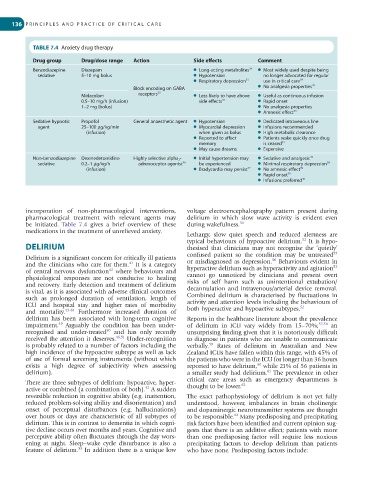
            TABLE 7.4  Anxiety drug therapy

            Drug group      Drug/dose range  Action             Side effects         Comment
            Benzodiazepine   Diazepam                           ●  Long-acting metabolites 34  ●  Most widely used despite being
             sedative       5–10 mg bolus                       ●  Hypotension         no longer advocated for regular
                                                                ●  Respiratory depression 35  use in critical care 34
                                             Block encoding on GABA                  ●  No analgesia properties 35
                            Midazolam         receptors 33      ●  Less likely to have above   ●  Useful as continuous infusion
                            0.5–10 mg/h (infusion)                side effects 35    ●  Rapid onset
                            1–2 mg (bolus)                                           ●  No analgesia properties
                                                                                     ●  Amnesic effect 35
            Sedative hypnotic   Propofol     General anaesthetic agent  ●  Hypotension  ●  Dedicated intravenous line
             agent          25–100 µg/kg/min                    ●  Myocardial depression   ●  Infusions recommended
                             (infusion)                           when given as bolus  ●  High metabolic clearance
                                                                ●  Reported to affect   ●  Patients wake quickly once drug
                                                                  memory               is ceased 34
                                                                ●  May cause dreams  ●  Expensive
            Non-benzodiazepine  Dexmedetomidine  Highly selective alpha 2 -  ●  Initial hypertension may   ●  Sedative and analgesic 36
             sedative       0.2–1 µg/kg/h     adrenoceptor agonist 36  be experienced  ●  Minimal respiratory depression 38
                             (infusion)                         ●  Bradycardia may persist 37  ●  No amnesic effect 39
                                                                                     ●  Rapid onset 40
                                                                                     ●  Infusions preferred 40


         incorporation  of  non-pharmacological  interventions,   voltage  electroencephalography  pattern  present  during
         pharmacological  treatment  with  relevant  agents  may     delirium  in  which  slow  wave  activity  is  evident  even
         be  initiated.  Table  7.4  gives  a  brief  overview  of  these   during wakefulness. 54
         medications in the treatment of unrelieved anxiety.
                                                              Lethargy,  slow  quiet  speech  and  reduced  alertness  are
                                                                                                    52
                                                              typical  behaviours  of  hypoactive  delirium.   It  is  hypo-
         DELIRIUM                                             thesised  that  clinicians  may  not  recognise  the  ‘quietly’
                                                                                                              55
                                                              confused  patient  so  the  condition  may  be  untreated
         Delirium is a significant concern for critically ill patients                    56
                                           41
         and  the  clinicians  who  care  for  them.   It  is  a  category   or misdiagnosed as depression.  Behaviours evident in
                                                                                                              52
                                     42
         of  central  nervous  dysfunction   where  behaviours  and   hyperactive delirium such as hyperactivity and agitation
         physiological  responses  are  not  conducive  to  healing   cannot  go  unnoticed  by  clinicians  and  present  overt
         and recovery. Early detection and treatment of delirium   risks  of  self  harm  such  as  unintentional  extubation/
         is vital, as it is associated with adverse clinical outcomes   decannulation  and  intravenous/arterial  device  removal.
         such  as  prolonged  duration  of  ventilation,  length  of   Combined  delirium  is  characterised  by  fluctuations  in
         ICU  and  hospital  stay  and  higher  rates  of  morbidity   activity and attention levels including the behaviours of
                                                                                                   52
         and  mortality. 43-48   Furthermore  increased  duration  of   both hyperactive and hypoactive subtypes.
         delirium  has  been  associated  with  long-term  cognitive   Reports in the healthcare literature about the prevalence
                    49
         impairment.   Arguably  the  condition  has  been  under-  of  delirium  in  ICU  vary  widely  from  15–70%; 57,58   an
                                    50
         recognised  and  under-treated   and  has  only  recently   unsurprising finding given that it is notoriously difficult
         received the attention it deserves. 46,51  Under-recognition   to diagnose in patients who are unable to communicate
                                                                     59
         is probably related to a number of factors including the   verbally.   Rates  of  delirium  in  Australian  and  New
         high incidence of the hypoactive subtype as well as lack   Zealand ICUs have fallen within this range, with 45% of
         of use of formal screening instruments (without which   the patients who were in the ICU for longer than 36 hours
         exists  a  high  degree  of  subjectivity  when  assessing   reported to have delirium,  while 21% of 56 patients in
                                                                                     60
                                                                                        61
         delirium).                                           a smaller study had delirium.  The prevalence in other
                                                              critical  care  areas  such  as  emergency  departments  is
         There are three subtypes of delirium: hypoactive, hyper-               62
                                                 52
         active or combined (a combination of both).  A sudden   thought to be lower.
         reversible reduction in cognitive ability (e.g. inattention,   The  exact  pathophysiology  of  delirium  is  not  yet  fully
         reduced problem-solving ability and disorientation) and   understood,  however,  imbalances  in  brain  cholinergic
         onset  of  perceptual  disturbances  (e.g.  hallucinations)   and dopaminergic neurotransmitter systems are thought
         over  hours  or  days  are  characteristic  of  all  subtypes  of   to be responsible.  Many predisposing and precipitating
                                                                              42
         delirium. This is in contrast to dementia in which cogni-  risk factors have been identified and current opinion sug-
         tive decline occurs over months and years. Cognitive and   gests that there is an additive effect; patients with more
         perceptive ability often fluctuates through the day wors-  than  one  predisposing  factor  will  require  less  noxious
         ening  at  night.  Sleep–wake  cycle  disturbance  is  also  a   precipitating  factors  to  develop  delirium  than  patients
         feature of delirium.  In addition there is a unique low   who have none. Predisposing factors include:
                           53

