


Page 158 - ACCCN's Critical Care Nursing
P. 158
Psychological Care 135


               TABLE 7.2  Anxiety self-report scales                TABLE 7.3  Non-pharmacological measures to
                                                                    reduce anxiety
               Scale       Number of Items  Comments
                                                                    Nurse-initiated treatments  Environmental factors
               Hospital    14 (including 7   Easy and fast to complete
                 Anxiety and   anxiety items)  Extensively used and   Patient massage 26    Provision of natural light 27,28
                 Depression                 therefore international
                 Scale                      comparisons are         Aromatherapy 24,29      Calming wall colours such as
                 (HADS) 14                  available                                         blue, green and violet 27,28
                                           Demonstrated validity 15  Music therapy 2,30-32  Noise reduction with
               Depression   21 (including 7   Items measured on scale                         consideration of alarms,
                 Anxiety and   anxiety items)  of 0 (did not apply to                         paging systems, talking, etc.
                 Stress Scale               me at all) to 3 (applied
                 21 (DASS                   to me very much or
                 21) 16                     most of the time)
                                           Demonstrated validity in   consent. Beneficial effects that have been reported include
                                            clinical populations 17
                                                                  lowered  blood  pressure,  heart  rate  and  respiratory  rate,
               Spielberger   20 items      Items measured on a    improved  sleep  and  reduced  stress,  anxiety  and  pain,
                 State                      scale of 1 (not at all) to   although as with any therapy, each non-pharmacological
                 Anxiety                    4 (very much so)
                 Inventory                 Validity demonstrated in   treatment  may  have  different  effects  on  individual
                                                                                                                23-25
                 (SAI) 1                    various populations 1  patients, consequently ongoing assessment is essential.
                                           Too long for routine   In addition, the safety of these therapies within the criti-
                                            clinical use, but may   cal  care  environment  has  not  been  well  demonstrated,
                                            be useful in associated   necessitating  a  high  level  of  monitoring  through
                                            research
                                                                  administration.
               Visual      1 item          10 cm/100 mm line from
                 Analogue                   ‘not at all anxious’ to
                 Scale                      ‘very anxious’
                 – Anxiety                 Demonstrated validity 18
                 (VAS–A)                                            Practice tip
               Faces Anxiety   1 item      5 possible responses or
                 Scale 19                   ‘faces’ to reflect anxiety  Ask your patient or his/her family if he/she likes music to help
                                           Fast and easy to use     relax. Have the family bring in a music player with some favou-
                                           Validity has been        rite  music  and  headphones.  Prepare  the  patient  for  a  rest
                                            demonstrated in a       period. Ensure that pain relief is sufficient, all interventions are
                                            small number of ICU     complete, and the patient is comfortable. Assess the anxiety or
                                            cohorts 20,21
                                                                    level of sedation beforehand and then commence at least 30
                                                                    minutes of uninterrupted music. Reassess after the session, and
                                                                    record and report results.


                                                                    Practice tip
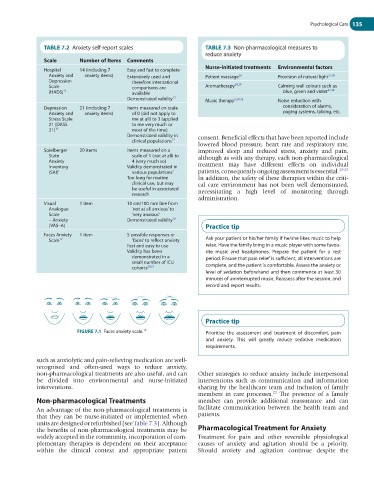
                          FIGURE 7.1  Faces anxiety scale.          Prioritise  the  assessment  and  treatment  of  discomfort,  pain
                                                19
                                                                    and  anxiety.  This  will  greatly  reduce  sedative  medication
                                                                    requirements.

             such as anxiolytic and pain-relieving medication are well-
             recognised  and  often-used  ways  to  reduce  anxiety,
             non-pharmacological treatments are also useful, and can   Other strategies to reduce anxiety include interpersonal
             be  divided  into  environmental  and  nurse-initiated   interventions  such  as  communication  and  information
             interventions.                                       sharing by the healthcare team and inclusion of family
                                                                                          22
                                                                  members  in  care  processes.   The  presence  of  a  family
             Non-pharmacological Treatments                       member  can  provide  additional  reassurance  and  can
             An advantage of the non-pharmacological treatments is   facilitate  communication  between  the  health  team  and
             that  they  can  be  nurse-initiated  or  implemented  when   patients.
             units are designed or refurbished (see Table 7.3). Although
             the benefits of non-pharmacological treatments may be   Pharmacological Treatment for Anxiety
             widely accepted in the community, incorporation of com-  Treatment  for  pain  and  other  reversible  physiological
             plementary  therapies  is  dependent  on  their  acceptance   causes  of  anxiety  and  agitation  should  be  a  priority.
             within  the  clinical  context  and  appropriate  patient   Should  anxiety  and  agitation  continue  despite  the

