


Page 246 - ACCCN's Critical Care Nursing
P. 246
Cardiovascular Alterations and Management 223

                of bleeding. Along with vital signs, these are attended   patients presenting with chest pain who meet the indica-
                every 15 minutes for the first hour, half-hourly for an   tions for reperfusion when: (a) facilities are available and
                hour, and then hourly according to the patient’s con-  can be achieved within 60 minutes; (b) there are contra-
                dition,  however,  patients  are  advised  to  report  any   indications  to  fibrinolytic  therapy  described  above;  (c)
                bleeding postdischarge as well.                   ischaemia  would  result  in  large  anterior  AMI  within  4
             ●  ECG monitoring. This includes 12-lead ECG on return   hours;  or  (d)  haemodynamic  instability  or  cardiogenic
                and ongoing ECG monitoring and chest pain assess-  shock are present.
                ment  to  detect  reocclusion.  Patients  need  to  be
                requested to inform nursing staff of any chest pain or   A stent is usually inserted to prevent abrupt closure and
                                                                                           26
                discomfort.                                       maintain patency for longer.  The structure of the stent
             ●  IV  anticoagulants  such  as  heparin  and/or  oral  anti-  within the vessel enlarges the lumen and prevents vessel
                platelet drugs, such as clopidogrel or ticlopidine, may   stricture.  Restenosis  due  to  intimal  hyperplasia  is  a
                be  given  following  thrombolysis  to  prevent  reocclu-  relatively common complication, occurring 10–12 weeks
                sion  in  the  stent.  Assess  International  Normalised   postimplantation.  In  response  to  this  problem,  drug-
                Ratio (INR), prothrombin (PT) and partial thrombo-  eluting  stents  have  been  developed.  The  drug  coatings
                plastin time (PTT), as bleeding is more likely to occur   include sirolimus, a macrolide antibiotic that has been
                if anticoagulants are above the therapeutic range.  demonstrated  to  effectively  decrease  hyperplasia  and
                                                                                         27
                                                                  prevent  reduction  of  flow.   Paclitaxel  has  also  shown
             Coronary angioplasty                                 promise in a series of studies.  In addition to dactino-
                                                                                            28
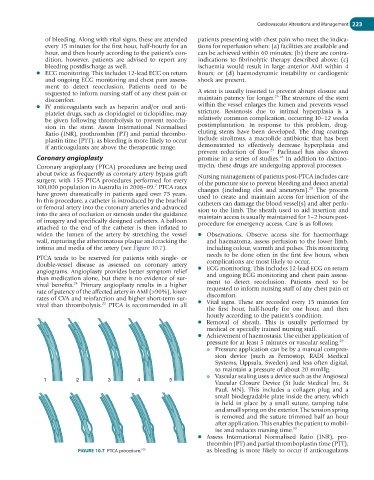
             Coronary angioplasty (PTCA) procedures are being used   mycin, these drugs are undergoing approval processes.
             about twice as frequently as coronary artery bypass graft   Nursing management of patients post-PTCA includes care
             surgery, with 155 PTCA procedures performed for every   of the puncture site to prevent bleeding and detect arterial
                                                    2
             100,000 population in Australia in 2008–09.  PTCA rates   changes  (including  clot  and  aneurysm).   The  process
                                                                                                      29
             have grown dramatically in patients aged over 75 years.   used to create and maintain access for insertion of the
             In this procedure, a catheter is introduced by the brachial   catheters can damage the blood vessel(s) and alter perfu-
             or femoral artery into the coronary arteries and advanced   sion to the limb. The sheath used to aid insertion and
             into the area of occlusion or stenosis under the guidance   maintain access is usually maintained for 1–2 hours post-
             of imagery and specifically designed catheters. A balloon   procedure for emergency access. Care is as follows:
             attached  to  the  end  of  the  catheter  is  then  inflated  to
             widen  the  lumen  of  the  artery  by  stretching  the  vessel   ●  Observations.  Observe  access  site  for  haemorrhage
             wall, rupturing the atheromatous plaque and cracking the   and haematoma, assess perfusion to the lower limb,
             intima and media of the artery (see Figure 10.7).       including colour, warmth and pulses. This monitoring
                                                                     needs to be done often in the first few hours, when
             PTCA  tends  to  be  reserved  for  patients  with  single-  or
             double-vessel  disease  as  assessed  on  coronary  artery   complications are most likely to occur.
             angiograms. Angioplasty provides better symptom relief   ●  ECG monitoring. This includes 12-lead ECG on return
             than medication alone, but there is no evidence of sur-  and ongoing ECG monitoring and chest pain assess-
             vival  benefits.   Primary  angioplasty  results  in  a  higher   ment  to  detect  reocclusion.  Patients  need  to  be
                         24
             rate of patency of the affected artery in AMI (>90%), lower   requested to inform nursing staff of any chest pain or
             rates of CVA and reinfarction and higher short-term sur-  discomfort.
             vival than thrombolysis.  PTCA is recommended in all   ●  Vital signs. These are recorded every 15 minutes for
                                  25
                                                                     the  first  hour,  half-hourly  for  one  hour,  and  then
                                                                     hourly according to the patient’s condition.
                                                                  ●  Removal  of  sheath.  This  is  usually  performed  by
                                                                     medical or specially trained nursing staff.
                                                                  ●  Achievement of haemostasis. Use either application of
                                                                     pressure for at least 5 minutes or vascular sealing. 29
                                                                     ●  Pressure application can be by a manual compres-
                                                                       sion  device  (such  as  Femostop,  RADI  Medical
                                                                       Systems, Uppsala, Sweden) and less often digital,
                                                                       to maintain a pressure of about 20 mmHg.
                                                                     ●  Vascular sealing uses a device such as the Angioseal
               1          2         3         4         5
                                                                       Vascular  Closure  Device  (St  Jude  Medical  Inc,  St
                                                                       Paul,  MN).  This  includes  a  collagen  plug  and  a
                                                                       small biodegradable plate inside the artery, which
                                                                       is  held  in  place  by  a  small  suture,  tamping  tube
                                                                       and small spring on the exterior. The tension spring
                                                                       is removed and the suture trimmed half an hour
                                                                       after application. This enables the patient to mobil-
                                                                       ise and reduces nursing time. 30
                                                                  ●  Assess  International  Normalised  Ratio  (INR),  pro-
                                                                     thrombin (PT) and partial thromboplastin time (PTT),
                           FIGURE 10.7  PTCA procedure.              as bleeding is more likely to occur if anticoagulants
                                               106

