


Page 248 - ACCCN's Critical Care Nursing
P. 248
Cardiovascular Alterations and Management 225


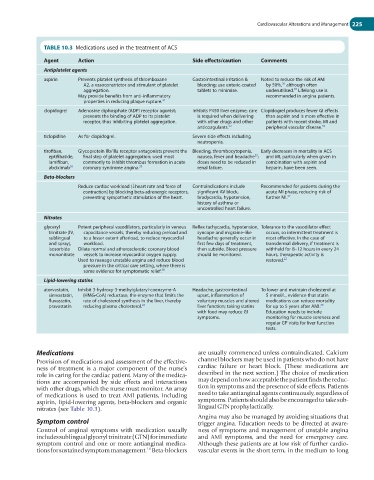
               TABLE 10.3  Medications used in the treatment of ACS

               Agent       Action                               Side effects/caution  Comments
               Antiplatelet agents
               aspirin     Prevents platelet synthesis of thromboxane    Gastrointestinal irritation &   Noted to reduce the risk of AMI
                            A2, a vasoconstrictor and stimulant of platelet   bleeding; use enteric-coated   by 50%,  although often
                                                                                             30
                            aggregation.                          tablets to minimise.  underutilised.  Lifelong use is
                                                                                                 33
                           May provide benefits from anti-inflammatory                  recommended in angina patients.
                            properties in reducing plaque rupture. 31
               clopidogrel  Adenosine diphosphate (ADP) receptor agonist;   Inhibits P450 liver enzyme; care  Clopidogrel produces fewer GI effects
                            prevents the binding of ADP to its platelet    is required when delivering   than aspirin and is more effective in
                            receptor, thus inhibiting platelet aggregation.  with other drugs and other   patients with recent stroke, MI and
                                                                  anticoagulants. 22    peripheral vascular disease. 34
               ticlopidine  As for clopidogrel.                 Severe side effects including
                                                                  neutropenia.
               tirofiban,   Glycoprotein IIb/IIIa receptor antagonists prevent the  Bleeding, thrombocytopenia,   Early decreases in mortality in ACS
                 eptifibatide,   final step of platelet aggregation; used most   nausea, fever and headache ;    and MI, particularly when given in
                                                                                    22
                 lamifiban,   commonly to inhibit thrombus formation in acute   doses need to be reduced in   combination with aspirin and
                 abciximab 36  coronary syndrome angina. 35       renal failure.        heparin, have been seen.
               Beta-blockers
                           Reduce cardiac workload (↓heart rate and force of   Contraindications include   Recommended for patients during the
                            contraction) by blocking beta-adrenergic receptors,   significant AV block,   acute MI phase, reducing risk of
                            preventing sympathetic stimulation of the heart.  bradycardia, hypotension,   further MI. 37
                                                                  history of asthma or
                                                                  uncontrolled heart failure.
               Nitrates
               glyceryl    Potent peripheral vasodilators, particularly in venous   Reflex tachycardia, hypotension,  Tolerance to the vasodilator effect
                 trinitrate (IV,   capacitance vessels, thereby reducing preload and   syncope and migraine-like   occurs, so intermittent treatment is
                 sublingual   to a lesser extent afterload, to reduce myocardial   headache; generally occur in   most effective. In the case of
                 and spray),   workload.                          first few days of treatment,   transdermal delivery, if treatment is
                 isosorbide   Dilate normal and atherosclerotic coronary blood   then subside. Blood pressure   withheld for 8–12 hours in every 24
                 mononitrate  vessels to increase myocardial oxygen supply.  should be monitored.  hours, therapeutic activity is
                           Used to manage unstable angina and reduce blood              restored. 22
                            pressure in the critical care setting, where there is
                            some evidence for symptomatic relief. 38
               Lipid-lowering statins
               atorvastatin,   Inhibit 3-hydroxy-3-methylglutaryl-coenzyme-A   Headache, gastrointestinal   To lower and maintain cholesterol at
                 simvastatin,   (HMG-CoA) reductase, the enzyme that limits the   upset, inflammation of   5 mmol/L, evidence that statin
                 fluvastatin,   rate of cholesterol synthesis in the liver, thereby   voluntary muscles and altered   medications can reduce mortality
                                                                                                          39
                 pravastatin  reducing plasma cholesterol. 22     liver function; taking statins   for up to 5 years after AMI.
                                                                  with food may reduce GI   Education needs to include
                                                                  symptoms.             monitoring for muscle soreness and
                                                                                        regular GP visits for liver function
                                                                                        tests.


             Medications                                          are usually commenced unless contraindicated. Calcium
             Provision of medications and assessment of the effective-  channel blockers may be used in patients who do not have
             ness  of  treatment  is  a  major  component  of  the  nurse’s   cardiac  failure  or  heart  block.  (These  medications  are
             role in caring for the cardiac patient. Many of the medica-  described in the next section.) The choice of medication
             tions  are  accompanied  by  side  effects  and  interactions   may depend on how acceptable the patient finds the reduc-
             with other drugs, which the nurse must monitor. An array   tion in symptoms and the presence of side effects. Patients
             of medications is used to treat AMI patients, including   need to take antianginal agents continuously, regardless of
             aspirin, lipid-lowering agents, beta-blockers and organic   symptoms. Patients should also be encouraged to take sub-
             nitrates (see Table 10.3).                           lingual GTN prophylactically.
                                                                  Angina may also be managed by avoiding situations that
             Symptom control                                      trigger angina. Education needs to be directed at aware-
             Control  of  anginal  symptoms  with  medication  usually   ness of symptoms and management of unstable angina
             includes sublingual glyceryl trinitrate (GTN) for immediate   and  AMI  symptoms,  and  the  need  for  emergency  care.
             symptom control and one or more antianginal medica-  Although these patients are at low risk of further cardio-
                                                 18
             tions for sustained symptom management.  Beta-blockers   vascular events in the short term, in the medium to long

