


Page 244 - ACCCN's Critical Care Nursing
P. 244
Cardiovascular Alterations and Management 221

                                                                  Thrombolytic therapy
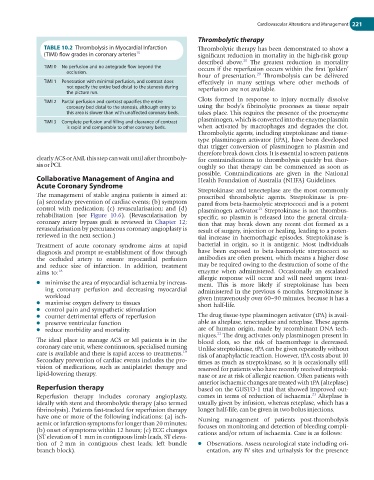
               TABLE 10.2  Thrombolysis in Myocardial Infarction   Thrombolytic therapy has been demonstrated to show a
               (TIMI) flow grades in coronary arteries 15         significant reduction in mortality in the high-risk group
                                                                                 20
                                                                  described  above.   The  greatest  reduction  in  mortality
               TIMI 0  No perfusion and no antegrade flow beyond the   occurs if the reperfusion occurs within the first ‘golden’
                       occlusion.
                                                                                     20
                                                                  hour  of  presentation.   Thrombolysis  can  be  delivered
               TIMI 1  Penetration with minimal perfusion, and contrast does   effectively  in  many  settings  where  other  methods  of
                       not opacify the entire bed distal to the stenosis during   reperfusion are not available.
                       the picture run.
                                                                  Clots  formed  in  response  to  injury  normally  dissolve
               TIMI 2  Partial perfusion and contrast opacifies the entire
                       coronary bed distal to the stenosis, although entry to   using  the  body’s  fibrinolytic  processes  as  tissue  repair
                       this area is slower than with unaffected coronary beds.  takes place. This requires the presence of the proenzyme
                                                                  plasminogen, which is converted into the enzyme plasmin
               TIMI 3  Complete perfusion and filling and clearance of contrast
                       is rapid and comparable to other coronary beds.  when  activated  by  macrophages  and  degrades  the  clot.
                                                                  Thrombolytic agents, including streptokinase and tissue-
                                                                  type plasminogen activator (tPA), have been developed
                                                                  that  trigger  conversion  of  plasminogen  to  plasmin and
                                                                  therefore break down clots. It is essential to screen patients
             clearly ACS or AMI, this step can wait until after thromboly-  for contraindications to thrombolysis quickly but thor-
             sis or PCI.                                          oughly  so  that  therapy  can  be  commenced  as  soon  as
                                                                  possible.  Contraindications  are  given  in  the  National
             Collaborative Management of Angina and               Health Foundation of Australia (NHFA) Guidelines.
             Acute Coronary Syndrome
             The management of stable angina patients is aimed at:   Streptokinase and tenecteplase are the most commonly
                                                                  prescribed  thrombolytic  agents.  Streptokinase  is  pre-
             (a) secondary prevention of cardiac events; (b) symptom   pared from beta-haemolytic streptococci and is a potent
             control  with  medication;  (c)  revascularisation;  and  (d)   plasminogen activator.  Streptokinase is not thrombus-
                                                                                      21
             rehabilitation  (see  Figure  10.6).  (Revascularisation  by   specific, so plasmin is released into the general circula-
             coronary  artery  bypass  graft  is  reviewed  in  Chapter  12;   tion  that  may  break  down  any  recent  clot  formed  as  a
             revascularisation by percutaneous coronary angioplasty is   result of surgery, injection or healing, leading to a poten-
             reviewed in the next section.)                       tial increase in haemorrhagic episodes. Streptokinase is
             Treatment  of  acute  coronary  syndrome  aims  at  rapid   bacterial  in  origin,  so  it  is  antigenic.  Most  individuals
             diagnosis and prompt re-establishment of flow through   have  been  exposed  to  beta-haemolytic  streptococci  so
             the  occluded  artery  to  ensure  myocardial  perfusion     antibodies are often present, which means a higher dose
             and  reduce  size  of  infarction.  In  addition,  treatment    may be required owing to the destruction of some of the
             aims to: 18                                          enzyme  when  administered.  Occasionally  an  escalated
                                                                  allergic  response  will  occur  and  will  need  urgent  treat-
             ●  minimise the area of myocardial ischaemia by increas-  ment.  This  is  more  likely  if  streptokinase  has  been
                ing  coronary  perfusion  and  decreasing  myocardial   administered in the previous 6 months. Streptokinase is
                workload                                          given intravenously over 60–90 minutes, because it has a
             ●  maximise oxygen delivery to tissues               short half-life.
             ●  control pain and sympathetic stimulation
             ●  counter detrimental effects of reperfusion        The drug tissue-type plasminogen activator (tPA) is avail-
             ●  preserve ventricular function                     able as alteplase, tenecteplase and reteplase. These agents
             ●  reduce morbidity and mortality.                   are of human origin, made by recombinant DNA tech-
                                                                  niques.  The drug activates only plasminogen present in
                                                                        22
             The ideal place to manage ACS or MI patients is in the   blood  clots,  so  the  risk  of  haemorrhage  is  decreased.
             coronary care unit, where continuous, specialised nursing   Unlike streptokinase, tPA can be given repeatedly without
                                                             19
             care is available and there is rapid access to treatments.    risk of anaphylactic reaction. However, tPA costs about 10
             Secondary prevention of cardiac events includes the pro-  times as much as streptokinase, so it is occasionally still
             vision  of  medications,  such  as  antiplatelet  therapy  and   reserved for patients who have recently received streptoki-
             lipid-lowering therapy.                              nase or are at risk of allergic reaction. Often patients with
                                                                  anterior ischaemic changes are treated with tPA (alteplase)
             Reperfusion therapy                                  based on the GUSTO-1 trial that showed improved out-
                                                                                                       23
             Reperfusion  therapy  includes  coronary  angioplasty,   comes in terms of reduction of ischaemia.  Alteplase is
             ideally with stent and thrombolytic therapy (also termed   usually given by infusion, whereas reteplase, which has a
             fibrinolysis). Patients fast-tracked for reperfusion therapy   longer half-life, can be given in two bolus injections.
             have one or more of the following indications: (a) isch-  Nursing  management  of  patients  post-thrombolysis
             aemic or infarction symptoms for longer than 20 minutes;   focuses on monitoring and detection of bleeding compli-
             (b) onset of symptoms within 12 hours; (c) ECG changes   cations and/or return of ischaemia. Care is as follows:
             (ST elevation of 1 mm in contiguous limb leads, ST eleva-
             tion  of  2 mm  in  contiguous  chest  leads;  left  bundle   ●  Observations. Assess neurological state including ori-
             branch block).                                          entation, any IV sites and urinalysis for the presence

