


Page 242 - ACCCN's Critical Care Nursing
P. 242
Cardiovascular Alterations and Management 219


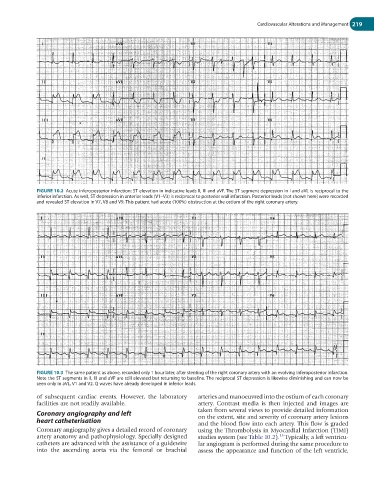
             FIGURE 10.2  Acute inferoposterior infarction: ST elevation in indicative leads II, III and aVF. The ST segment depression in I and aVL is reciprocal to the
             inferior infarction. As well, ST depression in anterior leads (V1–V3) is reciprocal to posterior wall infarction. Posterior leads (not shown here) were recorded
             and revealed ST elevation in V7, V8 and V9. This patient had acute (100%) obstruction at the ostium of the right coronary artery.


             FIGURE 10.3  The same patient as above, recorded only 1 hour later, after stenting of the right coronary artery with an evolving inferoposterior infarction.
             Note the ST segments in II, III and aVF are still elevated but returning to baseline. The reciprocal ST depression is likewise diminishing and can now be
             seen only in aVL, V1 and V2. Q waves have already developed in inferior leads.
             of  subsequent  cardiac  events.  However,  the  laboratory   arteries and manoeuvred into the ostium of each coronary
             facilities are not readily available.                artery.  Contrast  media  is  then  injected  and  images  are
             Coronary angiography and left                        taken from several views to provide detailed information
                                                                  on the extent, site and severity of coronary artery lesions
             heart catheterisation                                and the blood flow into each artery. This flow is graded
             Coronary angiography gives a detailed record of coronary   using the Thrombolysis in Myocardial Infarction (TIMI)
             artery anatomy and pathophysiology. Specially designed   studies system (see Table 10.2).  Typically, a left ventricu-
                                                                                            15
             catheters are advanced with the assistance of a guidewire   lar angiogram is performed during the same procedure to
             into  the  ascending  aorta  via  the  femoral  or  brachial   assess the appearance and function of the left ventricle,

