


Page 243 - ACCCN's Critical Care Nursing
P. 243
220  P R I N C I P L E S   A N D   P R A C T I C E   O F   C R I T I C A L   C A R E


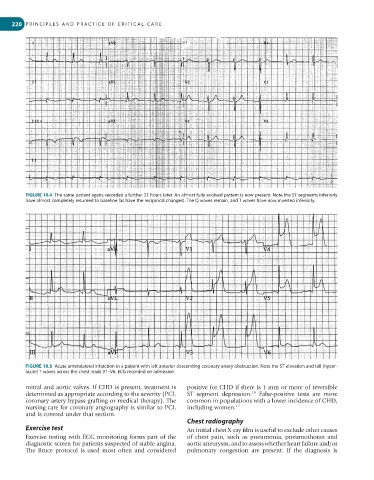
         FIGURE 10.4  The same patient again, recorded a further 21 hours later. An almost fully evolved pattern is now present. Note the ST segments inferiorly
         have almost completely returned to baseline (as have the reciprocal changes). The Q waves remain, and T waves have now inverted inferiorly.


         FIGURE 10.5  Acute anterolateral infarction in a patient with left anterior descending coronary artery obstruction. Note the ST elevation and tall (hyper-
         acute) T waves across the chest leads V1–V6. ECG recorded on admission.

         mitral and aortic valves. If CHD is present, treatment is   positive for CHD if there is 1 mm or more of reversible
                                                                                   16
         determined as appropriate according to the severity (PCI,   ST  segment  depression.   False-positive  tests  are  more
         coronary artery bypass grafting or medical therapy). The   common in populations with a lower incidence of CHD,
         nursing care for coronary angiography is similar to PCI,   including women. 17
         and is covered under that section.
                                                              Chest radiography
         Exercise test                                        An initial chest X-ray film is useful to exclude other causes
         Exercise testing with ECG monitoring forms part of the   of  chest  pain,  such  as  pneumonia,  pneumothorax  and
         diagnostic screen for patients suspected of stable angina.   aortic aneurysm, and to assess whether heart failure and/or
         The  Bruce  protocol  is  used  most  often  and  considered   pulmonary  congestion  are  present.  If  the  diagnosis  is

