


Page 256 - ACCCN's Critical Care Nursing
P. 256
Cardiovascular Alterations and Management 233

                                                                  ●  urinalysis for specific gravity and proteinuria.
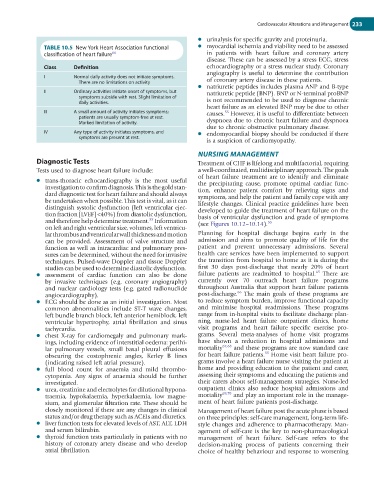
               TABLE 10.5  New York Heart Association functional   ●  myocardial ischemia and viability need to be assessed
               classification of heart failure 64                    in  patients  with  heart  failure  and  coronary  artery
                                                                     disease. These can be assessed by a stress ECG, stress
               Class     Definition                                  echocardiography or a stress nuclear study. Coronary
                                                                     angiography is useful to determine the contribution
               I         Normal daily activity does not initiate symptoms.
                           There are no limitations on activity      of coronary artery disease in these patients.
                                                                  ●  natriuretic peptides includes plasma ANP and B-type
               II        Ordinary activities initiate onset of symptoms, but   natriuretic peptide (BNP). BNP or N-terminal proBNP
                           symptoms subside with rest. Slight limitation of
                           daily activities.                         is not recommended to be used to diagnose chronic
                                                                     heart failure as an elevated BNP may be due to other
               III       A small amount of activity initiates symptoms;   causes.  However, it is useful to differentiate between
                                                                           55
                           patients are usually symptom-free at rest.
                           Marked limitation of activity.            dyspnoea due to chronic heart failure and dyspnoea
                                                                     due to chronic obstructive pulmonary disease.
               IV        Any type of activity initiates symptoms, and   ●  endomyocardial biopsy should be conducted if there
                           symptoms are present at rest.
                                                                     is a suspicion of cardiomyopathy.
                                                                  NURSING MANAGEMENT
             Diagnostic Tests                                     Treatment of CHF is lifelong and multifactorial, requiring
             Tests used to diagnose heart failure include:        a well-coordinated, multidisciplinary approach. The goals
                                                                  of  heart  failure  treatment  are  to  identify  and  eliminate
             ●  trans-thoracic  echocardiography  is  the  most  useful   the  precipitating  cause,  promote  optimal  cardiac  func-
                investigation to confirm diagnosis. This is the gold stan-  tion,  enhance  patient  comfort  by  relieving  signs  and
                dard diagnostic test for heart failure and should always   symptoms, and help the patient and family cope with any
                be undertaken when possible. This test is vital, as it can   lifestyle changes. Clinical practice guidelines have been
                distinguish systolic dysfunction (left ventricular ejec-  developed to guide the treatment of heart failure on the
                tion fraction [LVEF] <40%) from diastolic dysfunction,   basis of ventricular dysfunction and grade of symptoms
                                                  55
                and therefore help determine treatment.  Information   (see Figures 10.12–10.14). 55
                on left and right ventricular size, volumes, left ventricu-
                lar thrombus and ventricular wall thickness and motion   Planning  for  hospital  discharge  begins  early  in  the
                can  be  provided.  Assessment  of  valve  structure  and   admission  and  aims  to  promote  quality  of  life  for  the
                function as well as intracardiac and pulmonary pres-  patient  and  prevent  unnecessary  admissions.  Several
                sures can be determined, without the need for invasive   health care services have been implemented to support
                techniques. Pulsed-wave Doppler and tissue Doppler   the transition from hospital to home as it is during the
                studies can be used to determine diastolic dysfunction.  first  30  days  post-discharge  that  nearly  20%  of  heart
                                                                                                        65
             ●  assessment  of  cardiac  function  can  also  be  done   failure  patients  are  readmitted  to  hospital.   There  are
                by  invasive  techniques  (e.g.  coronary  angiography)   currently  over  70  outreach  heart  failure  programs
                and nuclear cardiology tests (e.g. gated radionuclide   throughout Australia that support heart failure patients
                                                                               66
                angiocardiography).                               post-discharge.   The  main  goals  of  these  programs  are
             ●  ECG should be done as an initial investigation. Most   to reduce symptom burden, improve functional capacity
                common  abnormalities  include  ST-T  wave  changes,   and  minimise  hospital  readmissions.  These  programs
                left bundle branch block, left anterior hemiblock, left   range from in-hospital visits to facilitate discharge plan-
                ventricular  hypertrophy,  atrial  fibrillation  and  sinus   ning,  nurse-led  heart  failure  outpatient  clinics,  home
                tachycardia.                                      visit  programs  and  heart  failure  specific  exercise  pro-
             ●  chest  X-ray  for  cardiomegaly  and  pulmonary  mark-  grams.  Several  meta-analyses  of  home  visit  programs
                ings, including evidence of interstitial oedema: perihi-  have  shown  a  reduction  in  hospital  admissions  and
                lar  pulmonary  vessels,  small  basal  pleural  effusions   mortality 67,68  and these programs are now standard care
                                                                                        55
                obscuring  the  costophrenic  angles,  Kerley  B  lines   for heart failure patients.  Home visit heart failure pro-
                (indicating raised left atrial pressure).         grams involve a heart failure nurse visiting the patient at
             ●  full  blood  count  for  anaemia  and  mild  thrombo-  home and providing education to the patient and carer,
                cytopenia.  Any  signs  of  anaemia  should  be  further   assessing their symptoms and educating the patients and
                investigated.                                     their carers about self-management strategies. Nurse-led
             ●  urea, creatinine and electrolytes for dilutional hypona-  outpatient  clinics  also  reduce  hospital  admissions  and
                traemia,  hypokalaemia,  hyperkalaemia,  low  magne-  mortality 69,70  and play an important role in the manage-
                sium, and glomerular filtration rate. These should be   ment of heart failure patients post-discharge.
                closely monitored if there are any changes in clinical   Management of heart failure post the acute phase is based
                status and/or drug therapy such as ACEIs and diuretics.  on three principles: self-care management, long-term life-
             ●  liver function tests for elevated levels of AST, ALT, LDH   style changes and adherence to pharmacotherapy. Man-
                and serum bilirubin.                              agement of self-care is the key to non-pharmacological
             ●  thyroid function tests particularly in patients with no   management  of  heart  failure.  Self-care  refers  to  the
                history  of  coronary  artery  disease  and  who  develop   decision-making  process  of  patients  concerning  their
                atrial fibrillation.                              choice of healthy behaviour and response to worsening

