


Page 309 - ACCCN's Critical Care Nursing
P. 309
286  P R I N C I P L E S   A N D   P R A C T I C E   O F   C R I T I C A L   C A R E


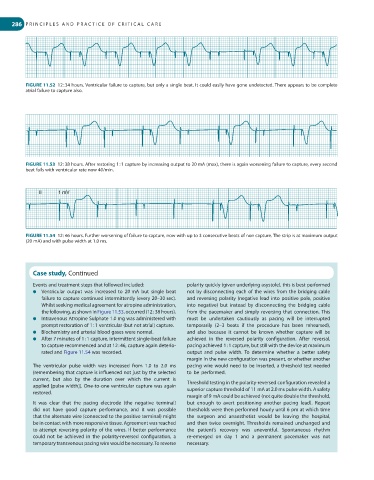
         FIGURE 11.52  12 : 34 hours. Ventricular failure to capture, but only a single beat. It could easily have gone undetected. There appears to be complete
         atrial failure to capture also.


         FIGURE 11.53  12 : 38 hours. After restoring 1 : 1 capture by increasing output to 20 mA (max), there is again worsening failure to capture, every second
         beat fails with ventricular rate now 40/min.


              II    1 mV


         FIGURE 11.54  12 : 46 hours. Further worsening of failure to capture, now with up to 3 consecutive beats of non capture. The strip is at maximum output
         (20 mA) and with pulse width at 1.0 ms.


            Case study, Continued
            Events and treatment steps that followed included:  polarity quickly (given underlying asystole), this is best performed
            ●  Ventricular  output  was  increased  to  20 mA  but  single  beat   not by disconnecting each of the wires from the bridging cable
               failure to capture continued intermittently (every 20–30 sec).   and reversing polarity (negative lead into positive pole, positive
               Whilst seeking medical agreement for atropine administration,   into  negative)  but  instead  by  disconnecting  the  bridging  cable
               the following, as shown in Figure 11.53, occurred (12 : 38 hours).  from  the  pacemaker  and  simply  reversing  that  connection. This
            ●  Intravenous Atropine Sulphate 1.0 mg was administered with   must  be  undertaken  cautiously  as  pacing  will  be  interrupted
               prompt restoration of 1 : 1 ventricular (but not atrial) capture.  temporarily  (2–3  beats  if  the  procedure  has  been  rehearsed),
            ●  Biochemistry and arterial blood gases were normal.  and  also  because  it  cannot  be  known  whether  capture  will  be
            ●  After 7 minutes of 1 : 1 capture, intermittent single-beat failure   achieved  in  the  reversed  polarity  configuration.  After  reversal,
               to capture recommenced and at 12 : 46, capture again deterio-  pacing achieved 1 : 1 capture, but still with the device at maximum
               rated and Figure 11.54 was recorded.           output  and  pulse  width.  To  determine  whether  a  better  safety
                                                              margin in the new configuration was present, or whether another
            The  ventricular  pulse  width  was  increased  from  1.0  to  2.0  ms   pacing wire would need to be inserted, a threshold test needed
            (remembering that capture is influenced not just by the selected   to  be  performed.
            current,  but  also  by  the  duration  over  which  the  current  is
            applied [pulse width]). One-to-one ventricular capture was again   Threshold testing in the polarity-reversed configuration revealed a
            restored.                                         superior capture threshold of 11 mA at 2.0 ms pulse width. A safety
                                                              margin of 9 mA could be achieved (not quite double the threshold,
            It  was  clear  that  the  pacing  electrode  (the  negative  terminal)   but  enough  to  avert  positioning  another  pacing  lead).  Repeat
            did  not  have  good  capture  performance,  and  it  was  possible   thresholds were then performed hourly until 6 pm at which time
            that the alternate wire (connected to the positive terminal) might   the  surgeon  and  anaesthetist  would  be  leaving  the  hospital,
            be in contact with more responsive tissue. Agreement was reached   and  then  twice  overnight. Thresholds  remained  unchanged  and
            to attempt reversing polarity of the wires. If better performance   the  patient’s  recovery  was  uneventful.  Spontaneous  rhythm
            could  not  be  achieved  in  the  polarity-reversed  configuration,  a   re-emerged  on  day  1  and  a  permanent  pacemaker  was  not
            temporary transvenous pacing wire would be necessary. To reverse   necessary.

